
FinksDaily
Sponsored by Apple Card
🛡️ Cyber reload
Good morning. CDs are back from the junk drawer. US recorded music revenue rose to ~$6B in the first half of 2026, helped by a 58.6% jump in CD revenue (opens in a new tab) and another strong stretch for vinyl. Streaming still dominates, though physical music is finding a fresh audience alongside it. Some fans are in it for the nostalgia, while others just like owning the album, keeping the artwork, and building a collection. So maybe don’t toss that old CD sleeve just yet. Pokémon cards already taught us what nostalgia can be worth.
Top Idea

Cybersecurity Is Entering a New Era. AI Is Driving the Next Upgrade Cycle
Hackers are putting AI to work, and security budgets are following. Companies need defenses built for faster, harder-to-spot attacks, pushing cybersecurity spending beyond routine upgrades. That puts the biggest vendors in position to turn the AI threat into years of new spending.
Machine-speed pressure: Palo Alto Networks is becoming the clearest public-market test of that shift. The company expects fiscal 2027 revenue to grow 23%—24% as customers replace fragmented security tools with platforms that can respond faster to AI-driven assaults. CEO Nikesh Arora warned (opens in a new tab) that “if your fragmented products don’t talk to each other, then AI is going to get the better of you” because cyber infrastructure must respond at “AI-level or machine-level speed” as customers modernize.
- Palo Alto reported fourth-quarter revenue of $3.41B, beating FactSet’s estimate as demand for its security platforms remained strong.
- Next-generation security annual recurring revenue surged 63% year over year to $9.1B, showing customers are shifting spending toward newer products.
Cybersecurity’s AI Boom Spreads Out
AI is creating opportunities across more of the cybersecurity market, from endpoint security and data recovery to vulnerability management and identity. Vendors are also using the technology to build faster defenses of their own. Nvidia and CrowdStrike recently introduced SafeMind, a family of agentic AI models (opens in a new tab) that can find attack paths and help close them inside CrowdStrike’s Falcon platform.
- CrowdStrike said AI-enabled adversaries jumped 89% in 2025, helping drive cybersecurity spending toward a projected $300B (opens in a new tab) by 2029.
- That demand is spreading across the sector, pushing Rubrik’s annual recurring subscription revenue 32% higher and helping Commvault Systems lift revenue 19%.
The investment case: As Nvidia's CEO Jensen Huang put it, “Instead of what everybody talks about, which is using AI to exploit companies, we’re going to use AI to defend companies.” Arora sees plenty of work ahead, estimating that companies have roughly $1T (opens in a new tab) of “global cybersecurity debt” tied to aging systems. With those upgrades likely to happen over several years, investors should focus on vendors already showing stronger revenue, platform adoption, and cash generation.
 (opens in a new tab)
Sponsored by Apple Card
Unlimited Daily Cash Back On Stuff You Needed Anyway
Whether it’s a new Mac for their first big semester or a new iPhone for yourself, you get 3% Daily Cash back on all your purchases at Apple using Apple Card.
And for other purchases, you can get 2% Daily Cash back when using Apple Card with Apple Pay.
- Apple Pay is available at over 85% of US retailers.
- Daily Cash never expires or loses value.
- It’s real cash (opens in a new tab) — unlimited Daily Cash on every purchase.
Apply now (opens in a new tab) for Apple Card, and you can use in minutes with Apple Pay (opens in a new tab) to start earning.
No bizarre points-conversion math required. Terms apply.
Large-Cap Recap
Industrial Sector Splits as AI Power Needs Drive New Winners
Industrials are splitting into two trades. Transport names like Delta and C.H. Robinson are under pressure, while AI infrastructure is supporting companies tied to power, cooling, and the grid. Vertiv, Eaton, and Quanta Services sit closer to that spending, with GE Vernova adding exposure to rising power demand. Manufacturing is still holding up, but the sector is no longer moving together. For investors, the better approach is to separate the areas benefiting from AI investment from the more cyclical parts of the market. [Read (opens in a new tab)]
SpaceX’s Power Push Rattles Turbine Stocks
SpaceX triggered a market rotation after announcing plans to manufacture gas turbine parts in-house to accelerate power generation for AI data centers. While the move weighed on incumbent suppliers like Howmet Aerospace and GE Vernova, surging prices and record backlogs confirm that structural supply shortages remain. Analysts view the specialized manufacturing moat as a durable advantage, signaling sustained pricing power across the sector despite mounting regulatory scrutiny. [Read (opens in a new tab)]
Custom Chips Drive AI Growth
Broadcom has turned custom AI chips into its biggest growth engine. AI semiconductor revenue more than tripled to $16.7B last quarter, helping drive an 86% jump in total revenue. But the stock still fell after earnings as weaker guidance exposed just how high the bar has become. Competition is also growing, with Google handing Marvell a major custom chip deal. Broadcom’s AI business is booming. The challenge now is growing fast enough to keep investors impressed. [Read (opens in a new tab)]
Market Pulse
HP Inc.
HPQThe PC maker’s shares rose after strong earnings and raised guidance helped push the stock to a 52-week high.
Palantir Technologies Inc.
PLTRThe defense software company’s shares fell as Google’s government AI push raised fresh competition concerns.
Axon Enterprise, Inc.
AXONThe public safety technology company’s shares fell as margin concerns outweighed strong earnings and raised guidance.
Markets & Economy
Fed survey shows modest growth and sticky prices: US economic activity edged higher while employment rose slightly and prices increased moderately. The mixed Beige Book leaves the case for a September rate hike unresolved as energy and tariff costs remain elevated. [Read (opens in a new tab)]
Goldman expects slower stock gains ahead: Goldman Sachs sees mid- to high-single-digit equity returns over the next year after a strong 2026 rally. Rising global bond yields and elevated valuations are likely to cap further upside. [Read (opens in a new tab)]
Ford ramps truck production after supplier fires: Ford pushed Super Duty output to a 20-year high as aluminum supply recovered. The rebound should improve dealer inventories, though US vehicle sales remain under pressure. [Read (opens in a new tab)]
Business & Tech
Google evades AdX breakup: A federal judge rejected the DOJ's demand to force Alphabet to sell its AdX ad exchange, ordering behavioral remedies instead. The ruling marks the third consecutive failed federal breakup bid against Big Tech. [Read (opens in a new tab)]
Uber cuts jobs as robotaxi spending rises: Uber plans to cut about 10% of staff in its biggest layoff round since 2020. The move aims to simplify management while freeing up resources for more than $10B in autonomous vehicle investments. [Read (opens in a new tab)]
S&P 500 rebalance puts new stocks in play: Bloom Energy, Astera Labs, Cheniere Energy and Everpure are among leading September addition candidates. Index changes can trigger automatic buying and selling from passive funds tracking the benchmark. [Read (opens in a new tab)]
Chart
Digit of the Day
America’s Budget Deficit Nears 7.5% as Borrowing Costs Climb
Washington’s credit line is getting one hell of a workout. The IMF expects the US budget deficit to reach 7.5% (opens in a new tab) of GDP in 2026 and stay around that level through 2030, putting America well above other Group of Seven borrowers. As the government leans harder on debt markets, the cost is showing up in mortgages, car loans, and corporate financing.
- The US 10-year Treasury yield hit 4.8% (opens in a new tab), while Mark Fleming of First American expects the Treasury selloff to push mortgage rates “much closer to 7%.”
- JPMorgan Chase CEO Jamie Dimon said America must remain the “pre-eminent economy” as G20 allies pushed back on tariffs and Iran policy.
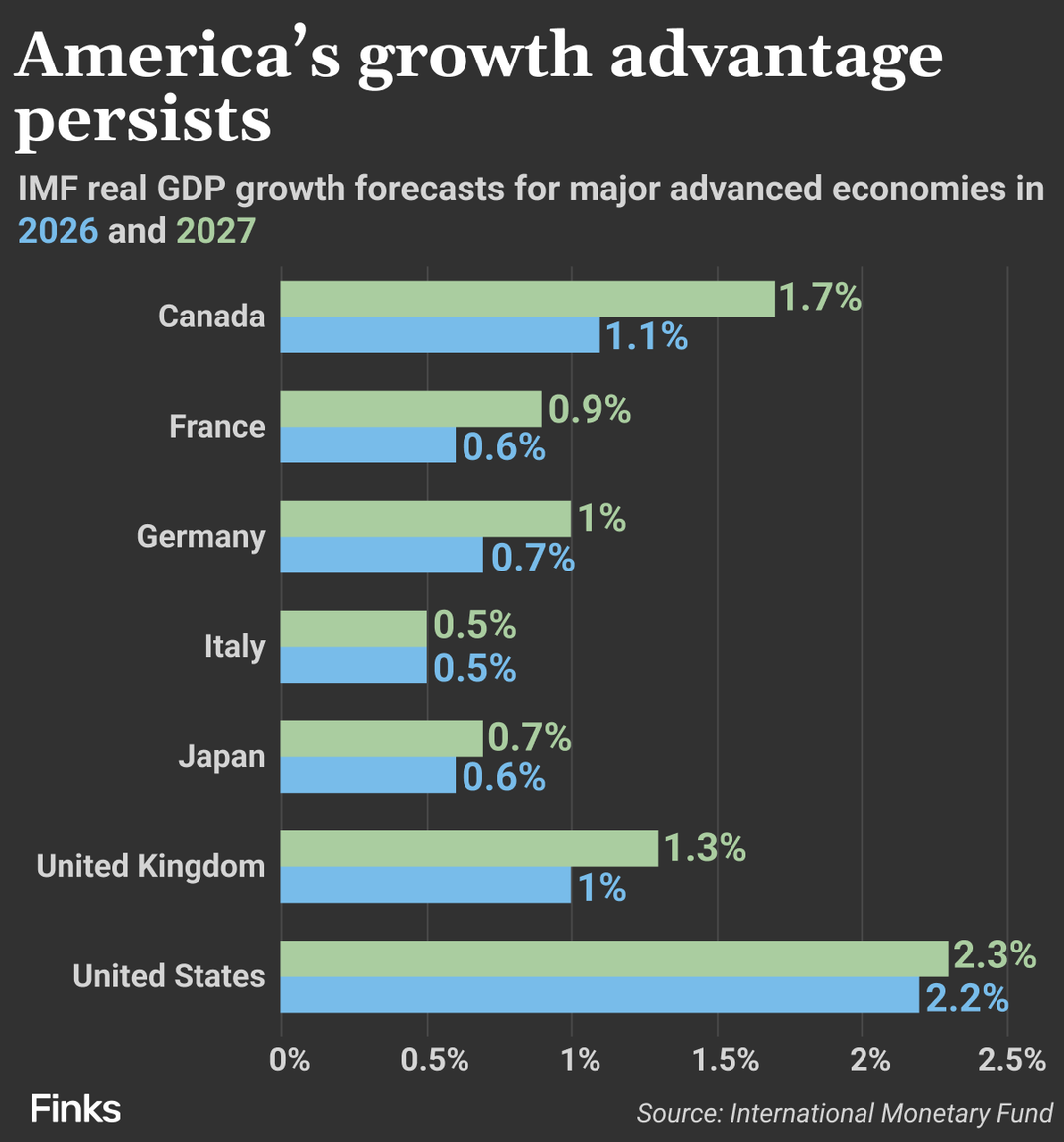
The growth cushion: America’s biggest advantage is that its economy is still growing faster than its peers, with AI investment and resilient consumer spending doing much of the heavy lifting. Scott Bessent leaned into that strength at the G20, calling the US the “A.I. superpower (opens in a new tab)” even as allies pushed back on tariffs and other US policies. If borrowing costs stay high, that advantage could start to narrow if consumers pull back or the AI-led stock rally loses momentum.
Post Credits

Sponsor
Claude, for investing
Finks is the financial assistant that never sleeps, never ghosts you, and watches your money like its compute depends on it. It’s like having your own analyst team on speed dial, minus the six-figure payroll.
- Analyze investments faster and better: Ask Finks to analyze any company (opens in a new tab), compare stocks, or help you reason through a financial decision.
- Agents that watch your money: Connect your holdings and watchlists, and let Finks keep an eye out for risks and opportunities around the clock.
- A news feed built around you: Get market stories and analysis tailored to your investments and interests, instead of everything else happening on Wall Street.
The market never really logs off. Good thing Finks doesn’t either.