
FinksDaily
🎢 Bond voyage
Good morning. Online shopping is swapping the solo scroll for a live crowd. US livestream shopping sales (opens in a new tab) are forecast to nearly double from 2024 levels to $20B this year, driven by TikTok and Whatnot. Sellers host hours-long shows, build loyal audiences, and close six-figure days. The format bridges the one thing e-commerce never could: the feel of a real store. Despite all the tech in the world, the age-old art of putting on a good show still has people reaching for their wallets.
Top Idea

What Rising Bond Yields Mean for Different Corners of the Stock Market
Bond vigilantes are back, and they brought inflation as a plus-one. The 10-year Treasury yield has climbed to its highest level since Jan. 2025, dragging stocks lower as inflation fears spread. With another Fed hike widely expected, the pressure is now landing unevenly across sectors.
Rate shock, decoded: The 10-year yield surge (opens in a new tab) has multiple drivers. Renewed fighting in the Strait of Hormuz pushed Brent crude above $92 a barrel, while widening government deficits are adding pressure to borrowing costs and Fed Chair Kevin Warsh has kept inflation front and center since Jackson Hole. The same strain is showing up overseas, with Japanese benchmark yields hitting a record high and 30-year UK yields reaching their highest level since 1998.
- The S&P 500 opened 0.7% lower on Tuesday and the Nasdaq fell 1.3%, as markets priced in a ~66% chance of a Fed rate hike this month.
- Treasury Secretary Scott Bessent said a plan to rein in the deficit could still be weeks or months away, offering bond markets little near-term relief.
How to Position Before the Fed Moves
Ned Davis Research found (opens in a new tab) that rising yields hit stocks differently depending on what is driving them. When inflation fears push yields higher rather than stronger economic growth, stock prices and bond yields tend to move in opposite directions. That pattern has been in place since the US attacked Iran in late February, with financials historically among the most vulnerable. Fed hikes can squeeze bank margins as short-term funding costs rise faster than rates on longer-term loans.
- Financials have lagged, with State Street’s Financial Select Sector SPDR ETF up 7% this year, while Invesco’s KBW Bank ETF has gained 15.5%.
- Defensive plays have been steadier, with State Street’s utilities, consumer staples, and health care ETFs showing little correlation to bond yields.
The way forward: Fed Governor Michael Barr believes (opens in a new tab) that the Fed should “act decisively to raise rates” if inflation fails to move toward its 2% target. Defensive sectors may not escape higher rates, but their steady cash flows and stronger yields could provide some cover in a month when the S&P 500 has historically fallen 1.1% on average. That cushion could soon be tested, with CPI due Sept. 11 and the Fed meeting just five days later.
 (opens in a new tab)
Sponsored by Outskill
Build your own AI coworker in just 3 hours (for $0)
If you want to WIN in 2026, it cannot happen with just knowing the AI Tools, but knowing which ones to use for what purpose and knowing them well enough to hand over real work.
With thousands of AI tools launching every week, figuring out which ones are actually worth your time is the hard part.
Introducing the 3 Hours AI Tools Workshop (opens in a new tab), a live session that cuts through the noise and teaches you the ins & outs of the 15 most powerful AI tools right now, exactly which one to reach for depending on the job: research, writing, design, data, code, automation.
Not just this, but they will also teach you how to build your own AI Co-Worker that literally works 24/7 even while you’re asleep.
Large-Cap Recap
Jersey Mike’s Takes On Bigger Ambitions
Jersey Mike’s Subs has something much of fast casual is paying to get — customers who keep coming back. That loyalty has helped stores average roughly $1.4M in annual sales, giving franchisees a reason to keep opening more. The bigger test comes as Jersey Mike’s expands its footprint and tries to win younger diners without joining the discount race. Wall Street is split on whether it can keep store returns strong along the way, making its first few earnings reports an important read on what comes next. [Read (opens in a new tab)]
Medtronic Targets High Growth Markets
Medtronic raised its fiscal 2027 organic growth forecast after posting strong quarterly results driven by surging demand for cardiac ablation devices. The company is accelerating expansion into surgical robotics and advanced heart treatments through strategic deals, including distributing Cornerstone Robotics' system and investing in Pi-Cardia. That helps Medtronic capture share in faster-growing medtech categories while putting fresh capital to work across expanding global healthcare markets. [Read (opens in a new tab)]
The Hidden Winner of AI’s Power Crunch
AI’s power boom is creating a new bottleneck in gas turbines, where specialized blades and vanes are already in short supply. Howmet Aerospace sits at the center of that squeeze, with demand rising faster than capacity. SpaceX’s plan to make its own parts rattled investors, but analysts see little near-term threat and argue the move only confirms how scarce these components have become. With data center power needs climbing and new supply taking years to scale, turbine capacity is becoming another way to play the AI buildout. [Read (opens in a new tab)]
Market Pulse
GoPro, Inc.
GPROThe camera maker’s shares surged after a $285M Starman Optical merger that would expand it into AI data center infrastructure.
SharkNinja, Inc.
SNThe appliance maker’s shares fell as heavy insider selling and profit-taking outweighed a strong recent quarter and raised full-year outlook.
Fervo Energy Company
FRVOThe geothermal company’s shares rose after securing its largest power agreement yet with Google to supply electricity for a planned Utah data center.
Markets & Economy
US factory activity slows as costs stay high: Manufacturing growth eased in August as new orders cooled and input prices remained elevated. Tariffs, the Iran conflict and AI-related demand are keeping cost pressures high and reinforcing expectations for another Fed rate hike. [Read (opens in a new tab)]
US labor market stays stuck in low-hire mode: Job openings edged up in July while hiring slipped and layoffs remained low. The data shows employers are still cautious without broadly cutting workers, keeping the labor market unusually static. [Read (opens in a new tab)]
House votes to avert government shutdown: Lawmakers approved a stopgap funding bill through Dec. 11 despite resistance from GOP hard-liners. The measure passed with broad bipartisan support and now heads to President Trump for signature. [Read (opens in a new tab)]
Business & Tech
Wall Street banks team up on stablecoin: Goldman Sachs, Bank of America, Citigroup and 18 other institutions plan a dollar-backed token for 2027. The move aims to defend deposits and payments as stablecoins push further into mainstream finance. [Read (opens in a new tab)]
Waymo widens its robotaxi lead: Alphabet’s Waymo launched paid driverless rides in three more cities, expanding its commercial footprint to 14 US markets. Zoox and Tesla are still earlier in deployment as competition intensifies. [Read (opens in a new tab)]
Gap pushes into handbags as Old Navy struggles: Gap is expanding beyond apparel with a new Reed Krakoff-designed bag line after its namesake brand posted strong growth. Old Navy remains the bigger drag, prompting a CEO change as sales and traffic weaken. [Read (opens in a new tab)]
Chart
Digit of the Day
Software Rallies 16% As Wall Street Rethinks The AI Threat
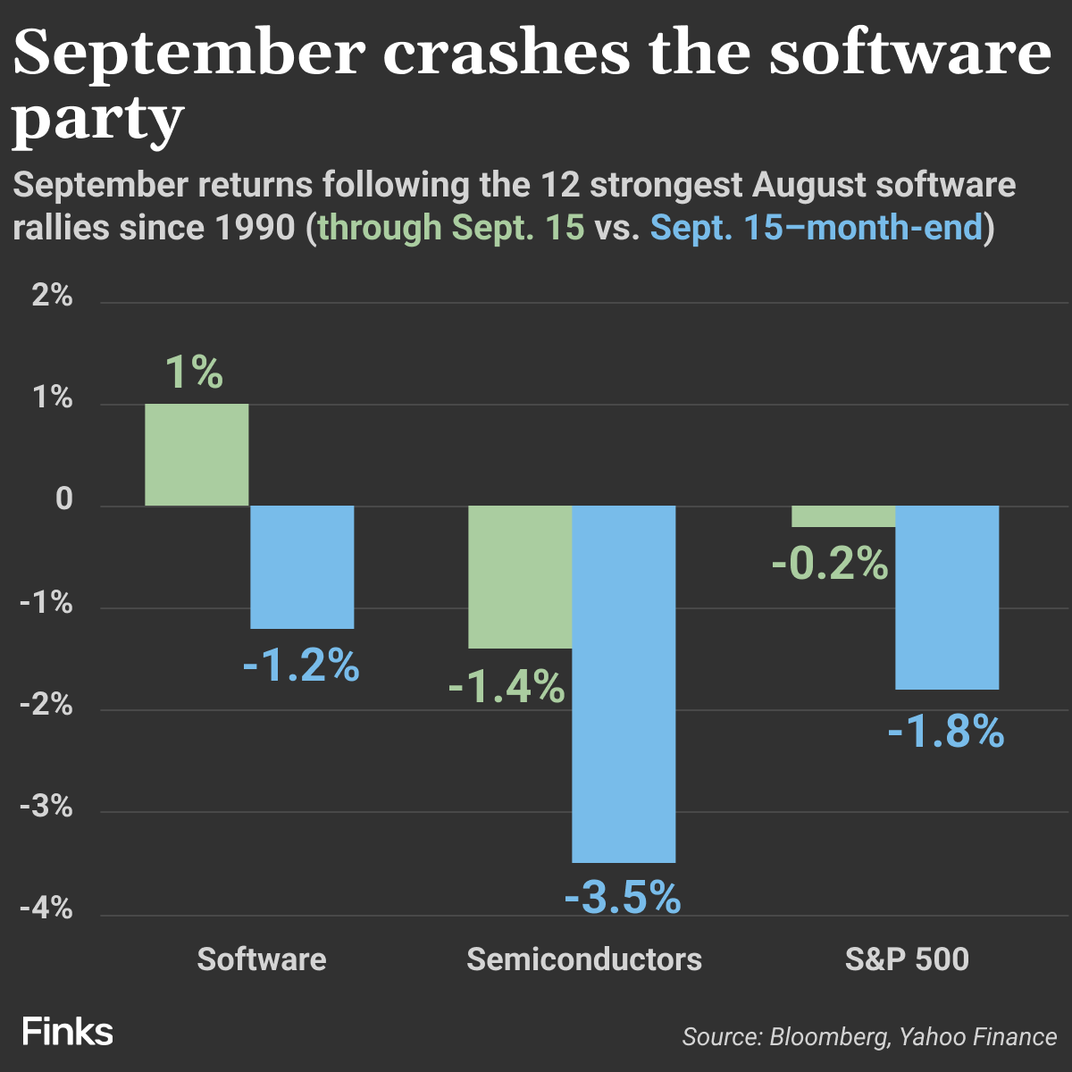
The great AI software wipeout is having a bit of trouble showing up. The iShares Software ETF soared 16% (opens in a new tab) in August for its second-best month since 2002, leaving semiconductors nearly flat at 1%. The comeback gained steam after strong earnings (opens in a new tab) from Salesforce and CrowdStrike challenged fears that AI would hollow out the sector.
- Atlassian nearly doubled in August for its best month ever, while Palantir gained 50% and Salesforce jumped 40%.
- CrowdStrike posted its best quarter on record, while Salesforce’s AI annual recurring revenue surged 240% to $1.5B.
Momentum check: History suggests September could make the software rally harder to sustain. Following the 12 strongest August rallies since 1990, software has typically lost ground in the second half of September as the broader tech trade weakened. Mizuho analyst Jordan Klein believes (opens in a new tab) institutional underweighting could keep software climbing into October, with ServiceNow and Microsoft flagged as preferred plays over chasing Salesforce at current prices.
Post Credits

Sponsor
Claude, for investing
Finks is the financial assistant that never sleeps, never ghosts you, and watches your money like its compute depends on it. It’s like having your own analyst team on speed dial, minus the six-figure payroll.
- Analyze investments faster and better: Ask Finks to analyze any company (opens in a new tab), compare stocks, or help you reason through a financial decision.
- Agents that watch your money: Connect your holdings and watchlists, and let Finks keep an eye out for risks and opportunities around the clock.
- A news feed built around you: Get market stories and analysis tailored to your investments and interests, instead of everything else happening on Wall Street.
The market never really logs off. Good thing Finks doesn’t either.