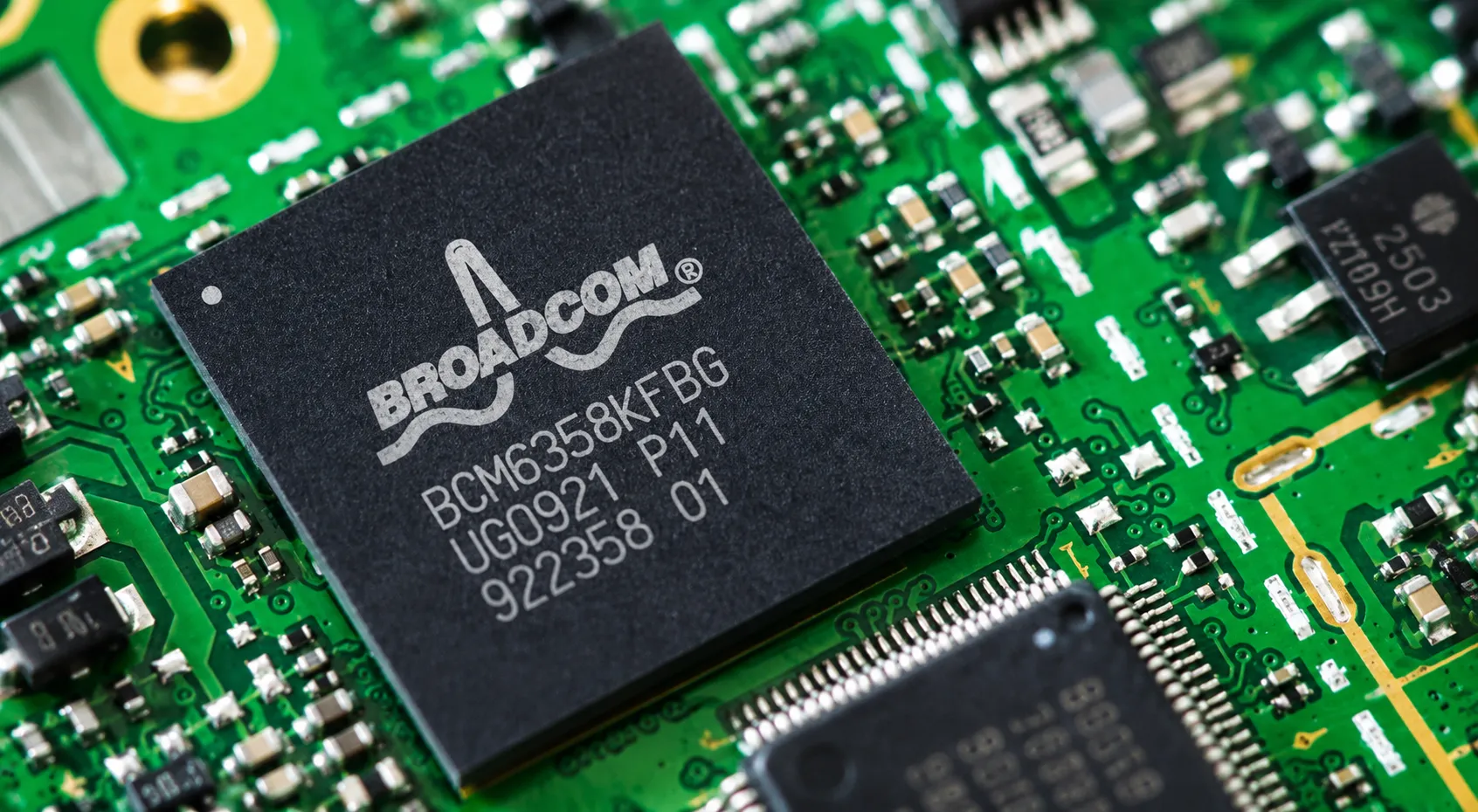
Custom AI chips are becoming one of the clearest ways big tech companies try to control AI costs. Broadcom sits near the center of that shift because it designs specialized processors for hyperscale customers. The trigger this week was a mixed earnings report that showed explosive AI demand alongside weaker-than-expected guidance.
AI demand keeps accelerating
Broadcom’s latest quarter showed how quickly custom silicon has moved from side business to core growth engine. Third quarter revenue rose to $29.59B from $15.95B a year earlier.
Profit more than tripled to $13.09B in the quarter ended Aug. 2. Adjusted earnings reached $3.32 a share, above FactSet expectations of $3.22.
AI semiconductor revenue more than tripled to $16.7B. Broadcom expects that figure to grow to $21.7B in the current quarter.
"Demand for our custom AI accelerators and networking continues to be very strong."
Hock Tan, Broadcom
That matters because custom accelerators are chips built for one customer’s specific AI workloads. They can be more efficient than general-purpose processors, but they depend heavily on the customer’s roadmap.
Guidance raised the bar
The stock fell after the report because the market focused on the next quarter, not the beat. Broadcom forecast fourth quarter revenue of about $34.8B, below LSEG estimates of $35.03B.
The reaction showed a higher bar for AI winners. CNBC reported that shares dropped 5% in extended trading after Broadcom’s current-quarter outlook disappointed.
The same report said Broadcom’s revenue increased 86% from a year earlier. It also said the company’s market value reached about $1.8T after a sharp rally since the end of 2022.
That combination creates a narrow path. Broadcom has to keep beating numbers while proving the AI buildout is broad enough to support its valuation.
Customer spending is shifting
Broadcom’s strength comes from deep ties with the biggest AI spenders. BMO Capital Markets highlighted its role in custom chip design for Alphabet and Meta Platforms, plus supply deals with Anthropic and OpenAI.
BMO analyst Harsh Kumar started coverage with an Outperform rating and a $455 price target. That target implied 25% upside from Broadcom’s Aug. 20 closing price.
Kumar also expects Broadcom’s AI business to grow 180% in 2026. His firm forecasts custom ASIC revenue of $38B in 2026, up from $12.7B last year.
The risk is that customers are spreading work across more suppliers. Marvell Technology recently issued Alphabet’s Google a warrant to buy 58.97M shares under a custom chip agreement.
That Google deal could make Marvell a larger player in the same spending pool. Reuters reported the agreement could bring Marvell $120B in revenue through fiscal 2033.
AI exposure needs sizing
Broadcom is no longer just a diversified chip and software compounder. The Wall Street Journal noted that AI chips were about 44% of revenue in the first fiscal quarter of 2026.
Analysts cited by the same report expect that share to rise to 70% within the next year. That shift makes Broadcom more sensitive to AI budgets and customer concentration.
The stock’s recent performance already reflects that tension. The same article said Broadcom had gained 6% in 2026, while the PHLX Semiconductor Index was up 60%.
Valuation also limits the margin for error. The Journal said Broadcom traded at about 20 times forward earnings, above the PHLX average of 19 times.
For you, the sector message is clear. Custom AI chips are gaining share inside the AI infrastructure budget, but the cleaner trade is becoming more selective.
Broadcom offers direct exposure to that shift. Nvidia remains the industry standard for broader AI workloads, according to Reuters.
Marvell gives you a smaller but more direct read on whether hyperscalers diversify custom chip suppliers. Broadcom remains the benchmark for custom AI silicon, but this week showed the stock now needs more than growth to work.

