
FinksDaily
🍕 The GLP-1 discount
Good morning. LinkedIn is accidentally becoming the hottest dating app in the room. Burned out on dating apps, singles are increasingly looking for love on LinkedIn. About 1 in 4 professionals (opens in a new tab) say using the platform romantically can be acceptable, while 22% have already tried it. LinkedIn bans romantic advances, but career histories and mutual connections reveal more about a potential match than a few prompts and photos. Turns out, the best dating profile may have been your résumé all along.
Sector Spotlight

America’s Robot Ambitions Are Running Into a Made-in-China Reality
TThe US is trying to build the future of robotics — just not the parts that go inside it. Washington has declared humanoid robots a national security priority, but China already dominates the supply chain, the manufacturing base, and increasingly the market. Whoever leads in physical AI leads in the next industrial revolution.
Drone déjà vu: The drone industry cautionary tale (opens in a new tab) looms large here. More than a decade ago, US startups were building drones on shoestring budgets until Chinese drone maker DJI arrived with cheaper, camera-stable models and pushed much of the young industry aside. Washington doesn’t want robotics to suffer the same fate. The FCC now requires new advanced robots sold in the US to be assembled domestically with at least 65% domestic content, rising to 75% by 2029.
- Nearly 90% (opens in a new tab) of humanoid robots sold globally in 2025 were Chinese-made, with Unitree alone shipping 5.5K+ units, far beyond US startup volumes.
- Unitree shares surged 460% (opens in a new tab) on their Shanghai debut, giving the robot maker a ~$51B valuation on just $250M in annual revenue.
America's Robot Startups Are Caught in the Middle
US founders say meeting the 65% domestic-content threshold is nearly impossible right now. Teddy Haggerty, Unitree’s former North American distributor turned robotics founder believes (opens in a new tab) that cutting China out entirely just makes a more expensive product without a viable alternative. Employees at some Silicon Valley firms have even flown robot parts from China to the US in their suitcases to keep development moving.
- Persona AI sources parts from Taiwan, Japan, South Korea, and Italy, but says it still can’t meet FCC domestic-content rules without more US support.
- Florida-based Jabil builds Apptronik’s humanoid robots in Mexico, suggesting the near-term supply chain could span North America rather than the US alone.
The carrot-and-stick problem: The FCC rules protect US robot makers from cheaper Chinese rivals, but the suppliers needed to meet them don’t exist at scale yet. With humanoid robotics still young, the US has a narrow window to build that supply chain without stifling innovation and repeating the drone industry’s collapse. As Michael Perry warned, “You need to provide the carrot as well as the stick. Right now, you're only providing the stick.”
 (opens in a new tab)
Sponsored by Insurify
Insurance rates have climbed, and if you haven't compared recently, there's a good chance you're overpaying. Insurify (opens in a new tab) lets you see real quotes from top carriers in minutes, so you know exactly where you stand.
Just enter your car make and ZIP code to instantly pull up rates side by side. No phone calls, no agents, no fees — just a fast, clear look at what's available in your area.
Drivers are finding rates starting as low as $39/month. The only way to know is to look.
Large-Cap Recap
Big Food Stocks Pivot Amidst Weight-Loss Drug Disruption
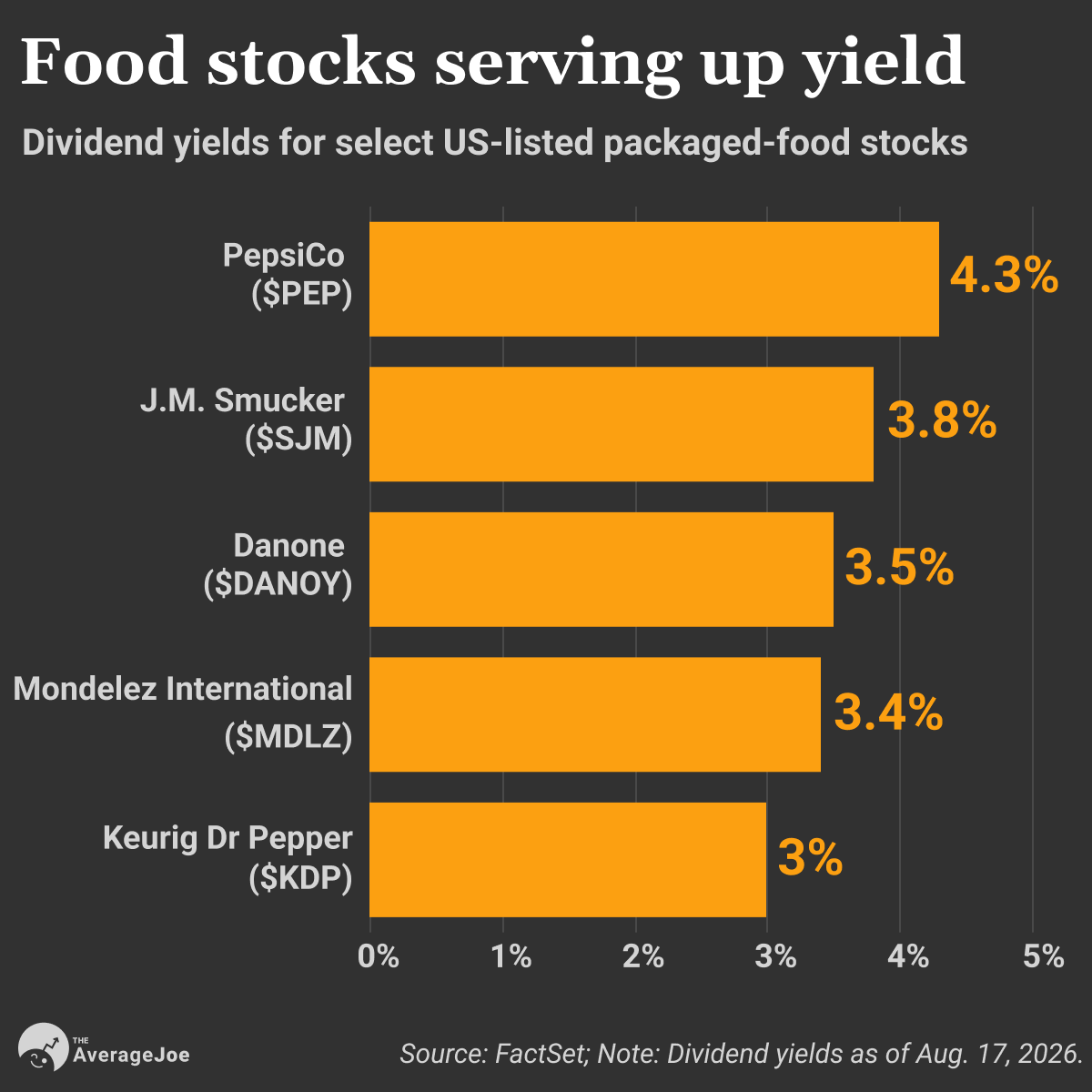
Weight-loss drugs are significantly altering consumer habits, with millions of Americans now on GLP-1 medications. Projections indicate these drugs could drain up to $55B in annual food revenue by 2030 as users consume fewer calories. Consequently, legacy food stocks like Kraft Heinz and General Mills face significant pressure. However, value is emerging in companies like PepsiCo and J.M. Smucker, which are actively adapting their portfolios through high-protein offerings and strategic growth in emerging markets. [Read (opens in a new tab)]
Investor Excitement Cools On Nuclear Power
Nuclear energy is seeing record policy support and surging demand from tech firms like Meta and Amazon to power data centres. Despite these strong long-term tailwinds, speculative enthusiasm has faded, causing shares of companies like Oklo and NuScale Power to decline significantly this year. Investors are now pivoting away from high-risk developers toward established players with credible capacity. The industry faces immense capital requirements and complex regulatory hurdles that remain years away from commercial scale. [Read (opens in a new tab)]
Chinese AI Firms Bypass US Export Curbs
Chinese AI companies including Alibaba and ByteDance are maintaining their momentum by remotely accessing advanced Nvidia chips in Southeast Asia, exploiting a gap in current US export controls. While the proposed Remote Access Security Act seeks to close this loophole, enforcement remains complex. Meanwhile, Nvidia continues to supply modified processors to the Chinese market under specific approvals, and Alibaba is leaning into its full-stack cloud dominance to sustain growth despite the evolving regulatory landscape. [Read (opens in a new tab)]
Market Pulse
Moderna, Inc.
The vaccine maker’s shares soared after its experimental melanoma vaccine delivered positive results in a late-stage trial with Merck.
Marvell Technology, Inc.
The chipmaker’s shares jumped after an expanded AI chip deal gave Google the right to buy up to $12.2B of stock.
Markets & Economy
US considers tariffs on Mexican strawberries: The Commerce Department found Mexican winter strawberries were sold below fair value, opening the door to new duties. Because Mexico supplies nearly all US winter imports, production cuts could push grocery prices higher. [Read (opens in a new tab)]
Car dealers lean on service as vehicle profits soften: US dealerships are relying more on high-margin parts, repairs and financing as new-car profits ease. The shift helps cushion weaker sales, though repair chains are steadily taking market share. [Read (opens in a new tab)]
State Farm sends customers record $5B dividend: Eligible auto policyholders are receiving refunds averaging about $100 per vehicle after the insurer announced its largest-ever payout. Payments are rolling out by state to customers insured during 2025. [Read (opens in a new tab)]
Business & Wealth
Retail earnings show a more selective US consumer: Target is regaining momentum, while Lowe’s remains pressured by weak big-ticket demand and TJX sees softer US apparel growth. Tariff refunds helped results, but underlying spending remains uneven. [Read (opens in a new tab)]
Alcohol makers chase growth beyond beer and spirits: Carlsberg is leaning on alcohol-free drinks as beer volumes slip, while canned cocktails emerge as a rare growth pocket. Trade tensions and shifting drinking habits are adding pressure across the industry. [Read (opens in a new tab)]
Estée Lauder leans on fragrance and skincare turnaround: Estée Lauder forecast stronger annual profit as Tom Ford, Le Labo and China demand drive growth. Makeup remains flat, while management plans to apply its fragrance playbook to weaker categories. [Read (opens in a new tab)]
Chart of the Day
Digit of the Day
Trump Puts 50% Canada Tariffs on Hold as Deal Talks Advance
Canada now has some reprieve from Trump’s tariff hammer. Trump paused the 50% tariffs (opens in a new tab) on $20B of Canadian imports just hours before they were set to take effect, giving both sides three days to finalize a deal. The levies would have covered roughly 5% of Canada’s annual US exports, pushing the average tariff rate on Canadian goods from 4.68% to 6.27%.
- The tariffs cover goods ranging (opens in a new tab) from hockey sticks and electronics to plastics and building materials, a relatively narrow but politically sensitive slice of trade.
- Canada’s Chamber of Commerce warned the tariffs could disrupt cross-border commerce and threaten 13M American jobs tied to USMCA trade.
USMCA hangs over: Canadian PM Mark Carney confirmed “substantial progress (opens in a new tab)” but said work remains, with autos still a key sticking point. A deal could also clear the way for broader USMCA negotiations after the pact missed its July renewal, triggering annual reviews until it expires in 2036. Capital Economics warned that failure could revive tit-for-tat tariffs, slow growth, and weaken business confidence across North America.
Extra Joe