

FinksDaily
Sponsored by hear.com
🎮 Grand heist
Good morning. Grand Theft Auto might be about to pull off its biggest heist yet, this time on the American workday. After 13 years of waiting, GTA 6 finally arrives on November 19. Fans are already clearing their calendars, with 18% of US workers planning to take the day off (opens in a new tab) rather than wait until the weekend. The excitement is paying off for Take-Two Interactive, which has already racked up nearly 7M preorders ahead of launch. The only thing harder to find than a copy of the game might be someone actually working that Thursday.
Top Idea
Pentagon Splits Golden Dome Work Across Tech Firms And Legacy Primes
Silicon Valley is setting its sights on one of Washington's biggest spending priorities. Alphabet is reportedly in early talks to help secure data for the $185B Golden Dome (opens in a new tab) missile shield, as the Pentagon looks beyond traditional defense contractors for software and cybersecurity expertise. It's a potentially lucrative opening in an industry long dominated by a handful of familiar names.
New battle lines: US defense spending topped $1T in fiscal 2026, and the competition for government contracts is heating up. Anduril, Palantir, and SpaceX are involved in developing Golden Dome's command-and-control systems, while newer procurement arrangements are making it easier for technology firms to secure long-term agreements. The Pentagon is also moving away from cost-plus contracts toward arrangements that reward companies for delivering projects on time and within budget.
- Boeing, Lockheed Martin, RTX, and Northrop Grumman collectively account for 92% of Pentagon contracts.
- Anduril and Palantir have secured 10-year enterprise agreements worth up to $20B and $10B, respectively.
The Old Guard Isn't Going Anywhere
Established defense manufacturers still have a major advantage in hardware-intensive programs, where years of experience and production capacity are difficult to replicate. Lockheed and RTX recently reported record backlogs and raised their 2026 forecasts, reflecting sustained demand for their weapons systems. For startups, securing an initial contract is only part of the challenge.
- Defense-tech startups attracted roughly $49B in venture funding in 2025, yet only 14% of reviewed Defense Innovation Unit prototypes progressed into production.
- Palantir generated approximately $1.885B in annual revenue from the US government, accounting for 41.5% of its total.
The investor angle: Traditional defense contractors now trade around 19x expected earnings, down from 26x in March, offering investors more established revenue streams at lower valuations. Software-focused companies have room to expand as military systems become increasingly connected, although their growth prospects often come with hefty premiums. The Pentagon may be expanding its roster, but investors still need to be selective about who makes the cut.
 (opens in a new tab)
Sponsored by hear.com
Not Your Grandpa’s Hearing Device
What happens when you combine German engineering with the world’s most trusted name in hearing care? “The biggest breakthrough in hearing technology in decades!” according to expert audiologists.
Introducing the Horizon IX by hear.com (opens in a new tab) — the world’s first dual processing hearing aid, which separates speech and background noise to deliver crystal-clarity. The best part? Horizon IX is nearly invisible, ensuring clear hearing and all day comfort. Designed for modern life, Horizon IX features:
- Seamless Bluetooth connectivity with smart devices
- Rechargeable, long-lasting batteries for max usability
- Insurance and flexible finance options
- Award-winning customer service
Qualify for a 45-day no-risk trial and join 670K+ happy customers (opens in a new tab)
Large-Cap Recap
Apple Beats Earnings Without the AI Spending Frenzy
Apple is showing Wall Street that strong growth doesn't necessarily require massive AI investments. The iPhone maker posted record quarterly revenue of $114.5B, up 12%, even as rivals poured billions into data centers and chips. Its lighter spending has preserved cash flow, although rising component costs and delayed AI features remain concerns. With iPhone sales holding strong, Apple's latest results suggest its more cautious approach to AI spending hasn't come at the expense of growth yet. [Read (opens in a new tab)]
SpaceX Eyes Mobile Carrier Market With Boost Mobile Talks
SpaceX can already beam internet from space, but reaching more phones on the ground is proving a different challenge. The company is reportedly in talks with EchoStar about acquiring Boost Mobile or using its network, potentially giving Starlink access to an established wireless business and millions of subscribers. Starlink reached 13.6M users globally and generated $5.2B in connectivity revenue in the third quarter. A deal could help SpaceX expand its mobile coverage, although regulatory hurdles and competition from established carriers remain obstacles. SpaceX expects its S-band spectrum to handle the majority of direct-to-phone connectivity. [Read (opens in a new tab)]
Wall Street's Fear Gauge Stays Quiet During Market Selloff
Wall Street suffered its worst weekly decline in months, yet the market's closely watched fear gauge barely reacted. The muted response comes as hedge funds cut equity exposure by 8%, selling stocks outright rather than buying protection against further losses. Much of the selling has centered on AI stocks, with Alphabet and Amazon facing questions over their massive infrastructure spending. The subdued volatility suggests some of the aggressive selling may have already played out. [Read (opens in a new tab)]
Market Pulse
IDEXX Laboratories, Inc.
The veterinary diagnostics company’s shares surged after strong earnings and revenue growth helped management raise its full-year profit outlook.
Oracle Corporation
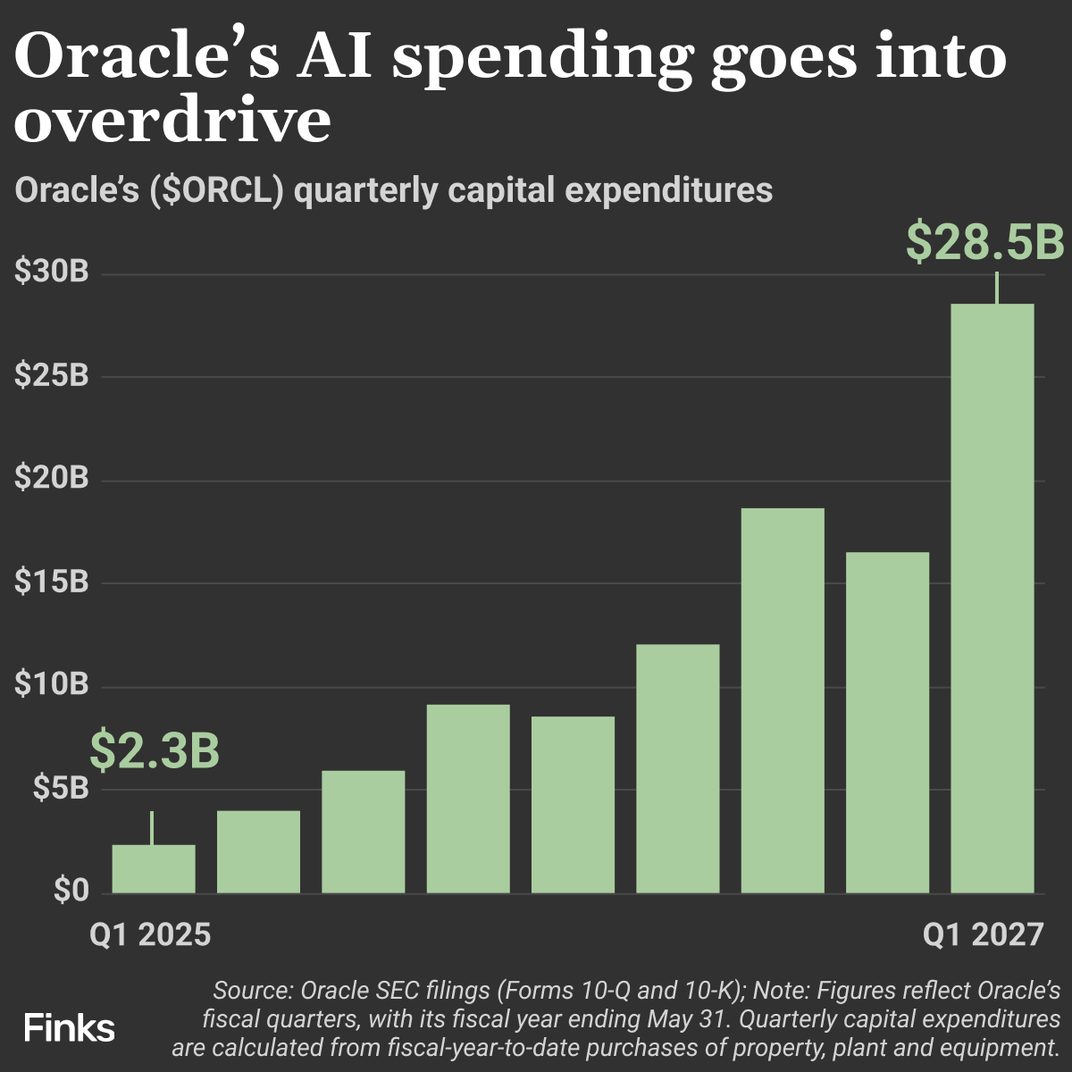
The software giant’s shares fell as concerns around its soaring AI infrastructure spending and growing debt burden outweighed optimism around cloud demand.
Cerebras Systems Inc.
The AI chipmaker’s shares dropped as investors weighed its heavy spending and continued dependence on major customers despite rapid revenue growth.
Markets & Economy
Oil falls on Iran peace talks: Crude prices dropped as Iranian and Qatari officials advanced a draft proposal to end the conflict and potentially reopen the Strait of Hormuz. Analysts warn that traders remain cautious ahead of US midterm voting and ongoing tanker attacks. [Read (opens in a new tab)]
Binance users pull billions after record exploit: Binance recorded $3.64B in net outflows as withdrawals resumed following a recent security breach. The exchange absorbed the hit using internal reserves while investigators traced stolen funds. [Read (opens in a new tab)]
US manufacturing expands for a tenth straight month: Production drove October activity higher, with the production index jumping to 59.0 from 56.7 despite persistent pricing pressures across factory floors. The data precedes a busy week of labor reports that will help shape upcoming rate expectations. [Read (opens in a new tab)]
Business & Tech
Estée Lauder fragrance sales jump 20%: The beauty giant saw sharp growth in its fiscal first quarter, driven by luxury scent brands like Le Labo and Tom Ford. Younger consumers are building fragrance wardrobes for different occasions, pushing daily wear higher across the industry. [Read (opens in a new tab)]
Rivian Automotive gains ground as EV sales slow: Rivian climbed to second place among US electric vehicle brands in the third quarter, capturing 7% of the market. Strong early demand for its newly launched R2 SUV came as sales of its older R1S and R1T models declined. [Read (opens in a new tab)]
Palantir commercial revenue surges: Palantir Technologies reported that US commercial revenue jumped 148%, surpassing its government business for the first time. The milestone highlights how corporate customers are becoming the company's biggest growth engine. [Read (opens in a new tab)]
Chart
Digit of the Day
Marvell’s $115B Lumentum Deal Is Bringing Back Dot-Com Bubble Memories
The AI boom is giving Wall Street a serious case of déjà vu. Marvell Technology is acquiring Lumentum Holdings in a $115B all-stock deal (opens in a new tab) to capitalize on surging demand for optical networking. But the price tag is stirring memories of the dot-com bubble, when sky-high valuations turned blockbuster acquisitions into costly mistakes.
- Marvell will offer 4.5 shares for each Lumentum share, a 24% premium to its Oct. 28 closing price, with no cash involved.
- The acquisition would give Marvell access to Lumentum's specialized lasers, strengthening its position against Broadcom in AI data center networking.
Dot-com echoes: Marvell is financing the deal with stock valued at roughly 65x earnings, a strategy that recalls JDS Uniphase's acquisition spree during the internet boom. Its $40B deal for SDL was worth just $13B by the time it closed, and Lumentum itself emerged from JDS Uniphase's breakup. With the deal expected to close in the first half of 2028, Marvell has plenty of time (opens in a new tab) to find out whether its timing was as good as its ambition.
Strategize
The Midterms Are Here. What’s at Stake for Your Portfolio?
Americans head to the polls today to decide who controls Congress, with the outcome potentially changing the outlook for taxes, government spending, and regulation. Investors are watching closely, particularly in sectors where a shift in Washington could affect corporate earnings.
Why it matters: The S&P 500 has gained an average of 15.1% in the 12 months following the past 19 midterm elections, although past performance offers no guarantee of another rally. Schwab expects volatility as results come in, while Citi sees limited impact on the broader market, with individual sectors more likely to feel the effects.
Finks can help you identify which holdings are most exposed to election-related policy changes and see how your sectors have performed after previous midterms.
Try it for free: How should I position my portfolio for the midterm election results? (opens in a new tab)
Post Credits