

FinksDaily
Sponsored by RYSE
📚 Plot twist
Good morning. America’s attention span may be in shambles, but its book budget is holding up fine (opens in a new tab). Barnes & Noble, which was shuttering locations as its valuation slumped not long ago, plans to open 60 new stores this year. Independent shops are multiplying too, with their ranks up 70% since the pandemic, and Americans now buy more books annually than they did a decade ago. Most of that demand comes from romantasy, a genre heavy on dragons and light on Dickens. The cash registers aren’t complaining.
Top Idea

Cruise Stocks Are Weathering Higher Fuel Costs. Will the Rally Last?
Cruise lines are facing a costly year as oil prices climb and geopolitical tensions disrupt travel. Yet strong passenger demand has helped the industry's biggest operators beat Wall Street's earnings expectations, even as their fuel bills keep growing.
Demand holds up: Royal Caribbean Group, Norwegian Cruise Line Holdings, and Carnival Corp. all delivered better-than-expected quarterly results. Travelers continue to favor cruises for their value (opens in a new tab) compared with land-based vacations, while stronger ticket pricing has helped operators manage higher expenses. Royal Caribbean also raised its annual earnings outlook, and Norwegian showed progress in its turnaround.
- Royal Caribbean reported revenue of $5.59B, up 9% from a year earlier, with passenger occupancy exceeding normal capacity and adjusted earnings beating expectations.
- Norwegian reported adjusted earnings of $1.12 per share, ahead of its 90-cent guidance, and raised its annual earnings outlook as occupancy improved.
Managing The Fuel Bill
Brent crude has reached a six-month high as the war with Iran drives energy prices higher, adding pressure to an industry heavily dependent on fuel. Carnival's quarterly fuel bill climbed to $615M from $425M in late 2025, while Royal Caribbean spent ~$347M. With little control over oil prices, the companies are relying on different strategies to contain expenses and protect profit margins.
- Royal Caribbean has hedged more than half of its 2026 fuel consumption at prices well below recent market levels, providing some protection against further increases.
- Carnival has reduced fuel consumption per unit of capacity by 26% since 2019 through efficiency improvements, which management expects to save approximately $700M this year.
Zooming out: Royal Caribbean says 2027 bookings are running ahead of historical levels at higher ticket prices, suggesting demand has plenty of room to run. But the outlook is less encouraging for Norwegian, which is carrying $15.1B in debt while struggling with weaker yields. Smaller operators are already feeling the pressure, with Villa Vie Residences suspending its MV Odyssey amid soaring fuel costs. The earnings show that Americans aren't giving up their cruises, but rising oil prices could determine which operators actually profit from that demand.
 (opens in a new tab)
Sponsored by RYSE
The Sharks Passed on Ring. Amazon Paid $1.2B. Daymond John Didn’t Pass on This One.
In 2013, a young founder pitched a video doorbell on Shark Tank. He left without a deal. Five years later, Amazon bought that same company, Ring, for $1.2 billion. (opens in a new tab)
One Shark won’t make the same mistake twice. Now Shark Tank’s Daymond John has backed RYSE. (opens in a new tab) It’s automating the one part of the home nobody owns yet: the windows.
RYSE’s small robot clips onto the shades you already have and moves them on its own. It has sold 100,000 devices, earned $20M+ in revenue and holds 10 patents.
This time, you don’t have to watch from the sidelines. Pre-IPO shares are $2.60 until November 20.
Learn About This Investment Opportunity → (opens in a new tab)
Large-Cap Recap
AstraZeneca Pursues $80B Goal Despite Patent Headwinds
AstraZeneca launched a three-year restructuring program targeting $1.5B in annual savings by 2029. That initiative aims to fund its pipeline as the drugmaker works toward an $80B revenue target for 2030. Oncology sales rose 17% to $7.77B last quarter, supported by cancer treatments like Imfinzi. Meanwhile, established drugs face generic competition, and upcoming patent expirations threaten revenue. Management hopes to offset those pressures with new product launches and positive Phase III trial results. [Read (opens in a new tab)]
Crypto Stocks Take a Hit After Binance Hack
Binance's $6.4B hack has exposed fresh security concerns in the crypto industry after attackers exploited internal systems to steal customer assets. Although the exchange has promised full reimbursement, most cryptocurrency holdings lack the federal protections available at traditional brokerages. The breach also unsettled markets, sending Bitcoin lower and hitting shares of Coinbase, Strategy, Circle, and Robinhood even harder. For investors, the question now goes beyond which cryptocurrencies to own to whether the platforms holding them can be trusted. [Read (opens in a new tab)]
Drugmakers Beat Earnings Expectations as Healthcare Stocks Gain Momentum
Healthcare stocks are attracting renewed interest as investors pivot toward defensive investments and away from technology. That rotation has helped the sector outperform while major drugmakers deliver strong quarterly results. Eli Lilly posted third-quarter revenue of $24.4B, driven by high demand for treatments like Mounjaro and Zepbound. Meanwhile, Merck and Gilead Sciences also beat earnings expectations, bolstered by strong sales from key franchises such as Keytruda. [Read (opens in a new tab)]
Market Pulse
FedEx Freight Holding Company, Inc.
The freight company’s shares surged after earnings beat expectations and stronger freight yields prompted management to raise its transition-period profit outlook.
Reddit, Inc.
The social media company’s shares plunged after weaker user growth and disappointing guidance deepened concerns about declining traffic from Google search.
Sandisk Corporation
The data storage company fell despite beating earnings expectations, as concerns over slowing growth and memory-chip prices weighed on shares.
Sponsored by Vantagepoint AI
Get your time back, trader.
Chart analysis shouldn't eat away your precious time. VantagePoint's patented AI forecasts direction 3 days in advance with up to 87.4% proven accuracy. What used to take hours can take under 15 minutes. Get your hours back. One live session, free, no replays. Grab your seat now. (opens in a new tab)
Markets & Economy
US and China agree on tariff relief framework: The nations will lower tariffs on $60B of non-sensitive goods, with each side covering $30B of products. The deal leaves technology and critical minerals outside the truce as export controls remain in place. [Read (opens in a new tab)]
Fed's Daly says AI is now relevant to monetary policy: San Francisco Fed President Mary Daly noted that AI impacts productivity, growth, and the labor market, though officials remain split on whether it causes near-term inflation or long-term deflation. [Read (opens in a new tab)]
US employment costs rise moderately: Total compensation climbed 3.4% over the 12 months through September, matching forecasts as wage growth slowed to its weakest annual pace since 2021. Benefit costs surged 3.9% to outpace wages for a fourth straight quarter. [Read (opens in a new tab)]
Business & Tech
Exxon and Chevron beat Q3 estimates on refining boom: ExxonMobil doubled profit to $15.4B, while Chevron saw earnings jump nearly 200% to $9.9B. Strong diesel margins and record refinery utilization fueled both companies’ results. [Read (opens in a new tab)]
YouTube captures record US TV viewing share: Alphabet saw the platform grab 15.8% of all US television viewing time in August. Connected-TV viewing now accounts for more than one-third of total YouTube ad revenue globally. [Read (opens in a new tab)]
Amazon and Intel earnings spark tech selloff: Amazon maintained its $220B capital spending plan for 2026 as AI costs weighed on cash flow, while Intel warned of cash burn and a $600M hit from an Israeli fab explosion. [Read (opens in a new tab)]
Chart
Digit of the Day
Bullish Sentiment Hits 52.5% as Stocks Enter Their Historically Strongest Stretch
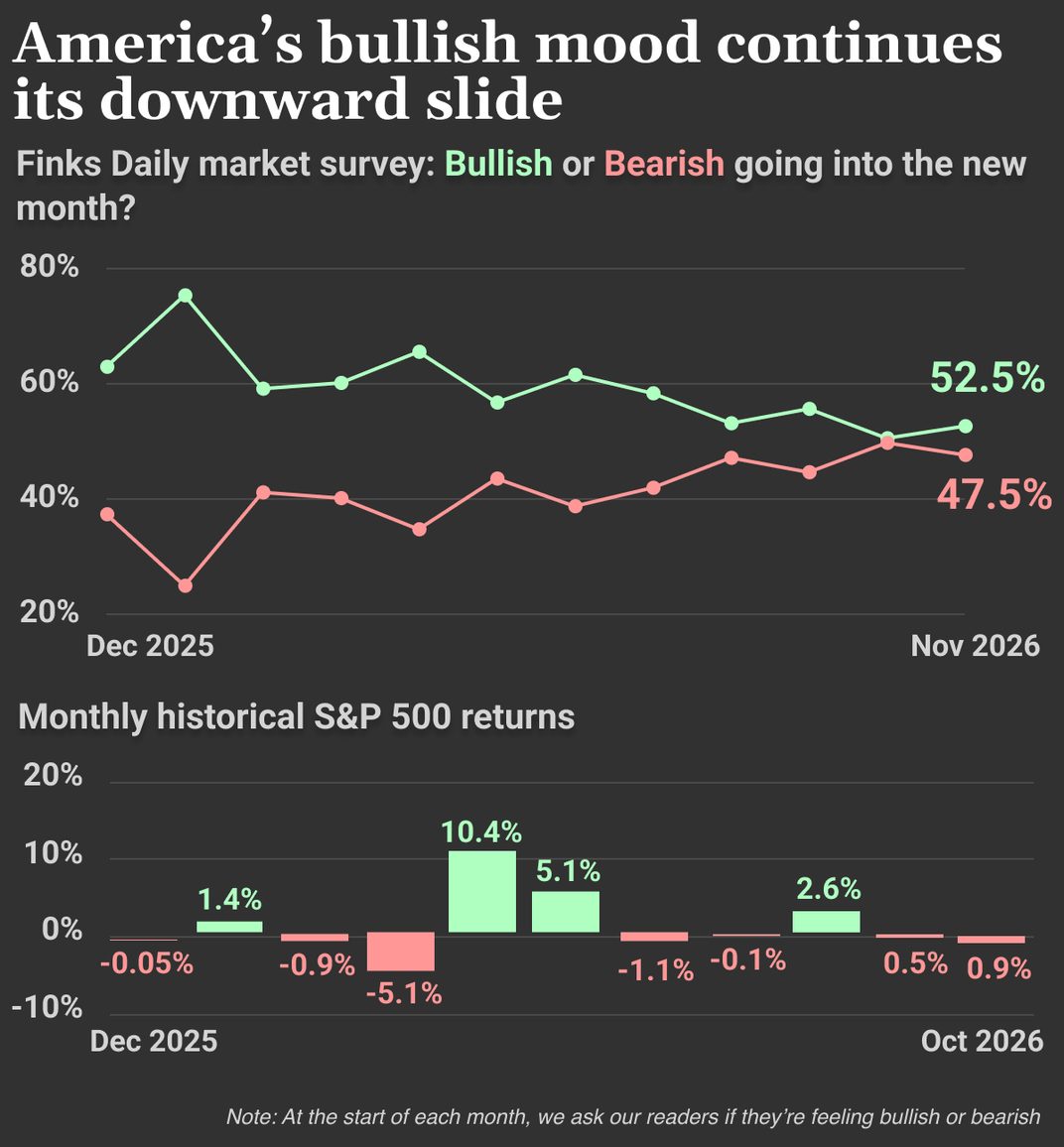
Readers skipped the bear costume this Halloween. Per our latest Bear & Bull survey, 52.5% of voters called themselves bullish (opens in a new tab) heading into November, the opening act of the market’s famed “best six months” stretch. With the midterms days away, Wall Street is banking on the vote clearing the fog — and history has rarely punished that bet.
- The S&P 500 rose in five of the past 12 months, with the index falling 0.9% in October — while the tech-heavy Nasdaq 100 fell 6.65% during the same period.
- Friday delivered a late-month sell-off, as Intel sank nearly 30% on a weak PC outlook and Amazon posted a rare miss — reviving AI-spending fears.
The post-vote playbook: The calendar is about to do the bulls a favor. Since 1950, the November-to-April stretch following a midterm has climbed 19 straight times, averaging a ~15% gain. Morgan Stanley’s chief US equity strategist sees the S&P 500 bottoming near $7.1K before ending the year around $8K, arguing June’s correction has mostly run its course. That puts Friday’s tech slump in a friendlier light, as Fundstrat urged investors to treat any weakness into November as a buying opportunity. Bears, consider yourselves outvoted.
Strategize
Where Should You Invest if the AI Bubble Bursts?
The AI boom has helped lift stocks for years, but Wall Street is questioning whether Big Tech's enormous spending will pay off. With technology shares falling after disappointing earnings, concerns about an AI bubble are growing. Even investors who don't own individual tech stocks may have more at stake than they realize.
Why it matters: The Nasdaq fell 2.9% on Friday as worries over AI spending rattled markets. Meanwhile, a handful of technology giants account for a substantial share of the S&P 500, meaning a prolonged selloff could affect millions of Americans who invest through index funds and retirement accounts.
Finks can help you find ways to diversify beyond AI stocks and explore investments that could hold up better during a market downturn.
Try it for free:Where should I invest if the AI bubble bursts? (opens in a new tab)
Post Credits

Disclosures
RYSE Inc. is offering securities under Regulation A+ through DealMaker Securities. Investing in early-stage companies is high risk and illiquid, and you could lose your entire investment. Read the offering circular (opens in a new tab) before investing. RYSE is not affiliated with, endorsed by or sponsored by Tesla, Elon Musk, Apple, Amazon, Google or Shark Tank. A reserved Nasdaq ticker is not a guarantee of listing.