
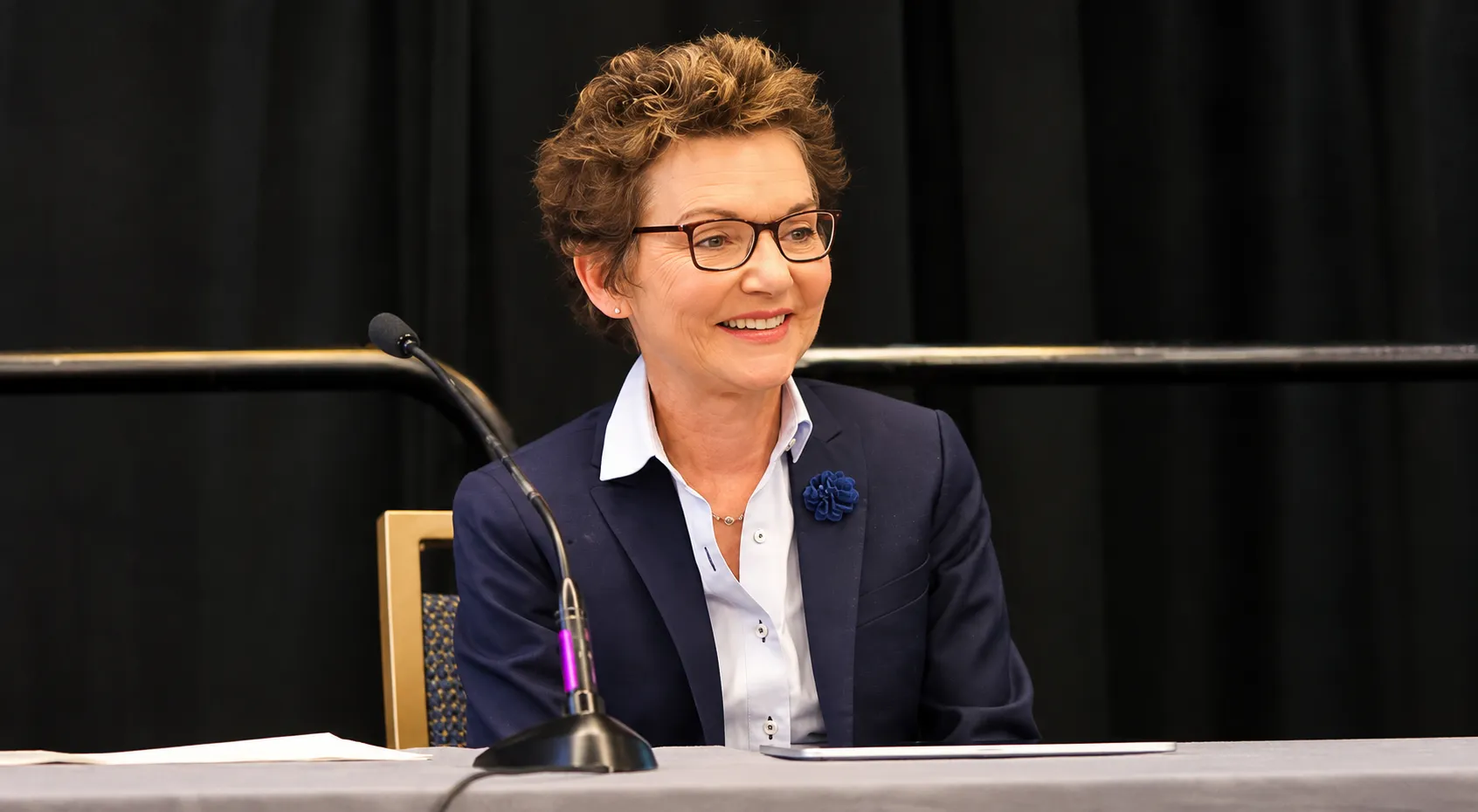
San Francisco Fed President Mary Daly said on Oct. 30 that artificial intelligence is relevant to the Fed's near and medium term policy analysis, because it can affect productivity, growth, and the US labor market.
She made the remarks opening the San Francisco Fed's AI and the Economy conference, a one-day research program where European Central Bank Executive Board member Philip Lane gave the keynote.
Daly tied AI to both halves of the Fed's job, price stability and full employment. She named no rate decision, no preferred path, and no estimate of AI's overall effect on inflation.
The view has moved three times this year
In February, Daly wrote that most macro studies showed limited evidence of a significant AI effect on productivity at that point. Her fix was to dig into disaggregated data and talk to businesses.
By June, she had put a clock on it. AI could turn deflationary over a five to 10 year window, she said, which sits well outside the roughly 12-month horizon policymakers use.
"When we're thinking about policy decisions, we have to think about today."
Mary Daly, Federal Reserve Bank of San Francisco
Then the framing flipped direction. On Oct. 6, Daly said rising demand for chips used in AI could add to inflation and make supply shocks more persistent, before any productivity payoff shows up.
Daly's AI View Shifted Through 2026
San Francisco Fed President Mary Daly's public remarks on AI, by date, 2026
| Date | View |
|---|---|
| Feb 17 | Limited macro evidence of AI productivity gains |
| June | AI could be deflationary over 5 to 10 years, outside the 12-month policy horizon |
| Oct 6 | AI chip demand could add to inflation |
| Oct 30 | AI matters for near and medium term policy |
Source: TokenPost, Crypto Briefing, Newsquawk
Fed Governor Michael Barr has made a similar point, describing AI investment as a near-term price pressure with productivity gains still a longer-term maybe.
What it means for rates
Daly described US policy in October as "slightly restrictive" and flagged that uncertainty around AI investment makes forecasting harder.
The two readings of AI pull the rate outlook in opposite directions. Treated as disinflationary through productivity, it argues for tolerance of easier policy. Treated as a labor displacement risk, it pulls the employment mandate forward.
Daly is a 2027 voter, so her words carry no immediate vote. Structural themes at the Fed usually travel from speeches into minutes and projections over several quarters, if they land at all.
The practical read is that AI probably won't be the reason rates move over the next year. It's becoming the lens officials use to read productivity and inflation data when they do.
The Fed itself uses AI for coding and research efficiency, not for monetary policy formulation or economic forecasting.
Voting members and the chair have yet to pick up the theme, and it has not surfaced in meeting minutes.

