

FinksDaily
👻 Ghost economy
Good morning. Halloween is tomorrow, and America's ghosts are already clocking overtime. Across the US, abandoned malls and empty warehouses are getting a second life as haunted attractions (opens in a new tab), bringing crowds to neighborhoods where even the tumbleweeds stopped showing up. In Baltimore, visitors pay up to $34 to get chased around a former department store, while similar haunts are reviving forgotten corners of Kansas City and Salt Lake City. Apparently, the housing market is so rough that even ghosts have to earn their keep.
Top Idea

Halloween Spending Is Set to Hit a Record. Why Candy Makers Aren’t Celebrating
Halloween candy is getting so expensive that the real trick is affording the treats. Years of price increases are pushing shoppers to cut back on chocolate, even as Americans prepare to spend record amounts on the holiday. Candy makers may have overplayed their hand (opens in a new tab), and consumers are beginning to call their bluff.
Indulgence premium: Americans are expected to spend a record $13.5B on Halloween this year, but candy makers aren't seeing much of that enthusiasm. Candy and gum prices have climbed 44% over five years, nearly twice the increase in grocery prices overall. The increases are beginning to hurt demand, with Halloween candy sales falling 6.7% in the month through Oct. 17. Larger bags have taken the hardest hit as families opt for smaller quantities rather than stretch their budgets further.
- Mondelez raised gummy pack prices by 39%, while Ferrero increased chocolate pack prices by nearly 19%, adding to the pressure on shoppers.
- Hershey lowered its full-year organic sales forecast to around 3% after third-quarter growth came in at just 0.8%.
Lower Cocoa Costs Offer Little Relief
Cocoa has lost much of its value since reaching record highs, but that hasn't given shoppers any relief at checkout. Manufacturers are still working through contracts signed when the commodity was far more expensive, delaying the impact on production costs. As those contracts expire, Hershey and Mondelez could see their margins improve, although recovering lost sales may prove harder than getting their ingredient bills under control.
- Cocoa futures dropped from a record high of $10.71K per metric ton down to $3.24K over the course of a few months.
- Grocery analyst Phil Lempert expects Halloween prices to keep climbing through 2027 and potentially 2028 due to lingering supply pressures.
Beyond the candy aisle: Home improvement retailers are cashing in as Americans rethink their Halloween budgets. Decorations now account for more holiday spending than candy, with shoppers increasingly favoring purchases they can reuse next October. Home Depot has held its popular 12-foot skeleton at $299, while Lowe’s has discounted its giant version to $215. At this rate, trick-or-treaters might need to start accepting installment payments.
Sponsored by Bullish Trends
AI just created the biggest power shortage in a generation. Nuclear is where the money is going to fix it.
Data centers are being built faster than the grid can supply them. Something has to generate that power - and increasingly, the answer is nuclear.
Tech giants are signing 20-year power contracts straight with nuclear plants. New reactor designs are clearing regulatory review. Fuel suppliers are locking in contracts for the next decade. This isn't a future trend - it's already happening, deal by deal.
A handful of publicly traded companies sit at the center of nearly every one of those deals. We built a free report naming 7 of them - the specific contract, approval, or deal behind each one, and the real risk that comes with it.
Not predictions. Not hype. Just the companies, the deals, and the sources behind each one.
Click here to subscribe + reveal the 7 stocks to go nuclear in 2027 (opens in a new tab)
Clicking the link above subscribes you to future messages from Equiscreen, LLC and instant access to two additional bonus subscriptions from our marketing partners. Unsubscribe anytime. View Privacy Policy (opens in a new tab)
Large-Cap Recap
Big Pharma Heavyweights Spend Big Ahead of Patent Cliffs
Big Pharma's blockbuster drugs come with an expiration date, and the industry is racing to beat the clock. Eli Lilly, Merck, and Bristol Myers Squibb all beat third-quarter expectations on strong sales, even as acquisition and licensing costs weighed on reported profits. The spending reflects a push to find new growth drivers before patents on major drugs expire. Lilly raised its annual revenue forecast to as much as $92B on booming obesity drug demand, while Merck is working to protect Keytruda sales ahead of patent expirations beginning in 2028. [Read (opens in a new tab)]
The AI Chip Boom Has More Winners Emerging
Nvidia may dominate the AI chip market, but the industry's rapid expansion is creating opportunities for a wider group of suppliers. Shortages of memory, server processors, and power management components are pushing prices higher as data center operators race to secure capacity. SanDisk is benefiting from surging storage demand, while Intel and Monolithic Power Systems are seeing stronger sales. Marvell Technology is also exploring a bigger role in optical networking. The opportunity is expanding beyond Nvidia, though today's pricing advantages may fade as production catches up. [Read (opens in a new tab)]
Amazon's AI Spending Puts Big Tech Under Pressure
Amazon's cloud business is growing rapidly, but its AI investments are taking a toll on cash flow. Trailing free cash flow swung to a $42.4B deficit despite AWS revenue climbing 39%, while Microsoft is reportedly preparing a $25B bond sale to fund expansion. Alphabet faces similar pressure as infrastructure commitments grow. With Big Tech increasingly relying on borrowing to finance AI, investors are paying closer attention to which companies can turn record spending into sustainable returns. [Read (opens in a new tab)]
Idea Desk
Which Blue-Chip Stocks Are Worth Buying Now?
Blue-chip stocks are known for stability, but some offer more than a safe place to park cash. With market uncertainty lingering, established companies with strong earnings and healthy balance sheets could offer investors a mix of resilience and growth.
We screened profitable US blue-chip stocks with strong financial fundamentals and promising growth prospects, then ranked them based on overall investment attractiveness. Here are the five that stood out.
| Company | Annual revenue growth |
|---|---|
| Microsoft ($MSFT) | +17.8% |
| Alphabet ($GOOGL) | +15.1% |
| Visa ($V) | +14.8% |
| Broadcom ($AVGO) | +23.9% |
| Nvidia ($NVDA) | +65.5% |
Market Pulse
Iovance Biotherapeutics, Inc.
The biotech company’s shares plunged after updated lung cancer trial results raised concerns about the durability of responses to its lifileucel treatment.
Crocs, Inc.
The footwear maker’s shares surged after earnings beat expectations and raised guidance, while HEYDUDE returned to growth.
Norwegian Cruise Line Holdings Ltd.
The cruise operator’s shares lifted after earnings beat expectations and stronger bookings helped management raise its full-year profit outlook.
Sponsored by Blockchain.com
Diversifying? Try This
Now may be the time to consider broadening your exposure to digital assets with Blockchain Wealth (opens in a new tab), the premium program for crypto trading and investing. Enjoy a dedicated relationship manager, 24/7 concierge, crypto-backed loans at rates from 0%, and private events. Apply today (opens in a new tab).
Markets & Economy
US third-quarter GDP tops expectations at 3.4%: Robust consumer spending and an aggressive AI hardware buildout pushed growth past the consensus estimate. Capital goods imports surged 77.2% from a year earlier, driving the goods trade deficit to $134.9B. [Read (opens in a new tab)]
ECB President Lagarde announces early departure: European Central Bank President Christine Lagarde will step down on Feb. 7, 2027, ahead of France's presidential election. The central bank held its deposit rate at 2.5% as Eurozone inflation touched 3.8%. [Read (opens in a new tab)]
DoorDash to buy Instacart for $17B: DoorDash agreed to acquire Instacart for $65 a share in a cash-and-stock deal representing a 26% premium. The combination aims to challenge Amazon and Walmart in same-day delivery. [Read (opens in a new tab)]
Business & Tech
Burger King sales jump on value deals: Restaurant Brands International reported an 8.4% rise in US same-store sales for Burger King in Q3, fueled by Whopper Wednesday and value deals. The sixth straight quarterly gain helped offset a 2.2% drop at Popeyes. [Read (opens in a new tab)]
Shell boosts buyback program as earnings surge: Shell raised its quarterly share buyback to $5B after third-quarter adjusted earnings doubled to $10.8B. Global refining margins hit a record $42 per barrel, fueled by tight market conditions. [Read (opens in a new tab)]
Caterpillar order backlog hits record on surging data center demand: Caterpillar reported third-quarter sales of $20.7B and adjusted earnings of $7.20 a share. Power generation sales jumped 30% as orders for large engines stretch into 2029. [Read (opens in a new tab)]
Chart
Digit of the Day
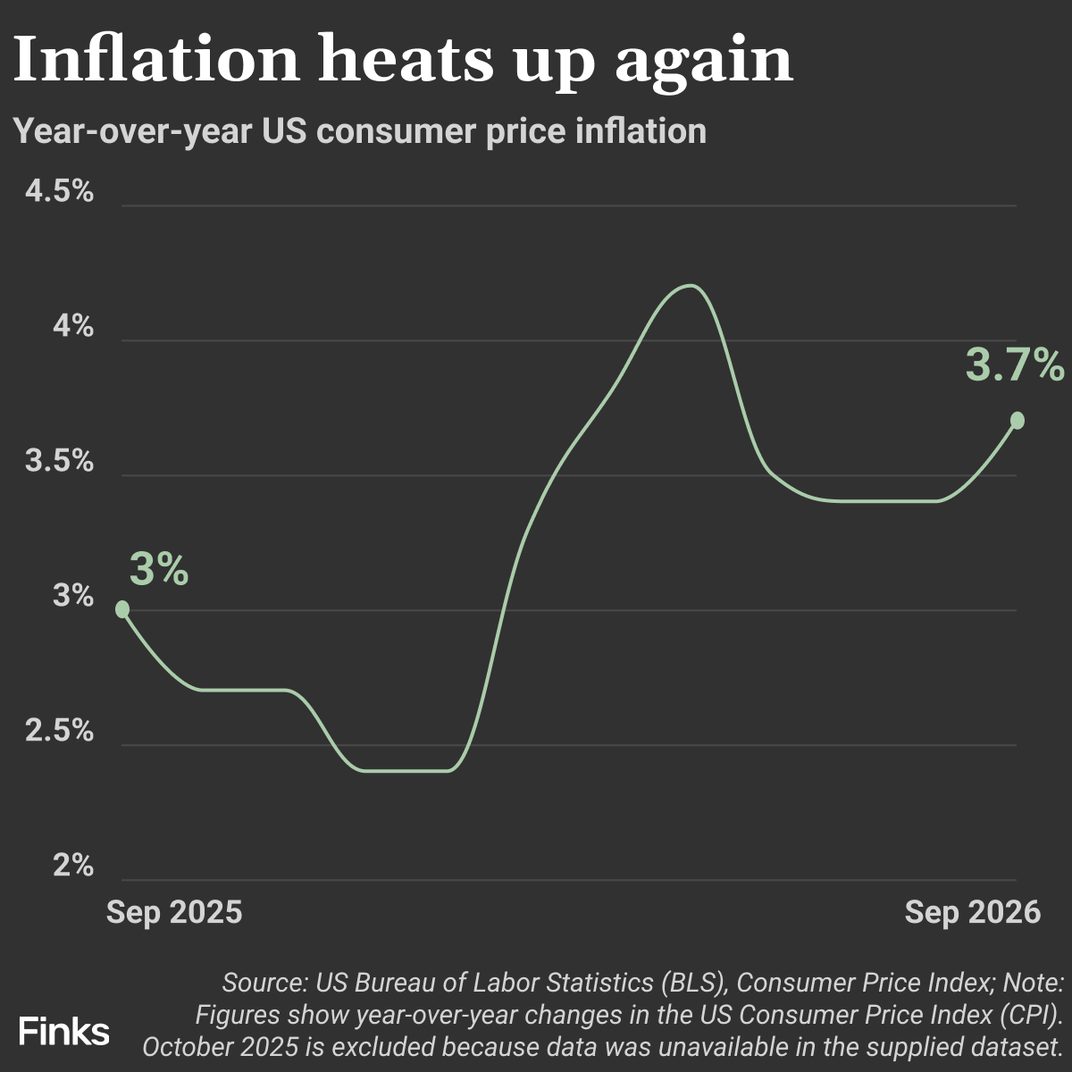
Inflation Rises to 3.6% as December Rate Hike Looms
The Fed wanted a cooldown and got a heat wave instead. The central bank’s favorite inflation gauge, the PCE price index, hit a 3.6% annual rate (opens in a new tab) in September — driven by its fastest monthly climb since March. With prices and growth both running hot, the case for holding rates steady is evaporating fast.
- Energy did the heavy lifting — fuel prices jumped 9.2% in September, more than double August’s rise, as Iran restricted shipping through the Strait of Hormuz.
- Beyond the pump, core PCE edged up to 3.1% — the reading the Fed relies on to judge whether businesses are passing energy costs on to customers.
No room to wait: The Fed’s usual escape hatch has slammed shut. A cooling economy typically lets central bankers ride out a stretch of hot prices, but third-quarter GDP grew at a brisk 3.4% pace. With headline inflation also running a full 1.6 points above the Fed’s 2% target, markets now heavily favor a December hike after Wednesday’s pause. For anyone carrying a mortgage, credit card balance, or auto loan, that spells a long, sweaty winter.
Post Credits