
FinksDaily
Sponsored by Blockchain.com
📊 Holding steady
Good morning. The country club crowd might need to make room at the kids’ table. Golf and tennis are becoming increasingly popular among younger Americans, with participation among kids ages 6–12 rising 55% and 72% (opens in a new tab), respectively, between 2019 and 2025. Shorter golf rounds, affordable youth programs, and a growing social media presence are helping both sports shake off their traditionally exclusive image. The next generation is getting an early start on its retirement hobbies.
Top Idea

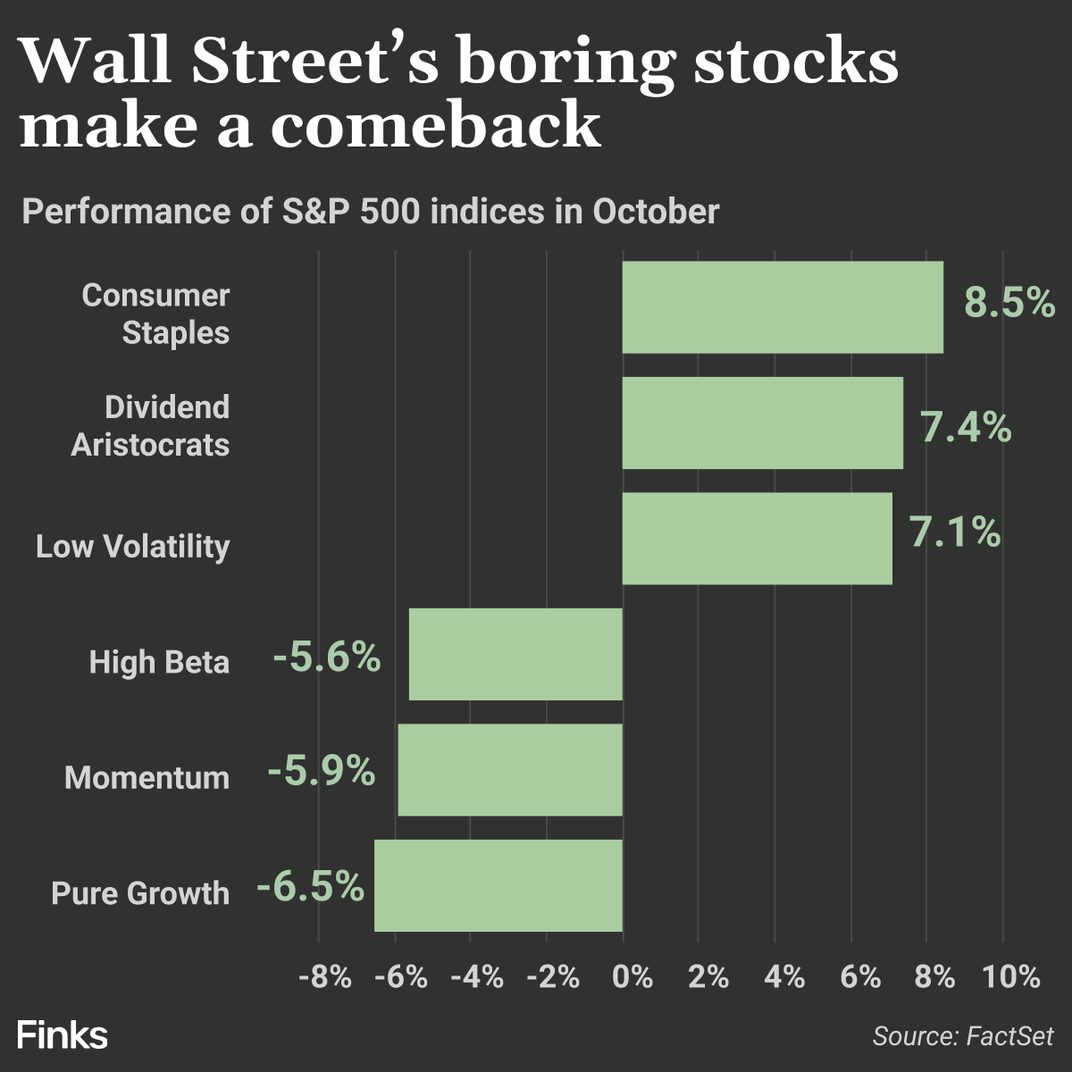
Defensive Stocks Are Outperforming Wall Street's Favorites. Can the Rally Last?
Wall Street's boring stocks are finally getting some action. The market's appetite for risk is changing, and investors are starting to question how much longer the same stocks can carry the rally. With November chip earnings approaching, the next test is whether tech can regain its lead or defensive stocks will keep winning.
Role change: High-beta S&P 500 stocks outperformed their less volatile peers (opens in a new tab) by 121 percentage points from the April 2025 market low through September 2026. But the trend reversed over the following four weeks, with low-volatility stocks pulling ahead by 13 percentage points. The Dividend Aristocrats and Pure Value indexes have also recovered after spending much of the tech rally trailing the broader market.
- Energy led all sectors with gains of roughly 20% over the three months through Oct. 23, while health care followed at 10%, according to Lighthouse Canton.
- Technology gained 5% and consumer staples rose 4% over the same period, whereas semiconductors declined 4%.
The Crowded Trade Unwinds
Semiconductor stocks had become closely tied to momentum investing, with their correlation reaching 0.95 in August. That relationship made it harder for momentum funds to diversify, as many of their biggest holdings responded to the same market forces. Meanwhile, the 10-year Treasury yield climbed above 5.1% in September, making high valuations harder to justify. For strategies built around continued price gains, even a small shift in investor expectations could lead to steep losses.
- Two major US momentum funds lost 9% to 11% between Oct. 6 and Oct. 22, compared with the S&P 500's decline of less than 2%.
- Goldman Sachs recorded the fastest hedge fund reduction in technology exposure since it began tracking the data in 2016.
What comes next: The concern now is whether the broader market can hold up without a handful of large stocks doing most of the work. On Oct. 27, only 210 S&P 500 companies finished higher despite the index gaining 0.5%, a pattern that has BTIG's Jonathan Krinsky questioning expectations for a post-election rally. Historical rotations following the 1998 financial crisis and 2020 pandemic suggest that less volatile stocks can outperform after extended periods of speculation. If history is any guide, Wall Street might be due for a little boredom.
 (opens in a new tab)
Sponsored by Blockchain.com
The Greatest Wealth Transfer in History Continues. Here’s Where the Money Is Flowing
As we move further into the 21st century, the greatest wealth transfer in history continues, and some 92% of young and wealthy Americans own crypto or want to. The future of finance – it appears – is going digital.
If you’re considering broadening your exposure to digital assets, Blockchain Wealth (opens in a new tab) is the premium program for crypto investing, loans and rewards. Accepted members receive a host of benefits, including:
- Discounted trading fees across 100+ digital assets, plus access to our OTC trading desk
- Access to crypto-backed loans (opens in a new tab) with interest rates starting at 0%, so you can access liquidity while retaining potential upside
- A dedicated relationship manager, plus 24/7 concierge service
- Private access to global cultural and sporting events, plus special merchandise
If you’d like to join Blockchain Wealth (opens in a new tab), please follow the link below to learn more.
For portfolios of $100k+
Large-Cap Recap
Big Tech Shows Cloud Gains Amid AI Spending
Cloud demand is giving Microsoft and Alphabet plenty of business, but keeping costs under control is another matter. Microsoft's Azure revenue jumped 48% to $33.2B, while Google Cloud generated $30.7B. Both spent less on capital projects than Wall Street expected, despite demand exceeding available capacity. Microsoft is cutting jobs to manage expenses, while Alphabet reported slower earnings growth and an $8.6B loss on private investments. The next advantage may belong to whoever brings new capacity online faster. [Read (opens in a new tab)]
Consumer Spending Divides Across Sectors
Consumer spending is holding up, but the latest earnings reveal a widening gap between businesses. Garmin reported record revenue of $1.99B as shoppers continued paying up for premium fitness watches and outdoor gear. eBay saw merchandise volume climb 15%, benefiting from consumers seeking better value through secondhand purchases. Chipotle managed just 2.1% same-store sales growth, with higher operating costs eating into restaurant profits. The American consumer hasn't closed their wallet, but businesses are having to work harder to earn a place in it. [Read (opens in a new tab)]
Telehealth Platforms Eye New Peptide Revenue
Peptide treatments are getting another shot at the US wellness market. The health department will temporarily allow pharmacies to compound six previously restricted peptides under strict purity requirements, opening a potentially multibillion-dollar market for telehealth providers and compounding pharmacies. Hims & Hers Health could benefit as it looks to expand beyond its struggling weight-loss business. FDA officials opposed the decision over safety concerns, meaning the opportunity comes with regulatory risks that providers can't afford to ignore. [Read (opens in a new tab)]
Market Pulse
Wingstop Inc.
The restaurant chain’s shares surged after quarterly earnings beat expectations, helping offset weaker revenue and another decline in domestic same-store sales.
F5, Inc.
The cybersecurity company’s shares sank as softer profit guidance and slowing growth expectations overshadowed an earnings beat and prompted an analyst downgrade.
The Wendy's Company
The fast-food chain’s shares surged after Trian Fund Management submitted a $1.4B takeover proposal to acquire the company and take it private.
Markets & Economy
US-Mexico trade talks stall over metals tariffs: President Claudia Sheinbaum said discussions remain deadlocked over Washington's 50% tariff on steel and aluminum exports. The US goods deficit with Mexico hit $155.9B through August, rising 21.2% year-over-year. [Read (opens in a new tab)]
Mortgage applications snap seven-week losing streak: Borrowing costs eased as 30-year fixed loan rates slipped to 7.37%, prompting purchase applications to climb 4%. The temporary relief left refinancing up 3%, though yearly volume remains sharply depressed. [Read (opens in a new tab)]
US goods trade deficit widens: Imports hit a record $344.1B in September as capital goods and tech hardware flooded the country. The widening gap will drag on quarterly GDP, though economists attribute the surge to robust business investment in AI infrastructure. [Read (opens in a new tab)]
Business & Tech
ServiceNow guides Q4 revenue below Wall Street expectations: ServiceNow issued fourth-quarter guidance of $4.25B to $4.26B. Despite the light near-term outlook, the company raised its 2026 AI annual contract value and expanded its partnership with OpenAI. [Read (opens in a new tab)]
Apple launches first touchscreen MacBook Pro: Apple introduced its first laptop with a touchscreen, featuring an OLED display and the M5 Pro chip. The launch arrives as the broader PC market struggles with a 20% drop in shipments due to an AI-driven memory shortage. [Read (opens in a new tab)]
Trump administration to scrap Biden methane rules for oil and gas: The EPA's proposed rollback would loosen leak standards for marginal wells and eliminate the Super Emitter Program. Officials project the changes will save the sector $45B through 2050. [Read (opens in a new tab)]
Chart
Digit of the Day
Fed Holds Rates at 4% as Officials Split Over Inflation
The Fed is keeping rates on hold, but inflation isn't taking the hint. Policymakers kept the benchmark rate at 3.75%–4% (opens in a new tab) on Oct. 28 in a 10–2 vote, following September's first increase in three years. With inflation still running above target and economic growth holding up, officials are weighing whether another increase is needed before the year ends.
- CME FedWatch data put the probability of a quarter-point rate hike at the Dec. 9 meeting at 76.5%, suggesting traders see October's pause as temporary.
- Wholesale inflation reached 6.3% annually, while September consumer prices rose 3.7%, reinforcing concerns that price pressures remain widespread.
Rate watch: Fed Governor Lisa Cook and Cleveland Fed President Beth Hammack both favored another quarter-point increase, highlighting disagreements over how aggressively to tackle inflation. Holding rates steady offers little immediate relief for households, with borrowing costs remaining elevated while savers continue benefiting from higher deposit yields. And with another rate increase potentially on the way, borrowers may have to wait a little longer before their monthly bills get any easier to manage.
Strategize
Refinery Stocks Are Up 150%. Can Their Winning Streak Last?
Oil producers usually grab the headlines, but refiners are stealing the spotlight. Valero Energy, Marathon Petroleum, and Phillips 66 have benefited from tight fuel supplies and stronger refining margins, turning a traditionally cyclical industry into one of Wall Street's biggest winners.
Why it matters: Limited refining capacity has kept profits elevated, but weaker fuel demand or recovering supply could quickly squeeze margins. With shares already reflecting strong earnings, investors need to separate companies capable of sustaining profits from those riding a temporary supply crunch.
Post Credits