
FinksDaily
📉 Memory loss
Good morning. Paris is known for haute couture, fine wine, and the Eiffel Tower, but its hottest new growth sector has four legs and a very short attention span. Four local business owners chipped in ~$23K to fund the city’s debut Dog Week (opens in a new tab), featuring a pajama party and a runway show. Their sights are set on a global pet care market worth $181B in 2025 and projected to reach $283B by 2033. Wall Street has bulls and bears, but this catwalk has a spaniel in tailored plaid.
Top Idea

The AI Wearables Race Is Heating Up. Tech Giants Are Coming for Meta and Oura
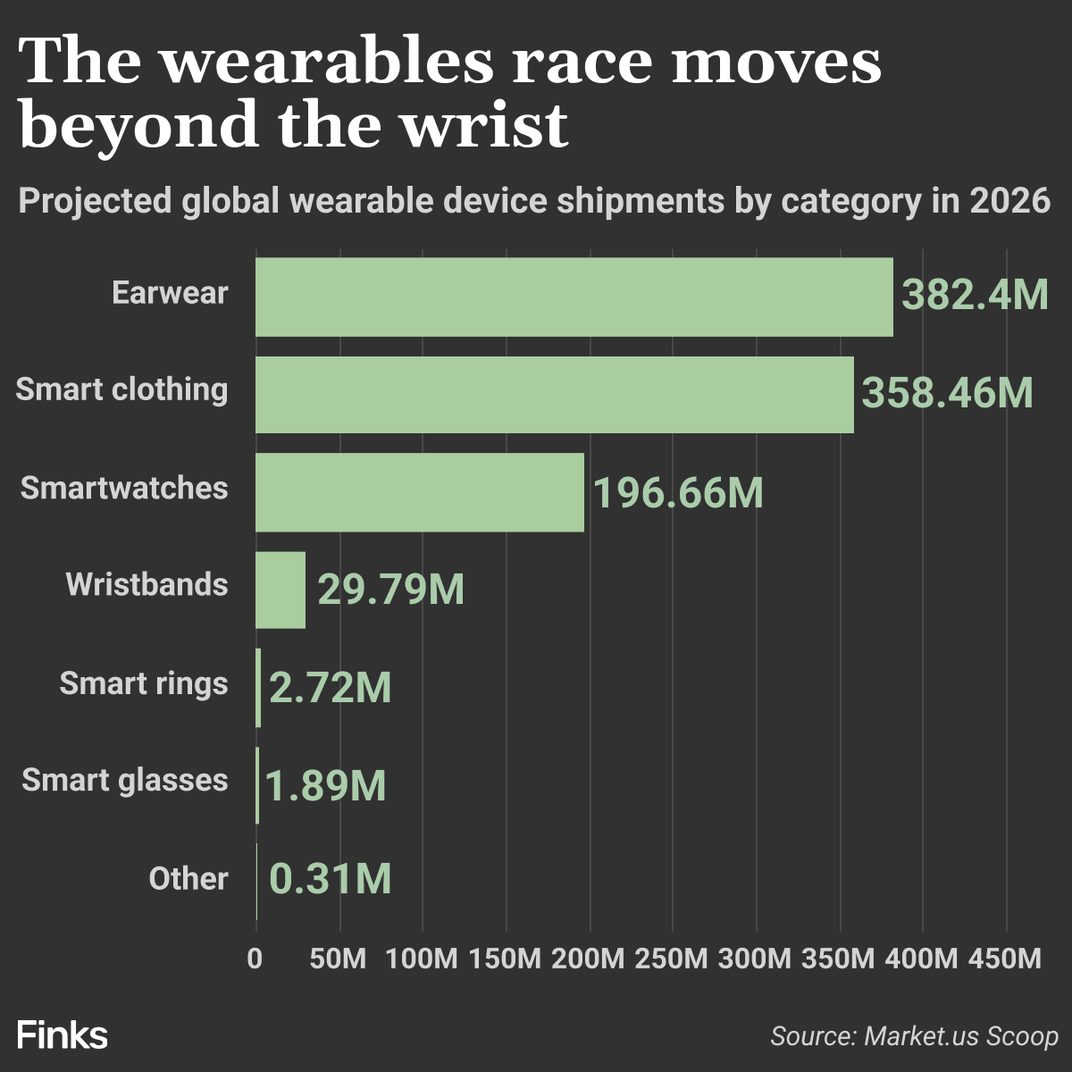
Smartwatches have ruled the wearables market for years, but the next big opportunity is emerging beyond the wrist. AI glasses are seeing explosive demand, smart rings are catching on, and screenless fitness trackers are drawing interest from tech giants. With more companies entering the market, the race to turn these devices into mainstream products is picking up.
Losing steam: Apple still accounts for 46% of global smartwatch shipments, but even the market leader faces a tougher selling environment. Consumers have fewer reasons to replace watches that already work well, while rising component costs are expected to push average prices up 12% this year. Garmin has fared better with fitness-focused buyers, but that strength hasn't been enough to offset weakness across the broader market.
- Omdia found smartwatch shipments rose 6% in Q2, driven by sports-focused models, even as overall wearable band shipments fell 2%.
- However, CCS Insight expects the global wearables market to shrink 3% in 2026, with smartwatch shipments falling 4% as demand weakens.
AI Glasses Carry the Growth
While smartwatch sales are slowing, AI glasses are becoming a major growth opportunity for Meta Platforms. Global shipments jumped 263% in the first half of 2026, with Meta capturing 94% of the market for models without built-in displays. That early lead is drawing competition (opens in a new tab) from rivals, with Alphabet and Samsung Electronics working on rival products, while Apple is reportedly planning its own entry into the market.
- Meta and EssilorLuxottica sold over 7M pairs of AI glasses in 2025, with EssilorLuxottica expecting annual sales to reach 10M by the end of 2026.
- Smart ring shipments are expected to grow 53% to 6M units this year, with demand increasingly coming from consumers who already own smartwatches.
Crowded field: Oura has been one of the biggest winners in smart rings, but that success hasn't made its Wall Street debut any easier. The company postponed its Sept. 29 IPO after seeking a valuation of up to $15.6B, citing market uncertainty. Competition is another concern, with Samsung already selling a rival ring and D.A. Davidson analyst Gil Luria questioning whether consumers would still need Oura's products if Apple launched its own. So while the wearables market has plenty of room to grow, not everyone will get a piece worth owning.
Ask Finks
Congrats, You’re Wall Street’s Newest Unpaid Intern
You bought a few stocks and somehow got roped into tracking every Fed comment, earnings surprise, and CEO meltdown, most of them about companies you don’t even own. The pay is zero, and the hours are whenever the market’s open.
Time to hand the job toFinks (opens in a new tab). It learns what you own, what you’re watching, and what you care about, so you get your own research team without the six-figure payroll.
- Your morning briefing, handled: Set a daily task that flags the news hitting your holdings and watchlist before your coffee’s done.
- Research on your schedule: Compare stocks, dig through years of financial data, and check the original sources whenever something looks off.
Consider this your two weeks’ notice.
Try: Brief me on my stocks every morning → (opens in a new tab)
Large-Cap Recap
Higher Rates Hit Chip and AI InfrastructureStocks
Higher borrowing costs are weighing on chipmakers and AI infrastructure stocks as investors question the debt funding their expansion. Twenty leading companies shed over $1T in combined market value this week after hotter inflation revived fears of another Fed rate hike. Even Taiwan Semiconductor Manufacturing’s sixth straight record quarterly profit offered little relief, while CoreWeave and Oracle faced pressure. AI demand remains strong, but investors are increasingly concerned about the cost of funding its growth. [Read (opens in a new tab)]
Retailers Find a Bargain in Booze’s Slump
Americans are drinking less, but retailers have found something worth toasting. Falling demand has left alcohol producers sitting on a mountain of unsold bottles, with Pernod Ricard reporting a 14% drop in US sales. The glut is giving Costco and Kroger more bargaining power, allowing them to offer premium wines at prices once reserved for budget bottles. With the surplus expected to take atleast a year or two to clear, shoppers could be enjoying the discounts long after the industry’s hangover wears off. [Read (opens in a new tab)]
The Chip Supplier Flying Under Wall Street’s Radar
Nvidia gets the headlines, but Qnity Electronics supplies the materials that help turn chip designs into finished products. Its polishing materials and specialty chemicals are used throughout manufacturing, with demand growing as chips become more complex. Revenue climbed 22% in Q2, prompting the company to raise its 2026 sales outlook. Yet its shares trade at roughly 24x expected earnings, well below rival Entegris. With limited analyst coverage, Qnity may be one of the less-noticed beneficiaries of the AI chip boom. [Read (opens in a new tab)]
Idea Desk
Which Stocks Are Worth Buying on a Dip?
Investors looking for buying opportunities don't always have to wait for a broader market selloff. Some established companies have seen their shares fall well below recent highs, even as their earnings prospects and financial strength suggest room to recover. The challenge is separating temporary setbacks from deeper problems.
We screened for 20 profitable US companies trading at least 10% below their 52-week highs, with healthy balance sheets and potential upside based on Wall Street's consensus 12-month price targets. Here are the five with the highest expected gains.
| Company | Current price | Potential upside |
|---|---|---|
| Texas Pacific Land ($TPL) | $346.52 | +84.4% |
| AppLovin ($APP) | $279.29 | +83.2% |
| Western Digital ($WDC) | $356.45 | +80.4% |
| Micron Technology ($MU) | $931.24 | +70.6% |
| Nvidia ($NVDA) | $217.23 | +56.1% |
Market Pulse
Regencell Bioscience Holdings Limited
The biotech company’s shares surged amid heavy trading activity, extending the extreme volatility that has repeatedly driven sharp moves in the stock.
Penguin Solutions, Inc.
The AI infrastructure company’s shares sank as investors took profits following its recent rally, despite continued optimism around growing demand for AI data centers.
FMC Corporation
The agricultural sciences company’s shares dropped as persistent weakness in crop protection demand and concerns around its debt load continued to weigh on investor sentiment.
Sponsored by Chaikin Analytics
Why OpenAI, Anthropic and Grok Should Fear Trump’s “American Atlas”
American Atlas isn’t just another AI program. It could upend conventional data centers and the AI providers built on them, from OpenAI to Anthropic to Grok. Marc Chaikin’s free report (opens in a new tab) reveals the ratings for 3 major AI stocks tied to it.
See their ratings free (opens in a new tab)
Chaikin Analytics Privacy Policy (opens in a new tab)
Markets & Economy
Wholesale inflation jumps on fuel costs: Producer prices rose 1.3% in September, far above the 0.6% economists expected. Core prices, which exclude food and energy, climbed 5% over 12 months, a sign the pressure is spreading. [Read (opens in a new tab)]
Headline strength hides a stalling core consumer: Core sales, which feed GDP estimates, grew just 0.1% after 1.2% in August. Producer prices jumped 1.3% in September, and a growing minority of futures traders now price in a Fed rate hike. [Read (opens in a new tab)]
Banks call IPO slowdown a pause as bond yields bite: JPMorgan CFO Jeremy Barnum says deals are being delayed, not canceled. Global M&A volumes fell 41% in the third quarter to $993B, per LSEG data. [Read (opens in a new tab)]
Business & Tech
Bitcoin miners fall as AI hosting bets sour: Miners that rent computing power to AI customers were hit hardest, with several dropping double digits. Gartner expects more than 80% of neoclouds to lose independence by 2030. [Read (opens in a new tab)]
Advanced chip demand brings steeper costs for TSMC: Taiwan Semiconductor Manufacturing Co. maintains a $60B to $64B annual capex budget. CFO Wendell Huang warned that new capacity will dilute gross margins by 2% in 2026. [Read (opens in a new tab)]
Record margin borrowing reshapes brokerage earnings: Charles Schwab also posted record core net new assets of $190.4B. Without hedging-linked long/short positions, margin debt growth slows to 24%, a far tamer picture. [Read (opens in a new tab)]
Chart
Digit of the Day
Memory Prices Expected to Fall 23% as Asian Competition Looms
The AI trade’s favorite shortage is getting a reality check. After a red-hot run, Counterpoint Research expects prices for DRAM, a key type of memory, to fall around 23% in 2028 (opens in a new tab). The forecast lands as investors fear an oversupply from Asian competition — a reminder that scarcity is a great business model right up until it isn’t.
- China’s CXMT announced a new memory chip that holds more data — rattling SK Hynix, Samsung and Micron over a possible loss of global market share.
- Meanwhile, two Korean experts, one a professor and one a chip industry association executive, expect a “flood of new supply” to hit the market in 2029.
Relief valve: What’s bad for memory makers is good for the rest of us. Smartphone shipments fell 20% to a 14-year low, and Apple raised iPhone prices by $100. PCs fared no better, with shipments down a similar amount and Dell and HP among the hardest hit. Acer’s CEO expects PC prices to climb another fifth before easing in the second half of 2027, but says Chinese memory supply is disrupting pricing. Save the confetti, because even after the forecast drop, DRAM would still sit around 230% above 2025.
Post Credits