
FinksDaily
Sponsored by BluSky AI
🧲 Bond pull
Good morning. The holiday splurge is getting a dollar-store makeover. Grocery inflation and shaky economic sentiment are sending shoppers toward the cheapest shelf in town, but they’re not stopping at the essentials. The share of US adults (opens in a new tab) planning to buy gifts at dollar stores hit 13% in 2026, up from 5% in 2020 and now ahead of specialty chains. Even six-figure households are spending more there. Turns out, it’s the thought and the price tag that count.
Top Idea

Bond Yields Are Near 5%. Why Investors Are Buying the Selloff
Bonds are finally paying investors to stomach the pain. The 10-year Treasury yield recently topped 5.2%, hammering existing bondholders while giving new buyers some of the richest income in years. That tradeoff has some of the world’s biggest money managers calling this the best fixed-income opportunity in decades.
Cushion included: Investors don’t have to reach very far out on the yield curve to get paid anymore. Two-year Treasurys are yielding over 4.9% (opens in a new tab), barely below the 10-year, without taking on as much long-term risk from deficits, oil shocks, and shifting Fed policy. The high coupon helps cushion further price declines, while the short maturity means investors get their principal back sooner if rates keep climbing.
- If two-year yields rose another percentage point over a year, the hefty coupon would cushion most of the price hit, leaving investors with a roughly 4% total return.
- The same one-point move would hurt longer-dated bonds much more, leaving 10-year Treasurys down roughly 2% and 30-year bonds down about 8%.
Why The Pros Are Buying What Retail Fears
Bond selloffs scare investors in a way stock dips never do. The iShares Core US Aggregate Bond ETF sits down 4.8% in price this year. Bank of America strategist Savita Subramanian argues bonds today are more attractive (opens in a new tab) than the S&P 500 at any point in 20+ years, with her valuation work implying -3% annualized index returns for the next decade.
- UBS strategist Matthew Misch says higher rates (opens in a new tab) should widen the gap between strong and weak borrowers, favoring BB-rated debt and utilities over CCCs and tech.
- That gap is already widening, with high-grade corporate debt offering ~6% yields vs. the S&P 500’s sub-1.4% dividend yield.
The contrarian's case: Ray Dalio points to the more than $1T the US spends annually servicing its debt and recommends avoiding (opens in a new tab) rate-sensitive assets altogether. Pimco’s Dan Ivascyn lands somewhere in the middle, expecting slower growth without a recession and seeing room for patient investors to earn 6%–7% from a high-quality portfolio. The risks haven’t disappeared, but investors are finally being paid enough to stick around.
 (opens in a new tab)
Sponsored by BluSky AI
The House is Cracking Down on Big Data Centers
As community opposition over data centers dominates headlines, massive data center development will now foot the bill on the grid.
The House just passed the Ratepayer Protection Act, 417-3, a rare bipartisan vote that makes data centers pay for the grid upgrades they trigger instead of passing the cost to homeowners. It's aimed at the traditional data center model: massive, power-hungry facilities that strain the grid and raise consumers' electricity bills. That's where BluSky AI (opens in a new tab) has a unique solution.
They’re positioned to capture a massive opportunity with their SkyMods; pre-fab, modular, small-scale AI compute centers that use less power, fit into smaller footprints, and near-zero water versus traditional data centers.
And with AI's electricity demand projecting to double US data center power draw by 2030, the timing couldn’t be better. Invest in BluSky AI today at $5.50/share. (opens in a new tab)
Large-Cap Recap
US Trade Policy Fractures Into Four Distinct Economic Tracks
Trade policy is splitting into multiple distinct confrontations, creating varied risks for investors. The Canadian track has escalated with steep tariffs affecting $20B of exports, while talks with Mexico are targeting an early harvest deal before November. Meanwhile, the China conflict focuses on advanced chip controls involving Nvidia and Super Micro Computer. Finally, Europe and Brazil remain quiet holding patterns, with JPMorgan proposing a broader economic pact. [Read (opens in a new tab)]
Meta AI Agent Muse Ignites Platform Battle
Meta Platforms launched its personal AI agent Muse, which reached 2.5M downloads and topped the US iOS free-app chart in its first two weeks. That rapid adoption pressured legacy gatekeepers like Apple and Amazon as agents start bypassing traditional discovery layers. Meanwhile, Shopify and PayPal opened their rails to the tool. Analysts project substantial incremental revenue, though security concerns and platform pushback remain key risks for the emerging category. [Read (opens in a new tab)]
The US Army Turns to Navitas for High Voltage Chips
The US Army selected Navitas Semiconductor to develop next-generation 10 kV silicon carbide power devices through the ALATTIS prototype program. Washington wants domestic manufacturing capabilities built on American soil, targeting a critical gap in the semiconductor supply chain. While the project validates the company's engineering record, no financial terms were disclosed. Investors must weigh the military backing against ongoing quarterly losses and a pending patent dispute with rival Wolfspeed. [Read (opens in a new tab)]
Market Pulse
Carnival Corporation & plc
The cruise operator’s shares surged after quarterly earnings and revenue beat estimates while strong bookings reinforced demand expectations.
Warby Parker Inc.
The eyewear retailer’s shares rose as Meta’s AI glasses push fueled optimism around the growing smart eyewear market.
Fair Isaac Corporation
The credit scoring company’s shares plunged after Fannie Mae and Freddie Mac opened mortgage pricing to rival VantageScore.
Sponsor
The Economy Is Flashing Warning Signs. Here’s What Investors Need to Know
Consumer confidence just hit its lowest since 2014 and job openings fell, even as Fed officials kept another rate hike on the table. Friday’s jobs report could determine which risk takes over next.
What matters for your portfolio:
- Higher rates: Expensive growth stocks and other rate-sensitive names face more pressure as yields climb.
- Weaker demand: Consumer-facing companies could feel the squeeze if confidence spills into spending.
- Slower hiring: A softer labor market could favor defensive sectors if growth concerns deepen.
Ask Finks:Which stocks can help protect my portfolio if the economy keeps slowing? (opens in a new tab)
Markets & Economy
Home prices rise but trail inflation: US home prices rose 1.9% from a year earlier in July, marking the 14th straight month that gains lagged inflation. Chicago led major cities, while prices fell in Seattle, Las Vegas and Denver. [Read (opens in a new tab)]
Treasury expands Trump Account enrollment: Treasury will automatically create Trump Accounts for more than 60M children. Parents must still claim the accounts and elect to receive the $1K federal deposit for eligible children. [Read (opens in a new tab)]
Disney cuts hundreds more jobs: Disney is laying off a few hundred employees across its human resources and technology teams. The cuts follow roughly 1K layoffs in April as CEO Josh D’Amaro continues reshaping the entertainment giant. [Read (opens in a new tab)]
Business & Tech
Oura shelves $2.2B IPO amid market jitters: Smart ring maker Oura postponed its debut despite drawing about four times as many orders as shares available. The profitable company reported $1.21B in revenue for the nine months ended June 30, up 74% year-over-year. [Read (opens in a new tab)]
Molson Coors expands nonalcoholic portfolio: Molson Coors is taking Coors 0.0 nationwide by 2027 following a successful Northeast launch. The nonalcohol beer segment is projected to reach $2.6B by 2030. [Read (opens in a new tab)]
Berkshire Hathaway boosts Lennar stake: Berkshire Hathaway lifted its stake in Lennar to 11% with a $2.1B position. The homebuilder's stock has dropped about 20% in 2026 amid compressed margins and sliding profit. [Read (opens in a new tab)]
Chart
Digit of the Day
Car Dealers Face a Model Drought as Redesigns Fall to 9%
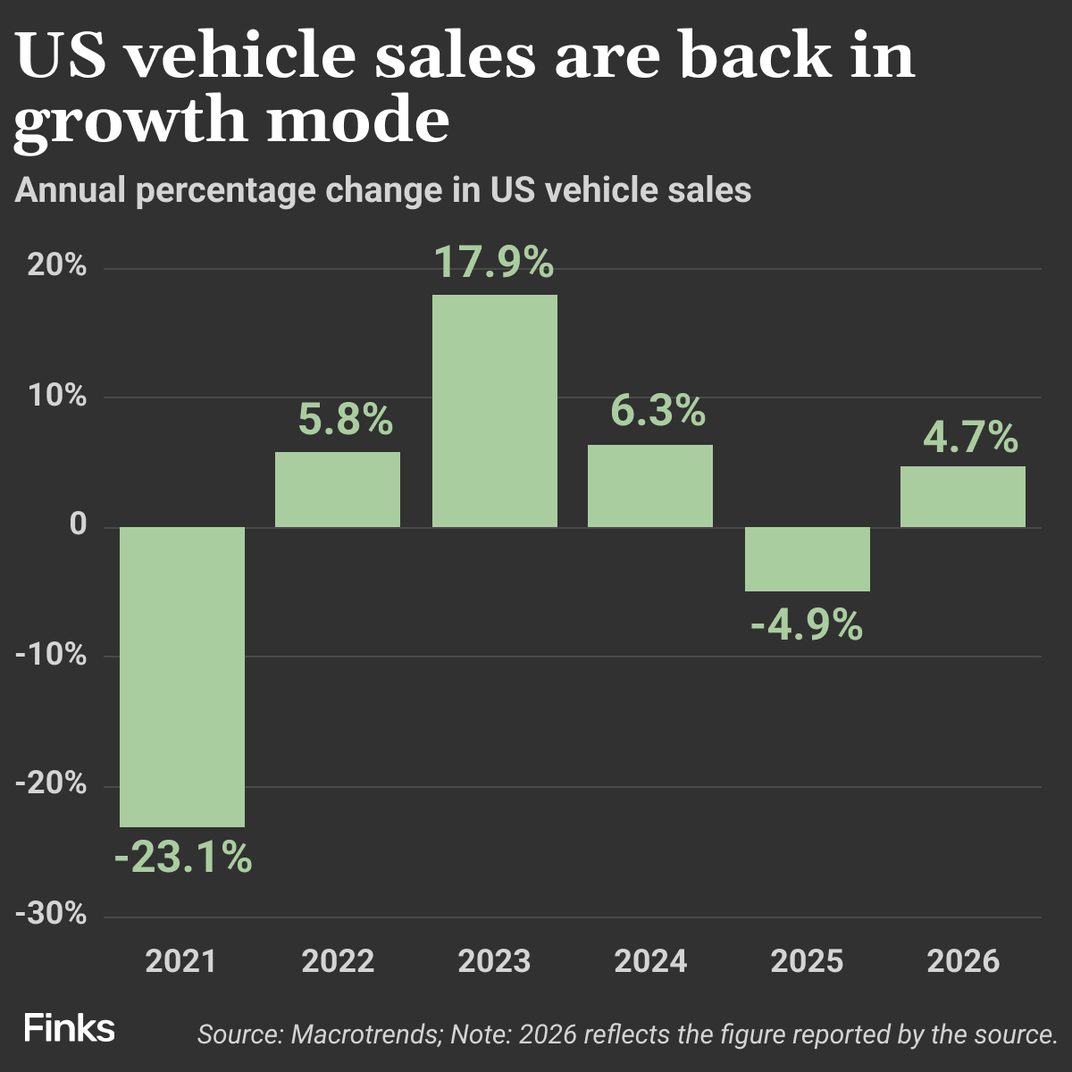
Showrooms are starting to feel like reruns. Automakers are expected to redesign 9% of their lineup (opens in a new tab) on average across the 2026-2028 model years, far below the 20-year average of 14%, per analyst John Murphy. The drought comes as US auto sales are already down roughly 2% this year, and the pipeline would look even thinner without GM’s pickup redesign.
- Carmakers canceled or delayed dozens of EV models, booking more than $70B in charges and impairments.
- Ford and GM have ceded share to Toyota, Honda, and Hyundai, which offer more hybrids and cheaper models.
Stalled out: Most fresh metal won’t arrive until 2028 and beyond, leaving what Murphy calls “a total stall for new products” just as the industry’s economics shift again. Washington has cut its 2031 fuel economy target to 34.9 mpg (opens in a new tab) from 50.4 mpg, while Bain & Company sees US sales falling by 2M (opens in a new tab) vehicles by 2040. So despite carmakers having more freedom over what to build, they have less room to get it wrong.
Post Credits

Disclosures
This is a paid advertisement for BluSky AI Regulation A offering. Please read the offering circular at invest.bluskyaidatacenters.com (opens in a new tab)