FinksDaily
🎨 Leisure pivot
Good morning. The annual performance review has finally met its match: a 20-something-year-old who wants feedback every week, not once a year. With just 42% of Gen Z and younger millennials strongly agreeing they know what is expected (opens in a new tab) at work, companies are trying to close the gap sooner. They’re hiring generational consultants, rolling out AI role-play coaches, and swapping yearly evaluations for quarterly two-way check-ins. Managers who learned to save it all for review season are now being taught to talk before December.
Monthly market survey: September gave investors plenty to digest, but the real question is what comes next. With earnings season around the corner and rates still setting the tone, we want to know where you stand. Are you feeling bullish or bearish heading into October? (Click to vote.)
Top Idea

Renewable Stocks Were Supposed to Be Long-Term Winners. Higher Rates Are Testing That Bet
Renewable energy may run on sunshine, but it was built on cheap capital. Higher borrowing costs are exposing just how dependent the industry became on it, dragging renewable stocks into the same rate-sensitive slump that has hit real estate and utilities. And the pain is showing up fastest in names investors thought could weather it.
Front-loaded and exposed: Renewable projects burn through cash long before they generate any, with developers paying for equipment, permits, and construction before a solar or wind farm starts producing power. That makes financing a huge part of the economics. Wood Mackenzie estimates that a 2 percentage point increase in the risk-free rate raises lifetime costs (opens in a new tab) by 20%, compared with 11% for a natural gas plant.
- The 10-year Treasury yielded 5.2% Friday, up a full percentage point in seven months and keeping financing costs elevated across the sector.
- Solar stocks are feeling the squeeze, with SunPower down 76% over six months and residential solar lessor Sunrun off 38%.
Where The Funds Are Going Instead
Equipment makers are getting caught in the selloff too, with First Solar, SolarEdge, and Enphase all declining (opens in a new tab) recently. Capital is moving elsewhere as well. Imports of China-made solar systems peaked above $5.8B a month in March 2023 but have averaged $2.7B (opens in a new tab) in 2026. Utilities are spending more on grids, storage, and transmission instead, building out the infrastructure needed to get more from the renewable capacity already installed.
- Importers paid ~$75B for Chinese batteries and grid equipment in the first seven months of 2026.
- NextEra Energy says it added more than $46B of hedges built to absorb interest-rate swings.
The long replacement cycle: Aging fleets should eventually give the industry a lift that higher rates can’t erase. More than 3.5 TW of wind and solar capacity is already operating globally, while 2.5 TW of projects will reach the end of their lives by the 2040s. Replacing them will drive another wave of spending, with Wood Mackenzie expecting equipment sales volumes to be more than 60% higher (opens in a new tab) in 2050 than in 2026. That gives the industry a long runway for demand, but does little to solve the financing squeeze investors are pricing in today.
Sponsor
Trump Rejected Iran’s Peace Plan. What Does That Mean for Your Portfolio?
President Trump rejected Iran’s latest proposal to end the conflict and reopen the Strait of Hormuz. Oil jumped above $107 a barrel Monday, stocks fell, and Treasury yields climbed as investors priced in more uncertainty. The fallout could reach well beyond oil.
- Energy: Higher crude prices can boost producers while raising costs elsewhere.
- Airlines: Pricier jet fuel can squeeze already-thin margins.
- Consumer stocks: Higher gas costs can leave households with less to spend.
- Defense: A prolonged conflict could keep contractors in focus.
Large-Cap Recap
Pickier Consumers Divert Leisure Dollars Toward At-Home Hobbies
Americans are spending heavily on hobbies like crafting, camping, and sports equipment while out-of-home entertainment faces mounting pressure. Bank of America card data shows hobby spending grew 7.9% in August from a year earlier. That shift has created severe distress for traditional venues, leading to debt downgrades for Lucky Strike Entertainment and slumping revenue at Dave & Buster's. Meanwhile, cruise operators like Carnival have lagged the broader market amid rising travel costs. [Read (opens in a new tab)]
Nvidia Fuels Rally With Record Buyback
Nvidia boosted its share buyback authorization by a record $150B, leaving the chipmaker with $235B available for repurchases. That commitment outpaces the previous US record set by Apple and towers over corporate spending trends as overall buybacks slow down. Management plans to execute the program through fiscal 2028, backed by surging revenue and robust cash generation. That scale signals confidence in future demand as AI buildouts continue. [Read (opens in a new tab)]
Washington Scales Back Fuel Economy Rules
The Transportation Department finalized a fleetwide average of 34.9 miles per gallon by 2031, replacing Biden-era targets of 50.4 mpg. That regulatory pivot slashes automaker technology costs by $60.6B through 2031. General Motors alone anticipates a $20.4B reduction in compliance expenses. Meanwhile, Ford and Stellantis face evolving consumer demand as high gasoline prices push buyers toward hybrids while electric vehicle adoption slows across the US market. [Read (opens in a new tab)]
Market Pulse
Kodiak Sciences Inc.
The biotech company’s shares surged after its Zenkuda eye drug met the primary endpoint in a pivotal late-stage trial.
Roblox Corporation
The gaming platform’s shares fell after Jefferies downgraded the stock to Underperform, arguing its recent rally had gone too far.
MongoDB, Inc.
The database software company’s shares sank after CEO CJ Desai abruptly left to take a senior role at Meta.
Sponsored by Alumni Ventures
Join Us on Sept 30 at 3 PM EST
Ready to diversify beyond traditional asset classes? Join the Alumni Ventures team for a quick, high-impact breakdown of venture capital fundamentals (opens in a new tab).
- How VC differs from private equity
- How AV builds diversified portfolios across stages and sectors
- How accredited investors can access an asset class once reserved for institutions
Markets & Economy
US-China trade truce buys more time: Washington and Beijing extended their tariff truce by two months, giving both sides more room to negotiate after recent talks. The extension keeps broader trade discussions moving while existing agreements remain in place. [Read (opens in a new tab)]
Gold slides as rate expectations climb: Gold came under fresh pressure as surging Treasury yields and inflation concerns strengthened expectations for higher US interest rates. Rising yields are reducing the appeal of non-yielding bullion after its earlier rally. [Read (opens in a new tab)]
S&P 500 rally masks growing divergence: Nearly half of S&P 500 stocks have recently moved opposite the broader index, an unusually high share. The split shows how headline index gains are increasingly disconnected from performance across much of the market. [Read (opens in a new tab)]
Business & Tech
SpaceX reaches orbit for the first time: SpaceX deployed 26 Starlink V3 satellites after Starship reached Earth orbit despite an engine failure during ascent. The milestone clears the way for regular deployments of the higher-capacity satellites. [Read (opens in a new tab)]
Nasdaq and NYSE Arca launch near-continuous trading: Nasdaq and NYSE Arca will launch overnight trading on Dec. 6, extending US stock sessions to 23 hours a day, five days a week. Overnight volume in US-listed stocks has more than tripled in the 12 months ended August 2026. [Read (opens in a new tab)]
CarMax Q2 earnings approach amid turnaround strategy: CarMax reports second-quarter earnings Tuesday, with analysts expecting 71 cents a share on revenue of $6.94B. The stock has surged 48% this year despite recent corporate layoffs and a rich valuation. [Read (opens in a new tab)]
Chart
Digit of the Day
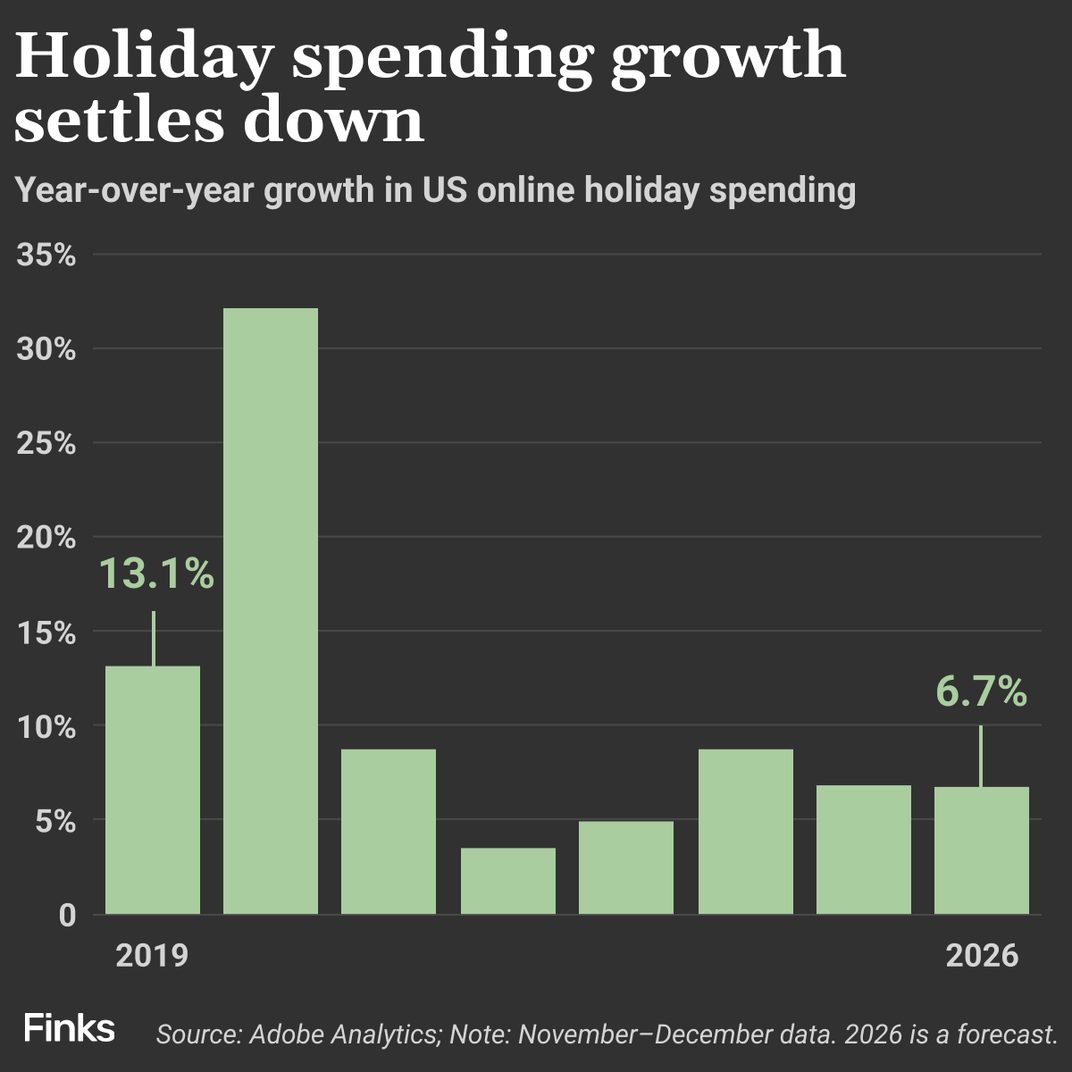
Adobe Sees US Holiday Online Spending Rising 6.7% as Deal Hunting Intensifies
Santa’s sleigh is running on promo codes this year. Adobe Analytics expects US online holiday sales to rise 6.7% (opens in a new tab) year-over-year to a record $275.1B between Nov. 1 and Dec. 31. Shoppers are still spending, but retailers may have to work harder for every dollar as Walmart, Kohl’s, and American Eagle warn about stretched consumers (opens in a new tab).
- Cyber Week discounts could reach 30%, helping Cyber Monday set a $15.1B sales record while Black Friday grows even faster to $12.9B.
- Holiday shopping is starting earlier too, with October online spending expected to hit $95.8B as Prime Day on Oct. 6 and 7 brings in $9.9B.
Bargain basket: Holiday deals are becoming a chance to stock up on more than gifts. Cyber Week sales of personal hygiene products could jump 150% (opens in a new tab) from September levels, while grocery is expected to be the fastest-growing major category. Buy Now Pay Later could finance $21.3B in purchases, giving stretched shoppers another way to keep spending. AI-driven traffic to retail sites is forecast to surge 130% this season, putting a new gatekeeper between shoppers and the brands fighting for their holiday dollars.
Post Credits