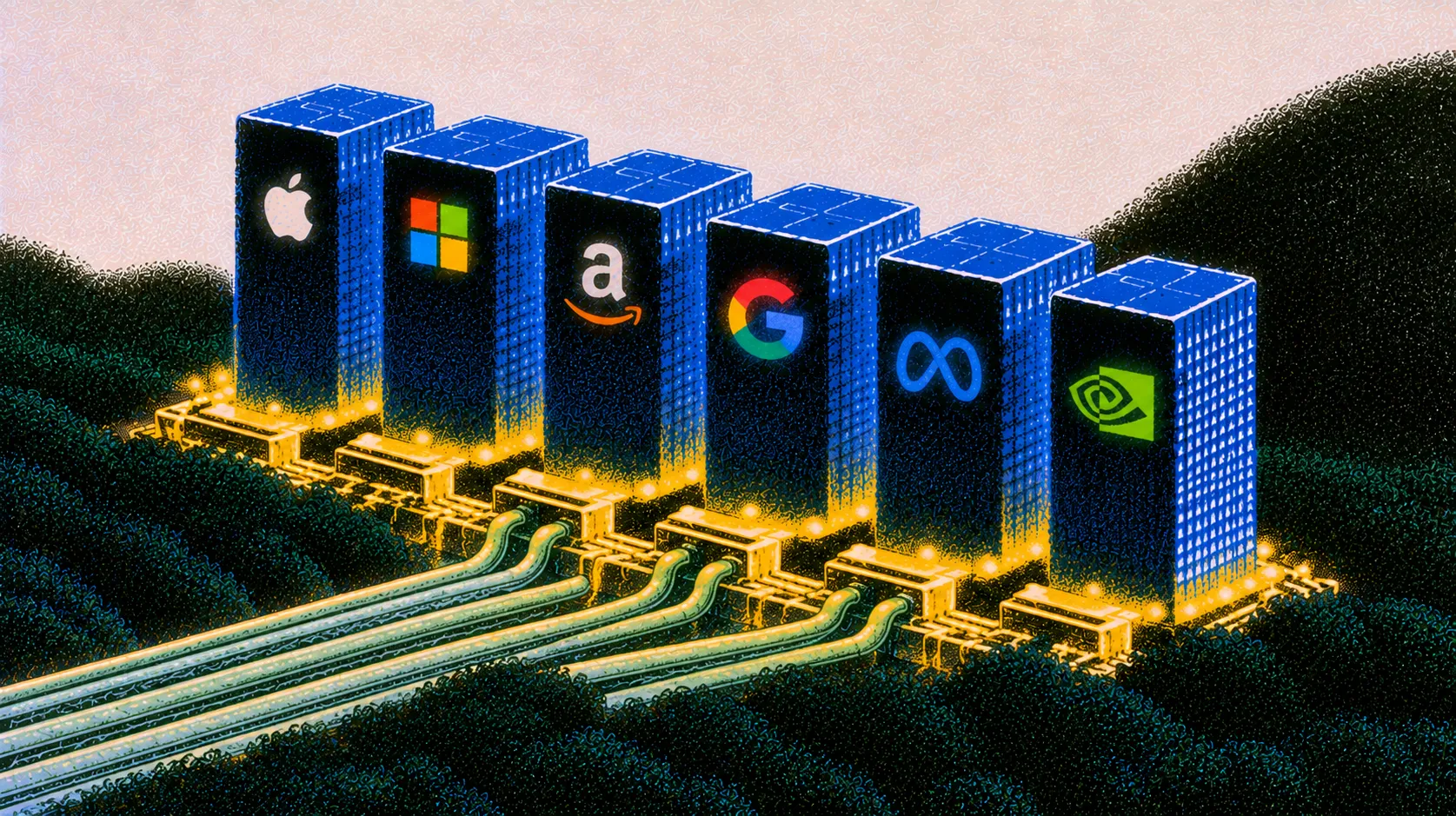
Big Tech spent most of 2026 as the stock market's problem child, lagging while the rest of the index climbed. Heavy AI spending squeezed cash flow and investors punished the stocks for it. Now two of Wall Street's largest banks say the punishment has gone far enough.
The premium has nearly vanished
The Magnificent Seven's valuation premium over the other 493 stocks in the S&P 500 sits at just 10%, the lowest in over a decade, per Morgan Stanley Wealth Management's Global Investment Committee. The group once commanded a premium above 30%.
Its collective price-to-earnings multiple has compressed to 23.9 from 32.6 in late October. That ratio measures how much you pay for each dollar of profit.
JPMorgan's equity strategy team puts the forward multiple relative to the broad market near one standard deviation below its historical median, a 10-year low.
"We think these mega-cap cloud giants now look simply too cheap."
Lisa Shalett, Morgan Stanley Wealth Management
What the spending did to cash
The de-rating has a real cause. Combined capital expenditures from Microsoft, Alphabet, Amazon, and Meta are projected to reach ~$725B in 2026, up from around $410B in 2025.
Bank of America's Michael Hartnett pegs hyperscaler capex at roughly $670B next year, equal to 96% of their cash flow. In 2023 that figure was 40%.
By the second quarter of 2026, aggregate capex began exceeding operating cash flow and pushed free cash flow into negative territory, according to Raymond James' investment planning group. Amazon still raised its 2026 capex forecast to $220B, citing AWS demand.
Earnings still separate the group
JPMorgan models the Magnificent Seven growing earnings 20% in 2026 against 11% for the rest of the index. That nine-point gap is why the bank isn't walking away.
Morgan Stanley frames the advantage more aggressively, crediting the seven with roughly a 45% annual earnings growth edge. Nvidia trades at a forward P/E of 18.7 times against a historical average of 36.9.
Bank of America Securities analyst Vivek Arya called the 18-times forward multiple a seven-year low and an excellent buying opportunity.
JPMorgan's Mislav Matejka doubts reports of an AI slowdown amount to much, describing the race as existential and winner-takes-all. He also wants investors back in semiconductors over software. Forward earnings estimates for chip companies have risen 30% since June while software saw almost none.
Money is already moving back
The rotation has started. The Roundhill Magnificent Seven ETF is up less than 9% in 2026 and trails the index, but gained close to 3.5% over the past month while the S&P 500 struggled to stay positive.
Momentum trades are going the other way. The iShares MSCI USA Momentum Factor ETF is up over 26% year to date but down 7.7% quarter to date, its worst quarter since the second quarter of 2022. Roughly $5B has been pulled over the past month.
Quality-factor funds offer a softer route into the same names. The JPMorgan U.S. Quality Factor ETF is up ~18% this year at a 0.12% expense ratio, with all eight top holdings in tech. The iShares MSCI USA Quality Factor ETF charges 0.15% and holds Microsoft, Apple, Nvidia, and Meta as its top four.
If you want cash generation instead, the VictoryShares Free Cash Flow ETF is an $11B fund that took in over $900M in net inflows last month at a 0.39% net expense ratio.
The seven stocks account for roughly one-third of the S&P 500's total market value, so index investors already own this trade. Neuberger Berman's Charles Kantor argues the payoff takes time, noting investors loved buybacks but not reinvestment.
Whether the discount closes depends on whether the market starts rewarding AI spending plans instead of punishing them.

