
Johnson & Johnson and Medtronic Are Coming for the King of Surgical Robots
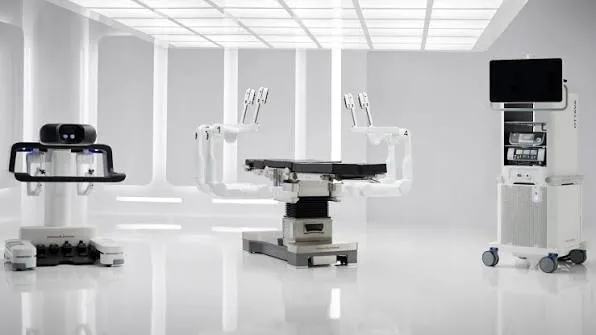
The operating room has been Intuitive Surgical's territory for more than two decades. Now two of healthcare's biggest names are coming for a piece of it.
Johnson & Johnson announced Thursday that Houston's Memorial Hermann-Texas Medical Center will become the first hospital to install its OTTAVA surgical robot, just two days after Medtronic secured another FDA clearance for its rival Hugo system. The 26-year reign of one dominant player is finally facing a serious challenge.
The competition gets FDA approval
Johnson & Johnson's first commercial OTTAVA installation follows FDA De Novo authorization in July, allowing the system to perform general surgeries including gallbladder removal, gastric bypass, and hernia repair.
Medtronic got its own boost Tuesday when regulators expanded Hugo's clearance to general surgery, opening access to procedures representing roughly 3.5M US operations annually.
Until then, Hugo's US authorization had been limited to urology procedures such as prostate removal, following its initial clearance in December. Medtronic says Hugo's global procedure volume is growing at more than twice the pace of the broader robotic surgery market, with cumulative procedures expected to surpass 50K by its fiscal year-end.
For hospitals considering a new surgical robot, the choice is getting considerably wider.
The numbers behind the surgical robot race
Key reported figures, 2026
| Figure | What it measures | As of |
|---|---|---|
| 12,094 | da Vinci systems installed worldwide | Sept 30, 2026 |
| 14% | Intuitive worldwide da Vinci procedure growth | Q3 2026 |
| $1.80B | Intuitive instruments and accessories revenue | Q3 2026 |
| 3.5M | US procedures per year covered by Hugo's new clearance | Nov 17, 2026 |
| 50,000 | Hugo global procedures on track by Medtronic fiscal year end | Nov 17, 2026 |
Source: Intuitive Surgical, Medtronic, Mugglehead
Intuitive has a formidable head start
Intuitive Surgical introduced its da Vinci system in 2000 and has dominated soft tissue robotic surgery ever since. Its installed base reached 12,256 systems, dwarfing the commercial presence of its newest competitors.
The company had 11,710 systems installed by June before placing another 546 in the third quarter. Quarterly revenue climbed 22% to $3.05B, while surgical procedure volume increased roughly 15%.
That lead won't disappear because of one hospital installation or an expanded FDA clearance. Surgeons are trained on da Vinci, hospitals have invested in its equipment, and switching platforms introduces costs and disruption. But healthcare systems planning their next purchase now have credible alternatives.
Stryker wants in, too
Stryker joined the race in October, agreeing to invest roughly $400M in Britain's CMR Surgical, maker of the Versius soft tissue robot.
The agreement gives Stryker preferred equity, exclusive US sales rights, and an option to acquire CMR outright. The orthopedic robotics specialist previously bought Mako for $1.7B and had installed more than 3K systems by the end of 2025.
Soft tissue surgery presents different economics. Without an orthopedic implant sold alongside each procedure, recurring revenue depends heavily on instruments and surgical volume. Winning hospital contracts is only the beginning.
CMR had raised approximately $1.34B across nine disclosed funding rounds before Stryker's investment, after reportedly seeking as much as $4B in an unsuccessful 2025 sale.
Hospitals have more than price to consider
Each challenger is approaching the operating room's space and capacity constraints differently. Johnson & Johnson integrated OTTAVA's four robotic arms into a standard-sized surgical table, while Medtronic designed Hugo with modular arms that hospitals can deploy as needed.
Hugo also supports Medtronic's LigaSure vessel-sealing technology, already used in more than 45M open and laparoscopic procedures.
Johnson & Johnson is taking a measured approach, initially offering OTTAVA to select early-access customers while gathering additional clinical evidence. MedTech worldwide chairman Tim Schmid called the Houston installation a significant commercialization milestone.
For investors, the contest won't be settled by the first machine delivered. Intuitive has spent decades building relationships, training surgeons, and collecting recurring instrument revenue. Its rivals must now prove hospitals can justify changing a system that already works.
Intuitive still owns the operating room. For the first time in years, it may have to defend the lease.

