FinksDaily
🏚️ Zillow’s moat cracks
Good morning. Finks who? Still us, The Average Joe. Just under a new name. We started the newsletter with a mission to simplify investing, but there’s only so much we can do in your inbox.
So we built a financial assistant (opens in a new tab) to help you invest and manage your money. Today, we’re opening it up to beta after testing with thousands of alpha users. Try giving Finks a task (opens in a new tab) and see what it can do:
- Reason through any financial decision: Get hyper-personalized answers by connecting your portfolio, building a watchlist, and setting up your profile.
- Discover new investments: Just tell Finks what you’re looking for — like "Find me undervalued robotics supply chain stocks."
- Stay ahead of the market: Get personalized insights and alerts on important events, major moves, and earnings you actually care about.
The roadmap is long and we’re shipping fast, so keep an eye out for what’s next — including our mobile app, crypto data, and more advanced tools.
Sector Spotlight

Investors Prioritize Dividends and Buybacks Over Tech Momentum
Investors are done paying for tomorrow’s promises. As AI doubts grow and bond yields climb, the market is shifting toward companies that put cash in shareholders’ pockets today. That shift is pushing cash returns ahead of the growth trades that dominated earlier this year.
Show me the money: The cash return factor (opens in a new tab) measures how much of a company’s net income goes back to shareholders through dividends and buybacks. It has gained 14.2% this year, leading the 16 factors tracked by 22V Research. The AI-linked momentum and price factor has fallen nearly 7% in recent weeks. 22V Research president Dennis Debusschere says investors are putting more value on dependable payouts as confidence in future AI profits weakens.
- The 10-year Treasury yield has climbed to 4.64%, putting more pressure on tech stocks whose valuations depend heavily on future earnings.
- Financial stocks have driven most of the cash return gains, with 65% of names in the sector carrying cash return yields above 10-year Treasury yields.
Caveats in the Boom
The record pace of corporate repurchases deserves some caution. Buyback announcements neared $1T (opens in a new tab) in the first half of 2026, while completed repurchases also ran at a record pace. But Research Affiliates founder Rob Arnott notes that buybacks have historically been negatively correlated with future returns. University of Michigan finance professor Nejat Seyhun is also “mildly pessimistic,” expecting only a “muted response” to the surge in buybacks.
- Tech accounted for 45% of 2026 buyback announcements and financials another 23%, giving the two sectors 68% of total activity.
- Abbott Laboratories, S&P Global, and 3M stand out for pairing buybacks with net insider buying, a combination historically linked to stronger returns.
Portfolio moves: For broader exposure to the cash return theme, dividend ETFs offer a simple route. Schwab US Dividend Equity ETF yields 3.13% (opens in a new tab) and requires 10 straight years of dividends for inclusion, while Vanguard High Dividend Yield ETF yields 2.24% and targets higher-yielding stocks. For more targeted bank exposure, the Invesco KBW Bank ETF tracks an index of companies primarily engaged in US banking, while the Cambria Shareholder Yield ETF leans heavily toward financial stocks and companies returning cash to shareholders.
Large-Cap Recap
Dollar Chains Split as Shoppers Cut Back
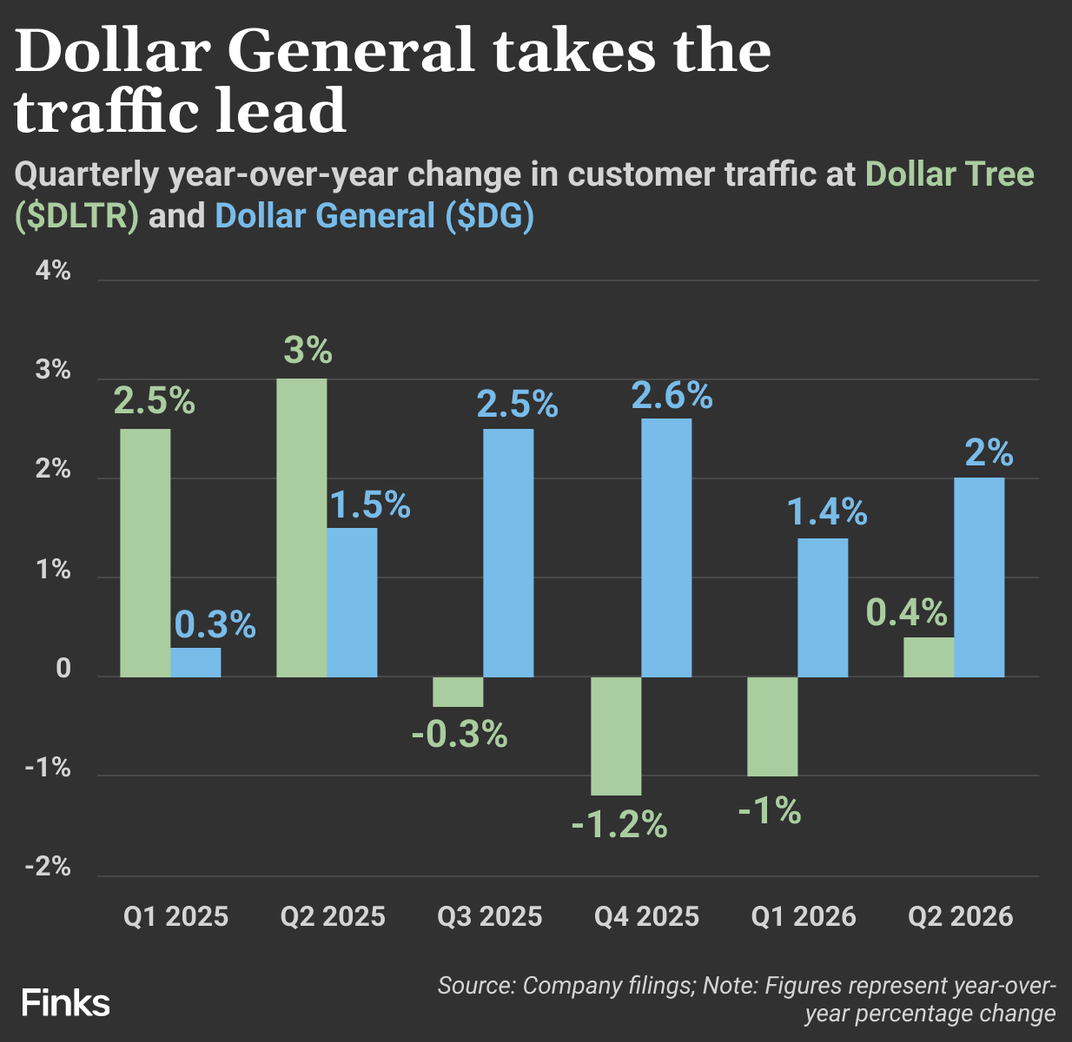
Dollar retail is splitting as consumers pull back on discretionary purchases and prioritize cheaper necessities. Dollar General came out ahead this quarter, with same-store sales rising 3.5% and customer traffic up 2%. Its focus on consumables also drew more middle- and high-income shoppers looking for value. Dollar Tree had a tougher quarter, with weak traffic leaving larger transaction sizes to drive growth. Its disappointing earnings outlook sent shares down double digits, widening the gap between the two chains. [Read (opens in a new tab)]
Copper Surges As Trade Policy And AI Demand Collide
Copper prices recently hit a record $6.70 per pound as tariff-driven stockpiling and booming AI data center demand tighten the market. Traders are rushing metal into US warehouses to preempt proposed tariffs, effectively draining global inventories and tightening supply. Additionally, data centers now provide price-inelastic demand that is overriding traditional manufacturing trends. Major miners like Freeport-McMoRan and BHP Group are benefiting from this structural shift toward copper as a critical hard-money hedge. [Read (opens in a new tab)]
Zillow Struggles To Hold Its Competitive Moat
Zillow is coming under pressure as its grip on housing listings weakens on two fronts. Regulators recently forced the company to end a deal that paid Redfin to leave the rental advertising market, where listing costs had risen 14.5%. Simultaneously, Compass is pushing more homes through private listings, limiting Zillow’s access to inventory and weakening its data advantage. Together, the threats are challenging the foundation of Zillow’s dominant housing platform. [Read (opens in a new tab)]
Market Pulse
Salesforce, Inc.
CRMThe software giant’s shares rose as earnings beat expectations and an expanded Anthropic partnership fueled optimism around its AI strategy.
Hormel Foods Corporation
HRLThe packaged foods maker’s shares fell as quarterly revenue missed estimates and weaker sales volumes led it to cut its full-year sales outlook.
Okta, Inc.
OKTAThe cybersecurity company’s shares surged as earnings beat expectations and stronger demand for AI-related security tools helped drive an upgraded outlook.
Markets & Economy
US weighs broader semiconductor tariffs: The Trump administration is considering new duties on chips, servers, laptops and gaming hardware. The proposal aims to push more semiconductor manufacturing into the US, though details remain preliminary. [Read (opens in a new tab)]
US jobless claims fall as trade gap widens: Initial unemployment claims dropped to 203K, pointing to a stable labor market despite softer hiring. The goods trade deficit hit a 16-month high as exports fell and AI-related imports surged. [Read (opens in a new tab)]
Canada targets key US states with retaliatory tariffs: Canada will impose duties of up to 50% on $20B of American goods, including steel, dairy and seafood. The measures are designed to pressure trade-dependent states ahead of the midterm elections. [Read (opens in a new tab)]
Business & Tech
Tech stocks rally on Nvidia’s AI outlook: Nvidia beat Q2 estimates and issued strong growth guidance, lifting chipmakers and software names. The rally came even as memory shortages, sticky inflation and Fed tightening risks kept the broader backdrop uncertain. [Read (opens in a new tab)]
Kalshi expands weather markets with new data partnership: Kalshi will use verified weather observations to settle contracts as trading volume in the category surges. The partnership also brings its real-time probabilities to The Weather Company’s consumer platforms. [Read (opens in a new tab)]
Best Buy raises outlook after strong Q2: Best Buy lifted its full-year sales forecast after comparable sales rose 4.1%, led by continued computing strength. Appliances remain weak, while tariff refunds and higher chip costs complicate the profit picture. [Read (opens in a new tab)]
Chart
Digit of the Day
Hormuz Crude Flows Climb To Nearly 8M Barrels Despite Ongoing Attacks
Iran keeps striking tankers in the Strait of Hormuz, and Gulf producers keep shipping anyway. Crude flows through the chokepoint have climbed to ~8M (opens in a new tab) barrels a day, still roughly half prewar levels, as producers across the region ramp up loadings despite the risk. For investors bracing for higher inflation, that’s one less reason to worry.
- Satellite imagery showed Saudi Arabia’s highest tanker count in several weeks — a sign the Middle Eastern energy powerhouse is pushing more crude onto the water.
- Meanwhile, Qatar and Kuwait have clawed back to 70% of pre-conflict export levels — deploying shuttles to reach tankers avoiding the Strait’s risk entirely.
The diplomatic dividend: As exports recover, Iran and Oman are advancing talks — with coordinated mine-clearing laying groundwork for a “permanent navigation corridor.” That easing of tension is already showing up in oil prices, with Brent on pace for its biggest weekly drop (opens in a new tab) since late June. The relief spread to equities too, as Tuesday’s stock gains (opens in a new tab) and falling yields reflect cooling inflation fears. Investors are now watching whether that goodwill can survive contact with the broader US-Iran war talks.
Post Credits