
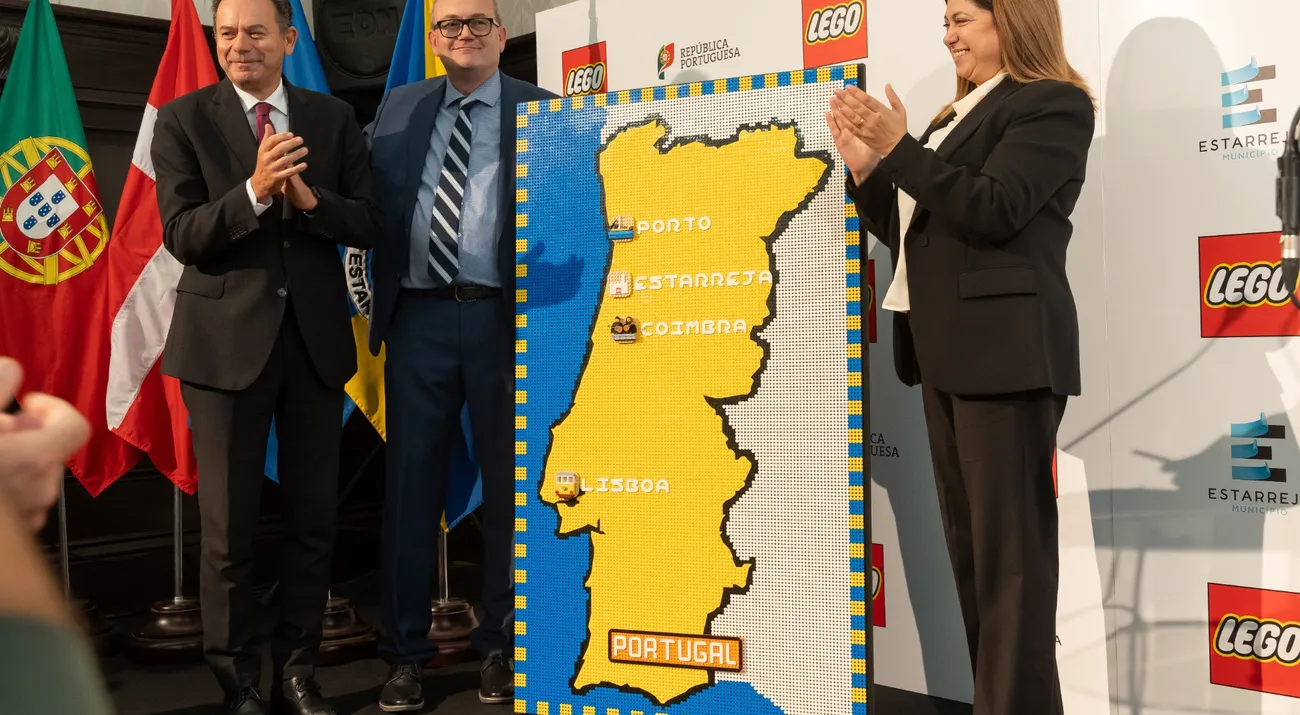
Lego will invest roughly $1.1B (€1B) in a new factory in Estarreja, Portugal, the family-owned Danish toymaker said Monday.
The 115K square-metre plant will handle moulding, processing, packing, and a high-bay warehouse, and employ more than 1K people once fully operational.
Construction starts in the first half of 2027, with production projected to begin in 2030.
It'll be Lego's fourth factory in Europe and eighth worldwide, sitting on a 60-hectare site roughly the size of 120 football pitches.
Lego says the site will be its most automated, with connected systems designed to speed up how fast it can launch new sets.
Adult collectors are powering the demand
Lego's consumer sales rose 22% in the first half of 2026, while revenue climbed 21% and operating profit rose 22%.
Across the half, 330 new sets arrived, including a replica of the official FIFA World Cup trophy, Pokemon kits using new interactive bricks, and a Formula 1 tie-up, fueled the growth spurt.
Grown-ups are doing much of the buying. US toy dollar sales grew 20% year over year from January through September, with sales to adults 18 and older up 25%, the industry's largest source of growth, per Circana data.
Adult-only households made up 55% of US toy sales through June, and Lego now sells sets labeled 18 and older, some running to thousands of pieces.
Adult Buyers And Lego Growth Are Both Running At Double Digits
Year over year change, %, first half 2026 and Jan to Sep 2026
Bar chart. Growth (%). Lego Hungary factory capacity increase (2025): Growth (%) 30%. US toy sales for adults 18+ YoY: Growth (%) 25%. Lego H1 2026 consumer sales growth: Growth (%) 22%. Lego H1 2026 operating profit growth: Growth (%) 22%. Lego H1 2026 revenue growth: Growth (%) 21%. US toy dollar sales growth Jan-Sep 2026: Growth (%) 20%.
Source: Euronews, EMARKETER/Circana
That strategy has helped Lego outpace rivals Mattel and Hasbro, with double-digit growth over the past two years.
Building closer to the customer
Estarreja is the latest in a run of capacity additions aimed at shortening supply chains.
Lego opened a factory in Vietnam in April 2025, lifted capacity at its Hungarian plant by 30% the same year, and expects to open a factory and regional distribution centre in Virginia in 2027.
It expanded its China site and announced plans in September to add capacity at its Monterrey plant in Mexico.
Chief Operations Officer Carsten Rasmussen told Reuters the bricks from Estarreja will feed developing markets in Africa, Southeast Europe, and the Middle East, though the main driver is closer to home.
The Portugal plant will be slightly smaller than the Virginia facility but produce more per square metre, Rasmussen said.
Lego aims to source 100% renewable energy for the site's annual needs, with roughly 80% expected from on-site solar panels and battery storage, targeting LEED Platinum certification.
Portuguese Prime Minister Luís Montenegro attended the launch and said the government would move to free up the land and speed construction.
For a company with around 34K employees worldwide, Estarreja is a bet that adults will keep buying bricks well into the 2030s.