
AMC's Recovery Is Picking Up Speed. The Hunger Games Could Give It Another Boost
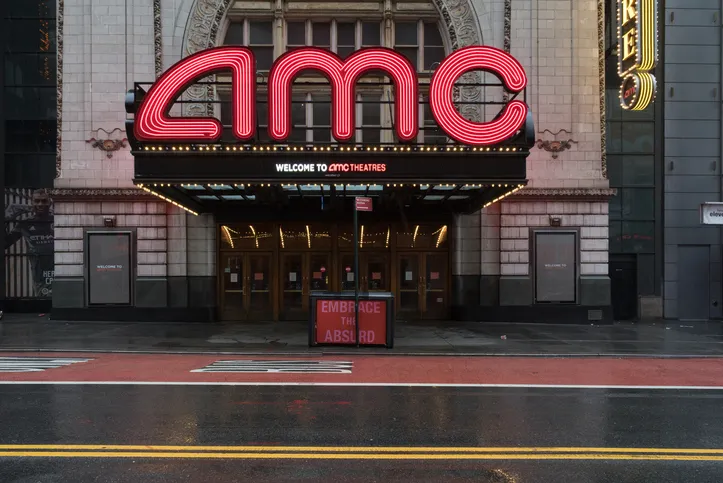
AMC Entertainment has another blockbuster on its hands. Lionsgate's Hunger Games prequel Sunrise on the Reaping opened to an estimated $120M in North America and $225M worldwide, giving Hollywood its first $100M domestic opening since July.
For the country's largest theater chain, the timing couldn't be better after a record quarter that finally put cash back in its pocket.
Ticket sales are paying off
AMC reported record third-quarter revenue of $1.71B, up 31.6%, with adjusted EBITDA reaching $348M. It also swung to a $109.3M profit from a $298.2M loss a year earlier.
Admissions revenue rose 33.3% to $953.9M, while concessions brought in $589.4M, up 30.5%. Merchandise and other theater revenue added another $168.2M.
Admissions Still Carry More Than Half of AMC Revenue
AMC revenue by segment, Q3 2026, $M
Pie chart. Admissions: Revenue Share 55.70. Food and beverage: Revenue Share 34.40. Other: Revenue Share 9.90.
Source: Barron's
AMC's push into premium screens is helping it make more from each blockbuster. CEO Adam Aron credited the company's growing premium large-format footprint for the results, while Imax and other premium formats accounted for 44.5% of the latest Hunger Games opening.
Business outside the US was particularly strong. International revenue jumped 40% to $412M, beating analysts' $388.4M estimate across a global network of roughly 840 theaters and 9.5K screens.
Cash flow turns positive
The biggest surprise came from AMC's balance sheet. The company generated $109M in free cash flow during a quarter that typically drains cash, marking its first positive third quarter since 2011. Roth analyst Eric Handler hadn't expected that milestone for another two years.
If ticket sales continue to improve, Handler believes AMC could avoid further borrowing and free up an additional $25M to $30M in 2027 and 2028 for better seating, theater renovations, and premium formats. Paying down debt or building cash reserves are other options.
Aron believes the company has finally put its pandemic-era struggles behind it.
"Today, we can finally say that AMC has recovered."
Adam Aron, AMC Entertainment
Debt remains the catch
AMC still has roughly $4B in borrowings, despite recently completing a $3.97B refinancing that pushed repayment deadlines further out. Investors also have to contend with continued share dilution and an ongoing class-action lawsuit over ticket fees.
Most of AMC Debt Now Comes Due in 2031
Debt maturities after recent refinancing, $B
Bar chart. Debt Amount ($B). 2030: Debt ($B) $0.1. 2031: Debt ($B) $2.8. 2033: Debt ($B) $1.1.
Source: Barron's
Even with the return to positive free cash flow, one good quarter won't make much difference to that debt load. AMC needs box office growth to continue for several years before it can meaningfully reduce what it owes.
That's far from certain. Streaming competition, shorter theatrical windows, and production disruptions remain challenges, while movie releases tend to produce uneven results. A blockbuster can fill theaters for weeks without guaranteeing a strong following quarter.
Can AMC keep it going?
AMC's operations are improving. Aron credited loyalty programs, premium screens, and cost controls for the stronger results, while October's domestic box office was roughly 35% higher than a year earlier.
Hollywood's 2026 box office has also been encouraging, with domestic ticket sales reaching $8.97B through Nov. 22. Still, the latest weekend's overall total fell short of the same period last year, showing how much results depend on the release calendar.
For investors, the concern isn't whether AMC can attract moviegoers anymore. It's whether enough of those ticket sales can turn into cash before its debt comes due in 2031.
AMC's recovery may finally be showing up in the numbers, but its balance sheet still has a long way to go.