
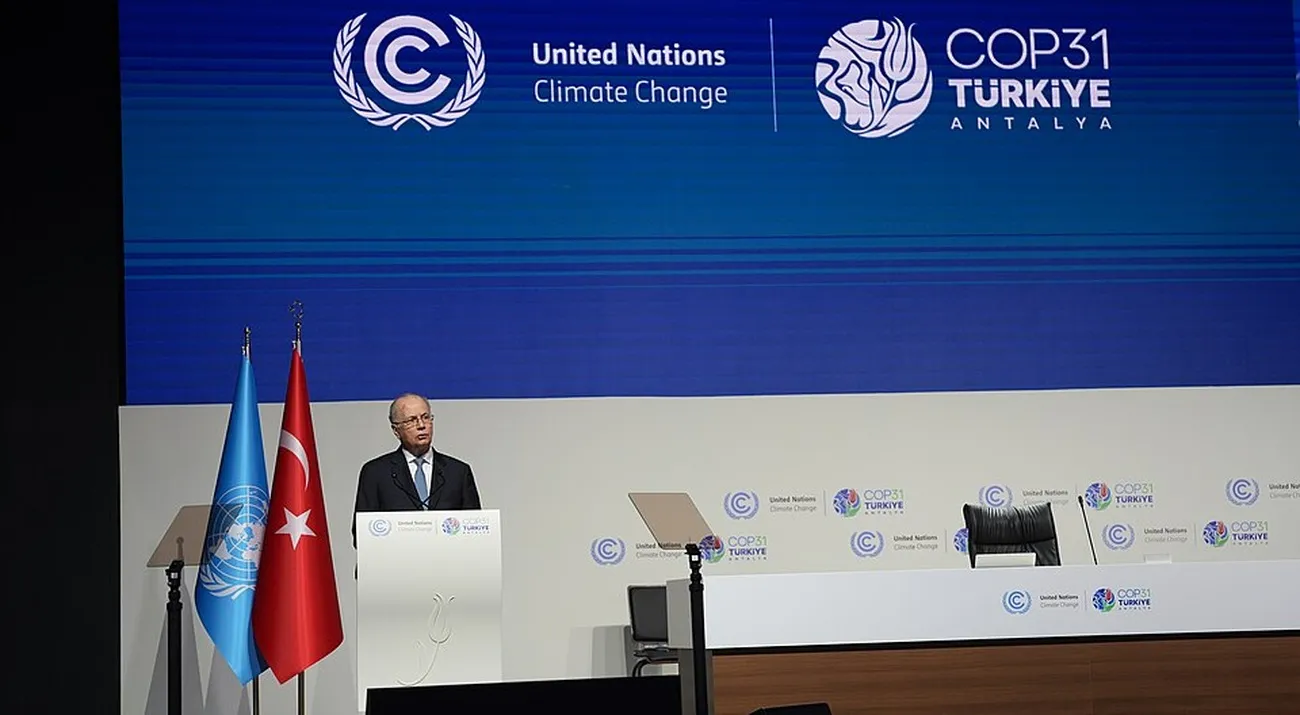
The COP31 climate summit in Antalya, Turkey, blew past its Friday 6pm deadline without a deal, with nearly 200 countries deadlocked and talks pushed into Saturday.
The sticking point is the second draft of the summit's cover decision, which dropped all references to fossil fuels and a $120B annual adaptation finance target that developing countries had pushed for.
A bloc from Europe, Africa, Latin America, and the Pacific, led by France and Panama, is challenging the text.
Panama's environment minister Juan Carlos Navarro has vowed to formally object if fossil fuel language stays out.
That threat carries weight because decisions are adopted by consensus, so a single formal objection can block an agreement outright.
The COP31 Goal Would Lift Electricity to 35% of Global Energy Use
Share of electricity in total global energy consumption, roughly 21% today and the 35% target for 2035, in percent
Bar chart. Share of global energy consumption (%). Today: Electricity share of global energy (%) 21%. 2035 target: Electricity share of global energy (%) 35%.
Source: Associated Press, COP31 summit coverage, Nov. 20, 2026
What replaced the fossil fuel language
In place of a phase-out, the draft puts forward an electrification goal, raising the share of electricity in total global energy consumption from ~21% today to 35% by 2035.
The text doesn't require that electricity to come from renewables, leaving room for gas and coal plants to count toward the target.
Some countries want the text to call for clean electrification, making renewables the explicit source.
Co-hosts Turkey and Australia are taking the criticism for removing fossil fuels from the draft. Turkey's environment minister Murat Kurum argued the electrification push already implies a transition away from them.
The resistance comes from Saudi Arabia and other major oil producers, who have fought hard against efforts to put phase-out language back on the table.
"It is not acceptable to have a COP or a cover document that does not even mention fossil fuels."
Juan Carlos Navarro, Environment Minister of Panama
Why energy investors should care
COP texts are voluntary and non-binding, but they shape the policy signals that national governments, lenders, and utilities follow for years.
A text without a fossil fuel phase-out keeps the long-run demand picture for oil and gas largely intact, and an electrification goal with no renewables requirement can even support new gas-fired generation.
The opposite outcome, explicit phase-out language plus a hard finance number, would tighten the timeline that oil and gas producers plan capital spending against.
The US, the world's largest economy and a major emitter, did not participate directly this year, which weakens the case of poorer nations asking rich countries for money.
The host country has done well regardless. Turkey says it has agreed deals and plans worth more than $26B since the conference opened on Nov. 9, including a preliminary $15B renewable energy deal with China and $5.1B in financing agreements with development banks.
The draft still keeps a call to at least triple adaptation finance by 2035, just without a dollar figure attached.
Negotiators expect a final draft Saturday, and next year's summit lands in Addis Ababa in November 2027.

