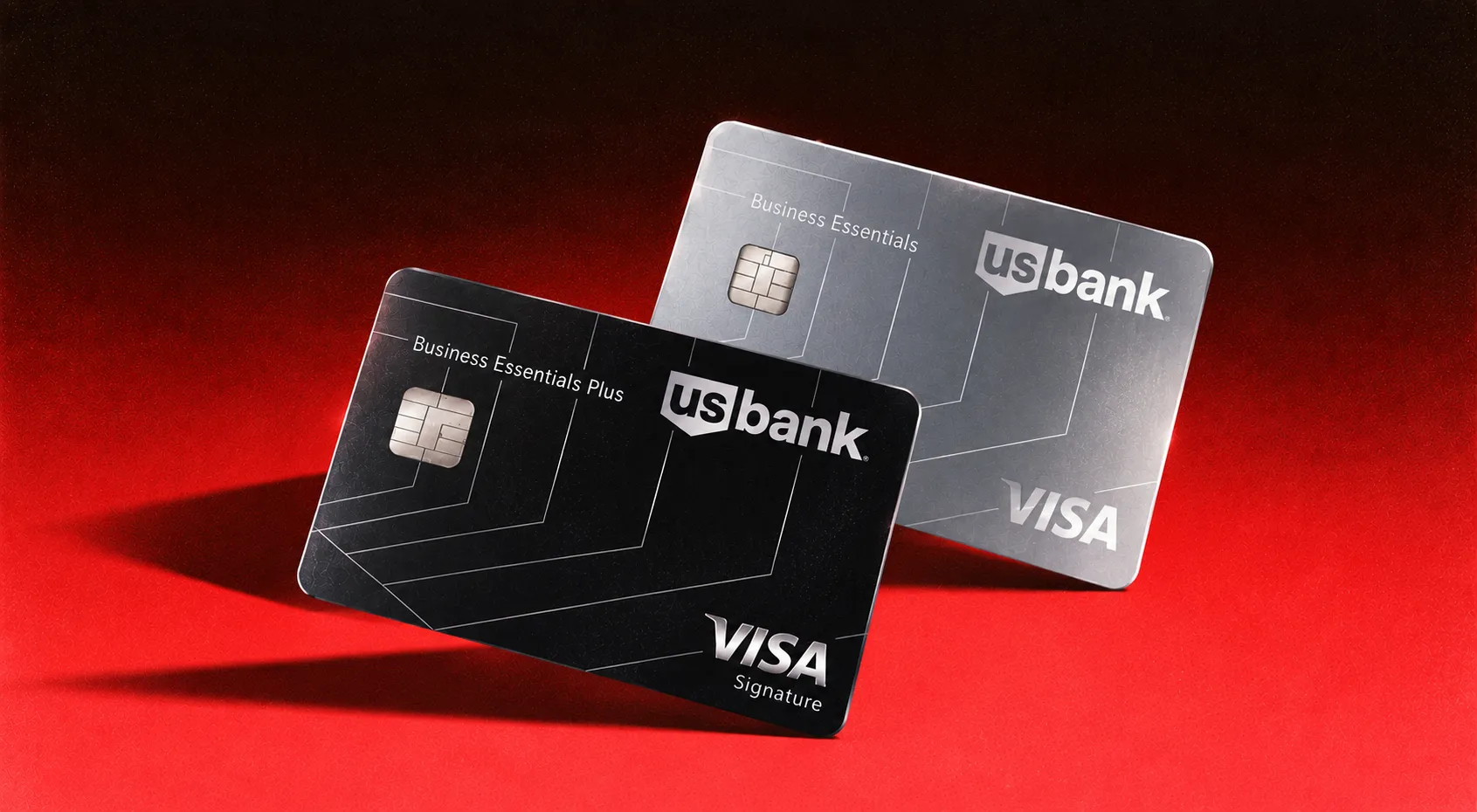
Business credit cards are getting more generous. U.S. Bancorp rolled out two new options on Sept. 28 that pay unlimited 2% cash back on eligible purchases, putting them above the 1.5% base rate still offered by some competing cards.
One comes with no annual fee, while the other costs $295 and offers more for businesses willing to pay for it.
What each card pays
The Business Essentials Visa Card earns 2% cash back with no annual fee. Businesses can push that rate to 2.5% by keeping qualifying balances in an eligible U.S. Bank business checking account.
The Business Essentials Plus Visa Signature Card also starts at 2%, but comes with a $295 annual fee. With qualifying checking balances, the card can earn 3.5% total cash back.
Businesses with more concentrated spending have another way to earn. The Plus card automatically pays 5% on the top spending category, covering up to $200K of purchases there each year.
How the welcome offers compare
New Business Essentials cardholders can earn $500 after spending $5K within the first 150 days. The card also offers 0% intro APR on purchases for the first 12 billing cycles.
The Plus card comes with a $1K bonus after $15K of spending within the same 150-day window. Both cards come with U.S. Bank’s Spend Management platform, with Jessica Alba serving as the face of the new lineup.
Where the flat rate stands out
Bank of America's Business Advantage Unlimited Cash Rewards Mastercard offers a useful comparison. The card earns 1.5% cash back on all purchases with no annual fee.
Its $500 bonus also requires $5K in purchases, although cardholders have 90 days to hit the target instead of the 150 days U.S. Bank allows.
Bank of America Preferred Rewards for Business members can earn up to 2.62% on all purchases, which still beats the 2.5% ceiling on U.S. Bank's no-fee card. Both higher rates depend on customers maintaining qualifying balances with the bank.
That gives both banks another reason to tie card rewards to deposits. Businesses get a higher cash-back rate, while the bank gets a stronger shot at keeping their checking balances too.
The $295 Plus card has a higher hurdle because the extra rewards need to justify the annual fee. Businesses that spend heavily in one category have the most room to benefit from its automatic 5% rate.
Small businesses are also putting much more spending on cards than they used to. Average monthly card spending doubled since 2020 to $23K in 2024, according to National Bureau of Economic Research data cited by eMarketer.
Access to credit remains a problem for some owners, with nearly 40% of small businesses saying they cannot get the working capital they need through cards, according to an NSBA survey. For those businesses, the 0% intro APR on the no-fee card could matter more than squeezing out another half-point of cash back.
The no-fee card is the easier comparison for businesses that mainly want a higher flat rate. Its 2.5% rate requires the checking relationship, but businesses still have a 2% base rate without paying an annual fee.
Square has refreshed its own credit card program as well, showing U.S. Bank isn't alone in going after more small-business card spending.

