

FinksDaily
Sponsored by RYSE
🤖 Nvidia flies solo
Good morning. The job market may be taking the holidays off, but your inbox shouldn't. White-collar hiring typically slows in November and December, making this the perfect time to get ahead of the January rush. And with 70% of jobs found through networking (opens in a new tab), a well-timed cold email could do more than another hour spent refreshing LinkedIn. The trick? Skip the corporate flattery, ditch the dreaded “pick your brain,” and make your ask worth answering. After all, the best way around a hiring freeze might be a warm introduction.

Sponsored by RYSE
As Electricity Bills Climb, Smart Windows Could Be the Next Big Home Upgrade
Your electricity bill keeps climbing, and your windows could be making it worse. Average US residential electricity prices rose from 16.5¢ per kilowatt-hour in 2024 to 17.2¢ in 2025, with the EIA forecasting (opens in a new tab) 18.2¢ this year. As power gets more expensive, finding ways to use less of it is becoming a business opportunity.
The AI bill comes home: Data centers are drawing more electricity from the same grid that serves American households, while utilities spend billions expanding capacity. Those costs can make their way onto monthly bills, turning power prices into a midterm election issue (opens in a new tab). AI isn't the only factor driving rates higher, but the added demand comes when families are already paying more for electricity.
- Electricity prices rose 6.7% (opens in a new tab) from December 2024 to December 2025, outpacing overall inflation and putting additional pressure on household budgets.
- The EIA's November outlook (opens in a new tab) puts residential rates roughly 10% above 2024 levels this year, with another increase to 18.7¢ per kilowatt-hour expected in 2027.
The Window of Opportunity
Higher power bills are giving homeowners more reason to rethink how they manage energy use. Smart thermostats have already shown how small upgrades can help control heating and cooling costs, and windows are another place to look. Nearly 80% of US homes (opens in a new tab) have inefficient single- or double-pane windows, yet only 2% replace them annually because of the cost. That leaves a sizable market for products that improve efficiency without an expensive renovation.
- Generac bought ecobee (opens in a new tab) in 2021 for up to $770M, while 3G Capital took control of Hunter Douglas (opens in a new tab) in 2022 at a $7.1B enterprise value.
- DOE research found (opens in a new tab) window attachments can cut heating and cooling energy use by 15% compared with vinyl blinds, while cellular shades can reduce heating energy use by up to 20%.
The trick is getting blinds to move when they should, without homeowners having to think about it. That's where automation comes in.
The Company Automating the Window
RYSE (opens in a new tab) makes a small robot that motorizes the blinds and shades already hanging in a home, allowing them to run on a schedule controlled from a phone. It installs in minutes and sells online at Amazon, Best Buy, The Home Depot, and Lowe's.
The company reports $20M+ in lifetime revenue, roughly 70% annual growth, more than 100K devices sold, and 10 granted patents. More than 4.5K investors have put $15M+ into RYSE (opens in a new tab), which has reserved the Nasdaq ticker.
RYSE's current round is open at $2.60 per share, with a $143.6M pre-money valuation and a $1K minimum investment.
The $2.60 share price is set to change this month.
Large-Cap Recap
Corporate America’s Week From Tech Hell Ends With a Cyberattack
Technology spent the week falling apart before hackers joined the fun. Microsoft 365 outages threatened $300M–$500M in insured losses, an Arkansas router failure grounded US flights, and banking apps at Bank of America and JPMorgan went down. But the week’s troubles took a darker turn when researchers discovered malicious code in Optimizely, potentially exposing 178 organizations, including Salesforce, HSBC, and Equifax, to data theft. Some failures were accidental, others deliberate. Either way, the only system working overtime is corporate America's expense account [Read (opens in a new tab)]
Nike Sets a Multi-Year Course to Revive Its Sneaker Empire
Nike built its empire on speed, but its comeback is turning into a marathon. The sneaker giant expects sales to keep falling in fiscal 2027, with growth not returning until fiscal 2029 as it tries to shake off a yearslong slump. Management is betting on a return to performance sports, backed by $2.5B in annual cost savings and plans to pay shareholders $12B in dividends through fiscal 2031. For investors hoping Nike would hit the ground running, the turnaround is looking more like an endurance test. [Read (opens in a new tab)]
Nvidia Posts Blowout Quarter as Washington Scrutiny Grows
Jensen Huang may be gone, but Nvidia hasn't forgotten how to beat Wall Street. The chipmaker reported $115.8B in quarterly revenue and announced a $150B buyback for good measure. The results arrive as Washington tightens chip export rules, the SEC probes Nvidia's disclosures, and interim CEO Colette Kress considers scaling back financing for AI cloud customers. Big Tech's spending plans remain largely intact, but smaller operators face a different reality as Nvidia rethinks its financial support. The AI arms race isn't slowing down, but Nvidia may stop paying for everyone else's ammunition. [Read (opens in a new tab)]
Market Pulse
SELLAS Life Sciences Group, Inc.
The cancer-vaccine developer's shares surged after its experimental vaccine extended survival in a late-stage leukemia trial.
Aecom
The infrastructure consultant's shares climbed after record backlog and a 2027 outlook above Street forecasts backed its earnings beat.
Salesforce, Inc.
The business-software giant's shares tumbled as investors sold seat-priced software names to make room for Anthropic's record IPO.
Markets & Economy
US factory output holds steady in October: Manufacturing production rose 0.3% despite a broader industrial dip driven by slumping utilities and mining. Autos and tech equipment led the gains, though capacity utilization remained below its long-run average. [Read (opens in a new tab)]
US retail sales cool to 0.2% in October: Shoppers barely increased spending last month as price pressures and stretched budgets weighed on discretionary categories. Furniture and home furnishings stores saw business fall 2.3%, while online retailers bucked the trend. [Read (opens in a new tab)]
Political ad spending shatters midterm records: Campaigns and PACs poured $12B into the cycle, marking the first time midterm spending surpassed a presidential year. Broadcast television claimed nearly half the spoils while cable and radio lost ground. [Read (opens in a new tab)]
Business & Tech
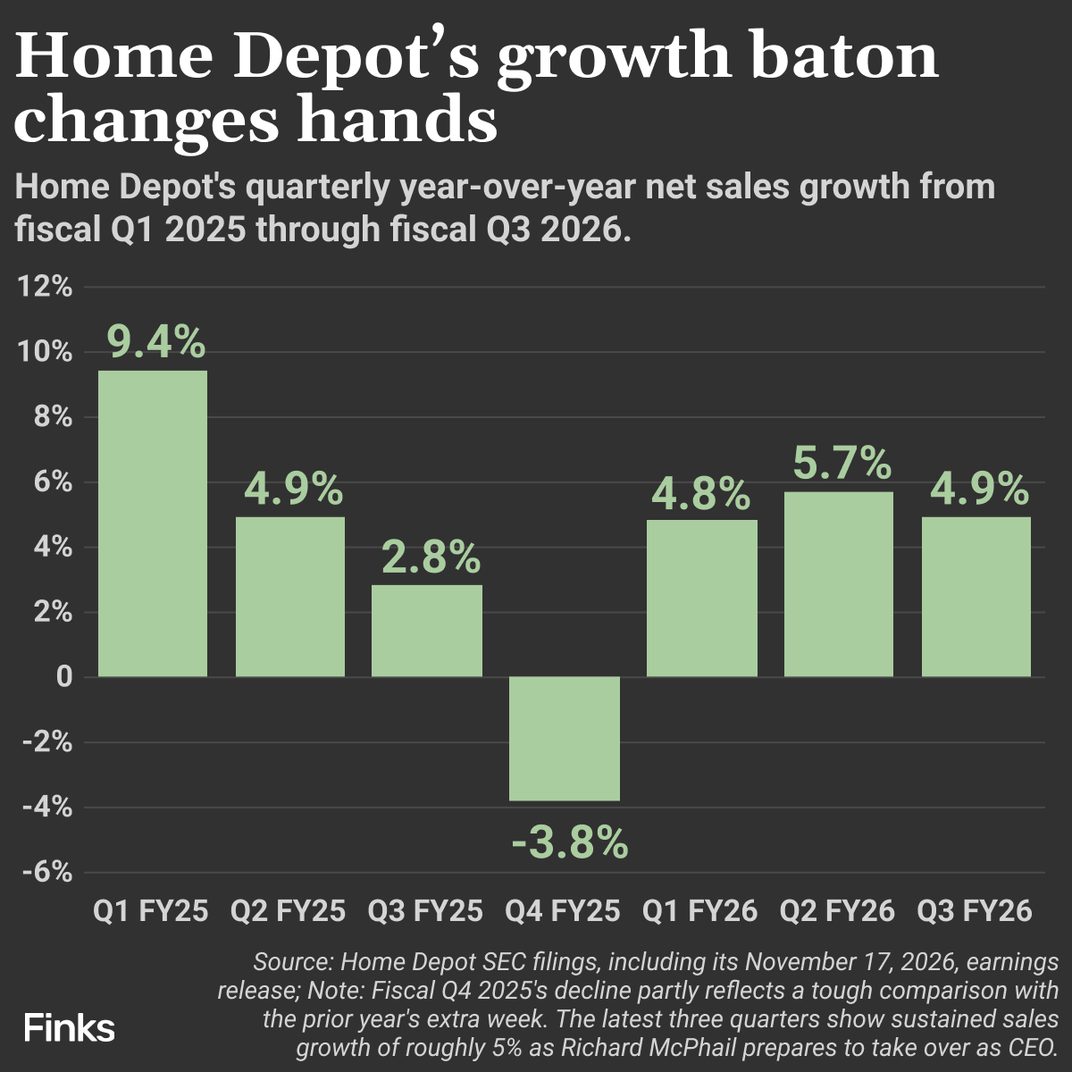
Home Depot promotes finance chief to CEO: Home Depot named Richard McPhail as its next chief executive as Ted Decker transitions to board chair. The leadership shuffle landed alongside quarterly results that beat Wall Street expectations despite a sluggish housing market. [Read (opens in a new tab)]
Kalshi enters stock trading to challenge Robinhood: Prediction market Kalshi plans to launch individual stock and ETF trading within two months, setting up a direct clash with Robinhood Markets. The expansion follows its acquisition of broker-dealer FB Securities. [Read (opens in a new tab)]
JetBlue faces steep financial pressure from FAA ground stop: JetBlue Airways faces up to $73M in profit hits from a recent FAA ground stop, compounding $8.4B in existing debt. The carrier canceled nearly a third of its schedule during the four-day disruption. [Read (opens in a new tab)]
Chart
Digit of the Day
Disney Targets $3B in Savings to Fund More Original Programming
Disney is trimming the payroll to keep the cameras rolling. The entertainment giant beat Wall Street's fourth-quarter estimates (opens in a new tab), finding $3B in annual savings by cutting corporate overhead. Its parks and streaming businesses helped keep revenue flowing, giving management more breathing room to invest in new shows, movies, and live sports.
- Disney raised its annual dividend 33% to $2 per share, with payments scheduled for January and July 2027.
- Global theme park attendance climbed 11%, led by Walt Disney World and Disneyland Paris during the fourth quarter.
Funding the next act: CFO Hugh Johnston expects Disney's content budget to grow as sports rights get pricier and the company invests in more foreign-language shows. The savings should help cover those costs without putting additional pressure on margins, while shareholders also get a higher dividend. Ironically, Mickey's next big production may be a corporate disappearing act.
Strategize
New US Chip Rules Close China's Cloud Loophole. Who's Exposed?
China found a workaround for US chip restrictions by renting American AI computing power through overseas data centers. Now, new Commerce Department rules require licenses for chip shipments to facilities that could serve restricted buyers.
Why it matters: Malaysia, Singapore, Indonesia, Thailand, and Brazil face tighter scrutiny, with existing operators given 90 days to comply. Nvidia and overseas data center operators could face delayed orders, raising questions about how much AI demand is at risk.
Finks can help you find which chip stocks face the most exposure and which are better insulated.
Try it for free: Find chip stocks with less China exposure (opens in a new tab)
Post Credits