
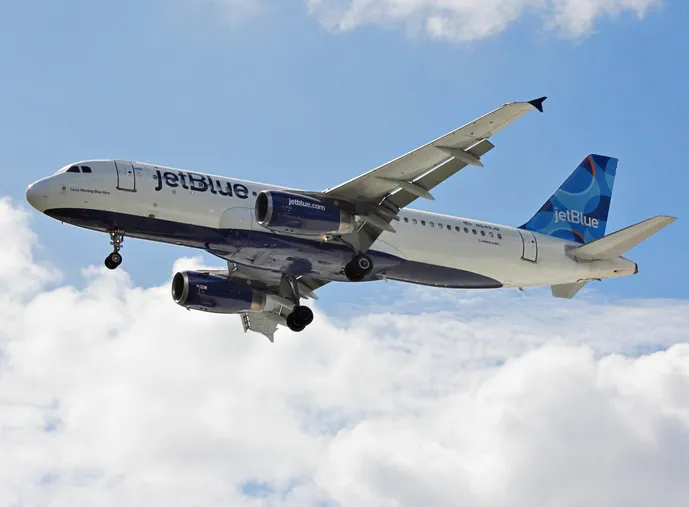
JetBlue Airways is looking at a $28M to $73M profit hit from a four-day FAA ground stop, on top of $8.4B in debt.
The carrier canceled or failed to operate 1.1K flights from Friday through Monday morning, nearly 33% of its schedule, among the hardest hit operationally of the major US carriers. American Airlines Group scrubbed 5.9K flights, about 23% of its schedule, and nearly 19.4K flights across the industry, about 18% of what was scheduled, were canceled or never operated, according to Cirium data.
The grounding threatens to cost airlines more than $1B, and Raymond James estimates American's hit at $136M to $354M. For a carrier that last posted an annual profit in 2019, the smaller figure is the harder one to absorb.
JetBlue Cut a Third of Its Schedule in the FAA Ground Stop
Flights canceled or not operated, Nov. 13 through Nov. 16, 2026
Bar chart. Flights canceled. Industry Total: Flights canceled 19K. American Airlines: Flights canceled 5,888. JetBlue: Flights canceled 1,119.
Context
- JetBlue's 1.1K cancellations were about 33% of its schedule.
- American's 5.9K cancellations were about 23% of its schedule.
- The industry total of 19.4K cancellations covered about 18% of scheduled US flights.
Source: Cancellation data: Cirium, Reporting: The Seattle Times
Why New York feels an FAA stop first
JetBlue is the New York airline, with its home hub at John F. Kennedy International Airport. A schedule built around one metro area loses a bigger slice of itself when the system stops. The air traffic control system's weak points have their own history.
The airline ended the third quarter with $2.2B in liquidity and an unencumbered asset base of $7B, including $2.8B in aircraft and engines, against total debt of $8.4B as of Sept. 30.
Its most recent quarterly net loss widened to about $257M from $143M a year earlier, driven by higher fuel costs.
Bondholders hired restructuring advisors in late October, and a majority of lenders have since signed a cooperation agreement.
Chief Executive Joanna Geraghty has said the airline has no intention and no plans to file for bankruptcy and is not engaged with any restructuring company.
Spirit is the warning label
Spirit Airlines filed for Chapter 11 in November 2024, emerged the following March, and filed again on Aug. 28, 2025 after losses kept mounting.
In the quarter ending June 2025 it lost about $246M, and operating expenses reached $1.2B, or 118% of quarterly revenue. Spirit's cash squeeze has a longer record.
The carrier stopped flying on May 2, 2026, after a White House rescue deal fell through, canceling every flight.
Spirit ranked seventh among passenger airlines in North America and was the biggest ultra low-cost operator on the continent.
Mid-sized airlines sit in the middle, without the balance sheet of the big three or the cost discipline of the deep discounters.
Frontier Group Holdings shows the other path: record revenue of about $1.4B last quarter, up more than 50% year over year, and revenue per available seat mile up 30%. Its first-class rollout has its own playbook.
JetBlue's answer is premium seating. BlueFirst, its domestic first class, starts flying next month with 12 seats on its Airbus A320 fleet, and retrofits run through 2027.
Management targets an operating profit next year and $1 in adjusted EPS by 2028.
Getting there means absorbing a ground stop that clipped a third of its schedule while $8.4B of debt sits on the books.

