
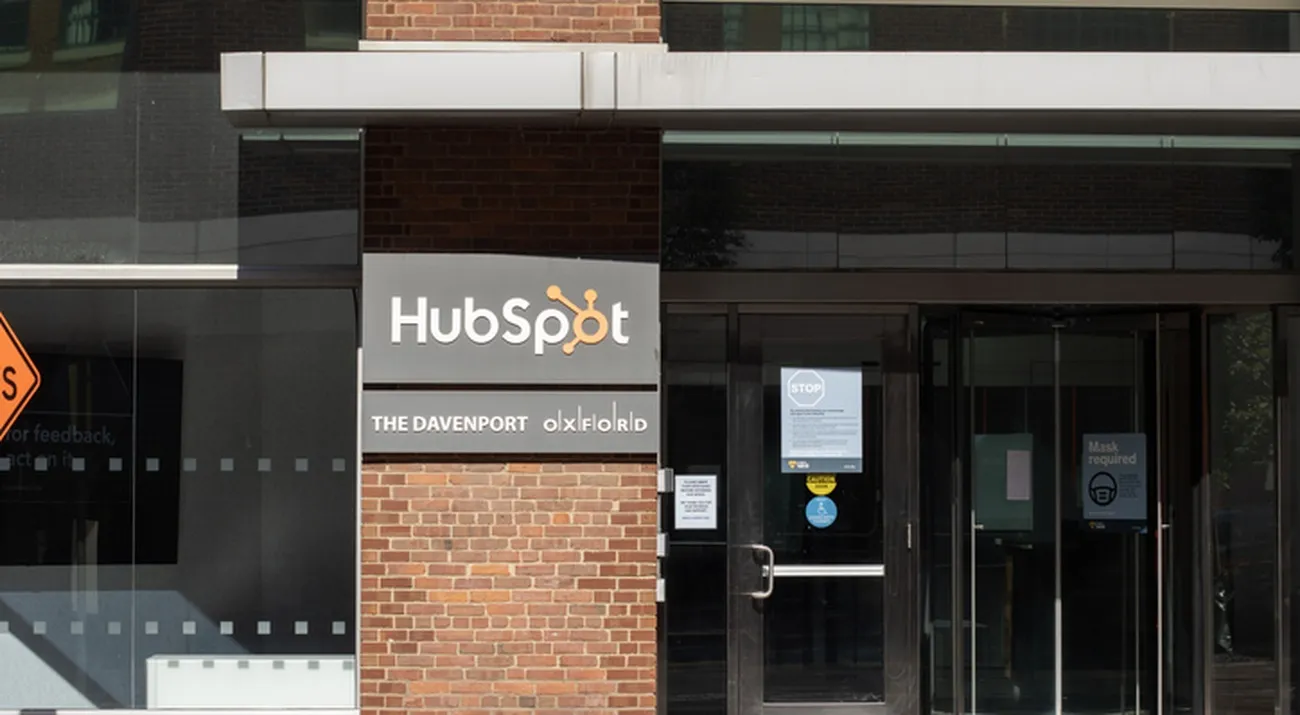
HubSpot sells customer relationship management software, a shared database where marketing and sales teams track every lead and deal. It mostly serves small and midsize businesses. Co-founder Brian Halligan returned as chief executive on Nov. 12, five years after stepping down, and he's calling it a refounding: a plan to rebuild the company around AI before AI-native tools disrupt it further.
Where the money comes from
Subscriptions do the work. HubSpot grew from $1.3B in revenue in 2021 to an expected $3.7B in 2026, and from 135K customers to more than 311K under outgoing CEO Yamini Rangan. HubSpot's growth playbook has its own history.
The stickiness is the data. Once a small business runs its contacts, email, deals, and reporting inside one system, moving means rebuilding its entire commercial workflow.
That lock-in is holding. Churn has held steady, Bueker said, while net revenue retention, which also counts upgrades, slipped to 101%. That means existing customers are spending only about 1% more than a year ago, but they are not switching away. The company said trials of its AI products rose 64% quarter over quarter and monthly credit consumption is up about 2.5 times since the start of the year.
What could break the thesis
AI-native rivals can rebuild a CRM without legacy baggage, and HubSpot's own customers now treat software as something to audit before they buy. Rangan told the third-quarter call that they want proof before they buy. The pressure on traditional CRM giants has its own history.
The slowdown shows up in sign-ups. HubSpot added 5.3K net customers in the third quarter, down from 7K in the second, and CFO Kate Bueker expects fewer than 5K in the fourth.
Revenue rose 17.1% to $947.6M in the third quarter, with growth expected to slow to about 12% in the fourth. Earnings per share landed at $3.81 against a $3.27 consensus.
HubSpot's Customer Base More Than Doubled
Customers, 2021 vs today: 135,000 to more than 311,000, per HubSpot
Line chart. Customers. 2021: Customers 135K. Today: Customers 311K.
Source: HubSpot
Part of the pressure comes from HubSpot's own pricing changes. HubSpot introduced free trials and outcome-based pricing in the second quarter, shifting two Breeze agents to pay-per-result terms, with the customer agent priced at $0.50 per resolved conversation.
Then came the cost side. A restructuring the board approved on Oct. 1 plans to cut nearly 660 roles, about 7% of staff, with $65M to $75M in charges landing mostly in the fourth quarter.
The finance seat turns over too. Bueker retires on Feb. 11, 2027, with Adobe's Karen Burgess, who ran finance for a $20B unit, arriving Nov. 30.
What to watch
The oddity here is a founder returning to rescue a company from AI agents while the company sells AI agents. HubSpot shipped Agent Hub in public beta in July and launched Breeze Assistant with a self-updating CRM in September.
His timing is part of the story. On Oct. 20, three weeks before he took the job, Halligan, then a board director, sold 8.5K shares for $2,036,345.
Halligan isn't treating a sale of the company as the exit. He told Bloomberg he doesn't want to see HubSpot swallowed up by a private equity firm, adding that he wants to rebuild and reimagine it.
Wall Street has already lost some patience. Most downgrades after the third quarter landed on neutral, with Cantor Fitzgerald's Matthew VanVliet going underweight and writing that HubSpot no longer deserves the benefit of the doubt. Wall Street's renewed bet on software stocks has its own history.
HubSpot reaffirmed fourth-quarter and full-year guidance on the day of the announcement, which limits how much of the reset is a near-term financial surprise.
The bet is that a founder who ran the company for 16 years, working again with co-founder Dharmesh Shah, can rebuild a product used by 311K customers faster than an AI-native startup can build a customer base that size. The operating test is whether the free trials convert into paying customers and whether the AI products can restore growth in existing-customer spending.