

FinksDaily
Sponsored by RYSE
💳 Swipe life
Good morning. The cheapest item in your Thanksgiving cart picked a terrible week to get ambitious. After a year of falling prices, eggs are climbing again. Wholesale prices rose 59% (opens in a new tab) in seven days, according to the USDA, with a retail dozen already costing about 81% more (opens in a new tab) than in 2019. Bird flu outbreaks in California, Illinois, and Oregon also wiped out more than 2M birds, squeezing supply further as stores restocked for pie and stuffing season. If the pumpkin pie comes out a little flat this year, blame the hens.
Top Idea
Huang Is Out, Anthropic Is Listing, and the AI Trade Faces Its Test
The companies that build artificial intelligence systems sell picks and shovels to everyone else, so their results read like a scan of the whole industry. Two of the biggest tests arrive within days of each other as Nvidia faces its first earnings report without Jensen Huang and Anthropic heads for the public market.
High stakes: Nvidia guided to third-quarter revenue of $108B, but the resignation of its co-founder leaves Chief Financial Officer Colette Kress to deliver the numbers without him. Wall Street consensus sat at $108.8B in revenue and $2.47 in earnings as the chipmaker navigated probes and leadership changes (opens in a new tab).
- Nvidia shares fell after three of its last four reports despite guiding to a gross margin of 74%.
- The FBI investigation into Huang adds fresh uncertainty just as the chipmaker enters its first post-founder era.
Suppliers Are Buying the IPO
Anthropic set the terms for its share sale, offering 825M shares at $70 to $78 each to raise up to $64.35B. Google, Nvidia, and other major suppliers are putting in a combined $26B through a private placement at the IPO price. The lab generated $33.24B in revenue for the nine months ended Sept. 30, but it also booked a $104B net loss over that same stretch.
- Anthropic's nine-month revenue surged roughly 1,200% from a year earlier, driven by surging enterprise adoption of its AI models.
- CoreWeave reported a revenue backlog of $132.5B, up from $104B in June, with Anthropic accounting for a significant share of those contracts.
Heavy baggage: Rising sales do not guarantee safety when losses run this deep. Cisco posted record quarterly revenue of $18.5B, yet its product gross margin slipped as infrastructure costs mounted. Nvidia and Anthropic will soon show whether the AI boom can sustain its massive spending without cracking under the weight of its own ambition.
Smart Home by the Numbers: A $355B Industry's Next Category Is the Window
The industry: The smart home market is projected to reach $355B by 2033. The first wave went to thermostats and doorbells: Google bought Nest for $3.2B in 2014, and Amazon bought Ring in 2018, a deal reported at over $1B. Window coverings are the category still being automated, with billions already installed.
Who's building it: RYSE (opens in a new tab) makes a robot that motorizes the blinds and shades already hanging in the window. It installs in minutes and sells online at Amazon, Best Buy, The Home Depot and Lowe's.
By the numbers:
- $20M+ in lifetime revenue
- ~70% annual growth
- 100,000+ devices sold
- 10 granted patents
- 4,500+ investors and $15M+ raised (opens in a new tab)
$2.60 per share at a $143.6M pre-money valuation, with a $1,001 minimum.
Large-Cap Recap
HubSpot Calls Its Founder Home to Fight AI
Software companies in trouble usually hire a turnaround specialist. HubSpot called its co-founder instead. Brian Halligan took back the top job on Nov. 12, half a decade after leaving it, vowing to rebuild the small-business sales software around AI. Sales climbed 17% to $947.6M last quarter, though growth should cool to about 12%, and roughly 7% of staff are being cut. Three weeks before stepping in, Halligan unloaded 8.5K of his shares for about $2M. The company now sells AI agents and hopes its founder can outrun them. [Read (opens in a new tab)]
Five Big Retailers Face Their Price Test This Week
Retailers live on the spread between their costs and what shoppers will hand over. This week that spread gets audited. Home Depot, Target, Lowe's, TJX and Walmart all report between Tuesday and Thursday, after wholesale prices rose 6.5% over a year, the hottest pace since Nov. 2022. Shoppers keep spending, with a $1.013T holiday season forecast by the National Retail Federation. Mastercard figures about half of holiday growth will come from higher prices, though. Watch the guidance, since the holidays fall next quarter. [Read (opens in a new tab)]
Growth Companies Start Writing Checks Like Utilities
Buybacks and dividends used to be the hobby of sleepy, mature companies. This November, the chip crowd joined in. Applied Materials handed shareholders $2.42B in one quarter, with its heaviest quarterly buyback in over eight years, on record revenue of $10.41B. EPAM Systems agreed to a $500M accelerated buyback, and Aflac raised its dividend for a 44th straight year. Plenty is still a promise, though, since declared dividends pay out into April and EPAM's deal settles next year. Until payday, a dividend is an IOU. [Read (opens in a new tab)]
Market Pulse
Modine Manufacturing Company
The cooling-equipment maker's shares surged after Bloomberg reported Samsung is in talks to acquire the data-center cooling specialist.
IonQ, Inc.
The quantum-computing company's shares tumbled as AI and quantum names sold off again under the Nvidia CEO probe overhang.
Newsmax, Inc.
The conservative broadcaster's shares climbed in their first full session after a third-quarter beat and two analyst upgrades.
140M+ US Homes. 5.6M Hotel Rooms. Every Window Is a Market.
RYSE (opens in a new tab) motorizes the blinds and shades already hanging in the window. It has sold 100,000+ devices and is growing ~70% a year. Shares are $2.60, and 4,500+ investors have put $15M+ into RYSE. (opens in a new tab)
Markets & Economy
Traders price in a December Fed hike: Futures markets put a December hike at 100%, with Dallas Fed President Lorie Logan pushing for rapid back-to-back quarter-point moves. [Read (opens in a new tab)]
Washington joins Japan's yen defense: The Treasury bought yen in July for the first time since 1998, and analysts say the modest ticket may leave traders willing to test weaker yen levels again. [Read (opens in a new tab)]
European gas surges on geopolitical risk: European wholesale gas logged a weekly gain as US-Iran talks collapsed, and storage at 71% no longer comforts traders fearing disrupted transit routes. [Read (opens in a new tab)]
Business & Tech
Singapore widens its AI-chip fraud case: Singapore prosecutors filed forty-one offenses against a corporate director in the widening AI-chip smuggling probe that spans several jurisdictions. [Read (opens in a new tab)]
China's next AI listing takes shape: Moonshot AI is unwinding its offshore holding structure ahead of a Hong Kong debut that could raise $5B, joining Zhipu and MiniMax on the region's exchanges, with DeepSeek bound for Shanghai's STAR market. [Read (opens in a new tab)]
A second cloud giant falls: Microsoft email and calendar systems went down for more than 12 hours, forcing government agencies and trading desks back to fax machines and paper records. [Read (opens in a new tab)]
Chart
Digit of the Day
Americans Put a Record $1.29T on Plastic as Inflation Stays Hot
Americans found a workaround for sticky prices, and it fits neatly in a wallet. Credit card balances climbed to a record $1.29T (opens in a new tab) last quarter, the New York Fed reported, as inflation stayed hot and markets priced in another Fed hike for December. Households are still swiping through the squeeze — on borrowed time and borrowed money.
- Borrowers added $22B in card debt over the quarter, lifting balances 4.2% on the year — and TransUnion pegged the average balance per consumer at $6.7K.
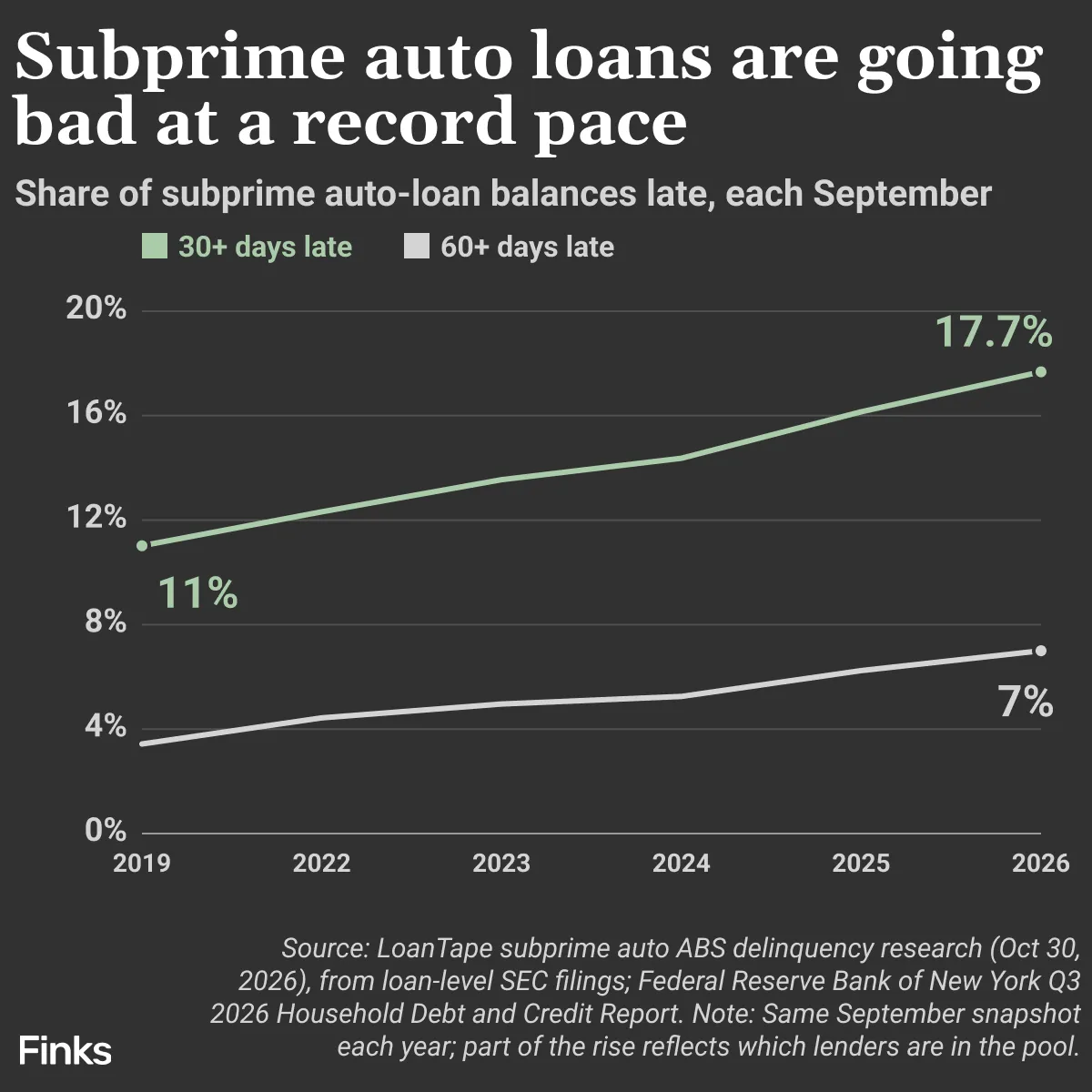
- However, the strain showed beyond cards — 5% of the $19.1T in overall household debt sat in some stage of delinquency, up 0.3 pts from Q2.
Who’s footing the bill: The pain lands hardest where wallets are thinnest. In the lowest-income neighborhoods, 10.3% of card balances went seriously delinquent over the past year, more than double the 4.4% rate in the wealthiest ones. Borrowers under 30 had the steepest rate of balances tipping 90 days past due. With the average card APR above 22% and new offers closer to 24%, anyone carrying a balance should target their highest-rate card first... or park it on a balance transfer deal (opens in a new tab).
Strategize
Berkshire Hathaway Hit a Record High. Should You Copy Its Moves?
Berkshire Hathaway closed at record highs four days in a row (opens in a new tab), up 19.1% since Oct. 1, while the S&P 500 slipped 1.2%. Investors appear to see it as a safe place to wait out the AI selloff. Later today, Berkshire is due to file its 13F (opens in a new tab), a report listing the stocks it owned on Sept. 30.
Why it matters: Many investors copy Berkshire's picks. But the list is already more than six weeks old when it appears, and Berkshire's buy price is not yours. Its last report (opens in a new tab) put Apple at 22% of its holdings, and Apple now trades at ~38x next year's expected earnings. A good buy for Berkshire can be a poor one for you.
Finks can help you look up Berkshire's biggest holdings and see what copying them would do to your portfolio.
Try it for free: How does copying Berkshire Hathaway's stock picks work, and what should I know before I try it? (opens in a new tab)
Post Credits