FinksDaily
🏎️ F1’s growth formula
Good morning. Once the source of countless childhood disappointments, the claw machine has quietly become one of retail’s hottest concepts. Modern clawcades are spreading across US malls (opens in a new tab), with roughly 300 to 400 locations offering everything from plush toys to Hermès bags. Operators now set machines to actually pay out, while players spend an average of $30 per visit. Near misses keep the dollars coming because almost winning doesn’t feel like losing. The house always wins, even at the claw machine.
Sector Spotlight

AI’s Search for Better Information Is Fueling a Data Licensing Rush
The world’s most valuable resource used to be oil — now it’s whatever’s sitting in your old email server. AI labs are racing to feed their models with real-world corporate data, and the appetite is insatiable. The result is a fast-emerging market where bankruptcies, bookshelves, and social media threads are all suddenly worth serious money.
Feeding the beast: The AI data licensing race (opens in a new tab) kicked into view when Google won a bankruptcy auction to buy Spirit Airlines’ software code, internal messages, and financial and operational data for $10M. The deal points to where AI companies are looking next for the massive volumes of human-generated information their models need to mimic real-world processes. With scraping the open internet becoming more legally fraught, corporate archives are emerging as the next frontier.
- Reddit brings in ~$60M annually from each of its OpenAI and Google licensing deals, with a larger Google agreement now in talks.
- John Wiley & Sons has generated over $110M in AI licensing revenue since 2024 through deals with leading AI developers.
Jumping In on the Data Hunt
It’s not just corporate email threads on the menu. Amazon is buying rare books at scale (opens in a new tab), scanning them, and destroying the originals in Las Vegas warehouses, joining Anthropic and Meta in the race for high-quality training data. Books published before 2022 are particularly valuable because they predate the explosion of AI-generated content. Training models on too much synthetic material can degrade their outputs over time, a phenomenon known as “model collapse.”
- Anthropic’s “Project Panama” was a secretive effort to mass-scan books for AI training data without drawing public attention.
- Micro1 committed over $20M to license operational data in 11 days, while Cloudflare acquired data marketplace Human Native.
Data meets privacy: A bankruptcy court delayed Google’s Spirit purchase (opens in a new tab) after former flight attendants argued that deidentifying records doesn’t fully protect sensitive payroll files, tax forms, and time cards. That privacy tension could become a major hurdle for this market. Consumer data often has explicit protections, while employee data can fall through the cracks. Companies eyeing the licensing payday may find the legal and reputational bill comes due first.
 (opens in a new tab)
Sponsored by Interactive Offers
The buyer wasn't a hedge fund. It was the government.
One stock tripled overnight. Another jumped 50% in hours. Both times, the buyer was the U.S. government.
Over the past year, the federal government has quietly partnered with, and taken direct stakes in, a growing list of companies. Nearly every time a deal went public, the stock surged. Not a small bump. A double. A triple. One deal made a federal agency a company's largest shareholder. Another sent a small-cap miner up over 200% before the open.
Our free report shows what's in the filings, not the headlines:
- All 24 companies named in the government's official partnership announcement
- Which are publicly traded now, and which are still private
- A bonus 5 where the government took direct ownership stakes
- How each stock reacted once the deal went public
- Direct source links for every claim
Just the official record, verified from the source.
Subscribe and reveal the government mission (opens in a new tab)
*Clicking the link above subscribes you to future messages from Equiscreen, LLC and instant access to two additional bonus subscriptions from our marketing partners. Unsubscribe anytime. *View Privacy Policy (opens in a new tab)
Large-Cap Recap
Formula One Finds New Gears for Revenue Growth
Formula One is transforming into a global commercial juggernaut by capturing high-margin opportunities in sponsorship and licensing. Analysts highlight that sponsorship revenue could reach $1.1B by 2027, while the licensing base has significant runway for expansion with partners like Mattel. Despite geopolitical risks causing recent race cancellations, demand continues to outstrip supply. Many on Wall Street view the current valuation gap as a potential opportunity for investors seeking non-AI growth. [Read (opens in a new tab)]
Crypto Stocks Roar Back On Regulatory Optimism
Crypto-linked stocks climbed after a surprising drop in long-term Treasury yields and a massive short squeeze ignited a sector-wide rally. Bitcoin surged above $72K, while Coinbase, Strategy, and Mara Holdings followed suit. The momentum was further fueled by President Trump pushing for the Clarity Act, which aims to clarify crypto regulations. Despite recent gains, the sector remains significantly down from 2025 peaks, making the upcoming Sept. 15 procedural vote on the bill a critical catalyst. [Read (opens in a new tab)]
Apple Emerges As Big Tech’s Defensive Haven
Apple has become the most stable performer among the Magnificent Seven, boasting the lowest correlation to broader market swings. While peers wrestle with the massive financial burden of AI infrastructure, the company’s restrained spending has shielded it from the extreme volatility impacting Nvidia and Microsoft. Analysts now see significant upside, citing potential shifts in AI strategy and the upcoming launch of a foldable iPhone as key catalysts for growth. [Read (opens in a new tab)]
Market Pulse
Deere & Company
The agricultural equipment maker’s shares rose after quarterly earnings and revenue beat forecasts.
Space Exploration Technologies Corp.
The space company’s shares fell as 319M early investor and employee shares became eligible for trading.
Markets & Economy
Treasury signals bigger buybacks to tame long-term yields: Scott Bessent said purchases could exceed $4B per issue after Treasury doubled its planned buybacks. The move aims to support bond markets as long-term yields remain elevated. [Read (opens in a new tab)]
Stripe deepens AI push with OpenRouter deal: Stripe is acquiring OpenRouter in a deal reportedly worth ~$7.5B, expanding beyond payments into AI infrastructure. The platform helps developers route requests across models while managing performance and token costs. [Read (opens in a new tab)]
Waymo builds custom chip for robotaxis: Alphabet’s Waymo developed an in-house chip to improve autonomous driving performance and reduce reliance on Nvidia. The move could lower costs while speeding sensor processing and AI decision-making. [Read (opens in a new tab)]
Business & Wealth
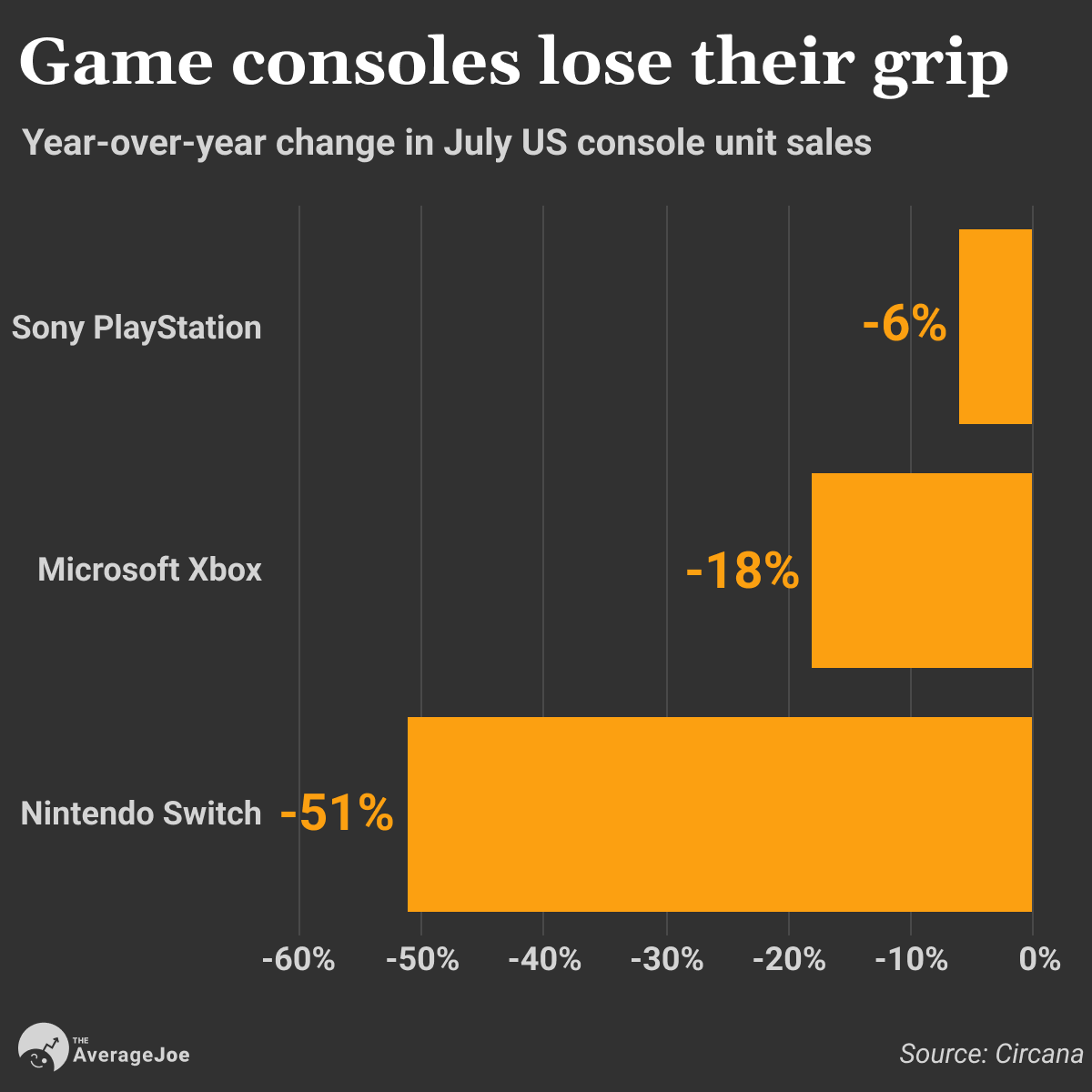
Nintendo hardware sales slump as US console market shrinks: The Nintendo Switch 2 saw its unit sales drop by more than 50% year-over-year in July. Industry hardware spending fell 29% to $282M, marking the sector’s worst month since the pandemic. [Read (opens in a new tab)]
Alibaba bets on AI infrastructure: Alibaba saw net profit plummet 76% this quarter as it funneled $10B into AI tech. While the company’s AI-related revenue is hitting triple-digit growth, analysts warn these aggressive investments could burn cash for another 3 years. [Read (opens in a new tab)]
Walmart flags softer consumer spending: Walmart posted its weakest US comparable sales growth in more than six years as fuel costs and pharmacy pressure weighed on shoppers. Its softer profit outlook adds to concerns about consumer momentum. [Read (opens in a new tab)]
Chart of the Day
Digit of the Day
National Debt Tops $40T As Borrowing Costs Climb
Imagine a debt so large it swallows your entire yearly income and still leaves a balance. That’s where the US stands now that the national debt topped $40T (opens in a new tab), a total bigger than the nation’s GDP. War spending, tax cuts, and tariff refunds have kept the borrowing binge alive, and bond investors are now demanding steeper compensation.
- The government is on track to borrow over $2T in FY2026 alone — with interest payments now consuming roughly half of that total.
- As spending outpaced revenue, cost-cutting efforts fell short too — DOGE set out to trim $1T from the budget but landed near $200B.
Cost of borrowing: As foreign demand retreats, the 30-year Treasury yield hit its highest level (opens in a new tab) in nearly two decades, raising the price tag on everything from mortgages to corporate debt. It’s an awkward backdrop for a White House whose approval has hit its lowest point yet, with only 29% (opens in a new tab) approving of its economic record. Treasury Secretary Scott Bessent hopes to roughly halve the deficit by 2028, but admitted last week it’s headed the wrong way. Its near-term fix, doubling debt buybacks, aims to keep borrowing costs in check. That’s Washington’s version of paying off one credit card with another.
Extra Joe