FinksDaily
Finks Daily
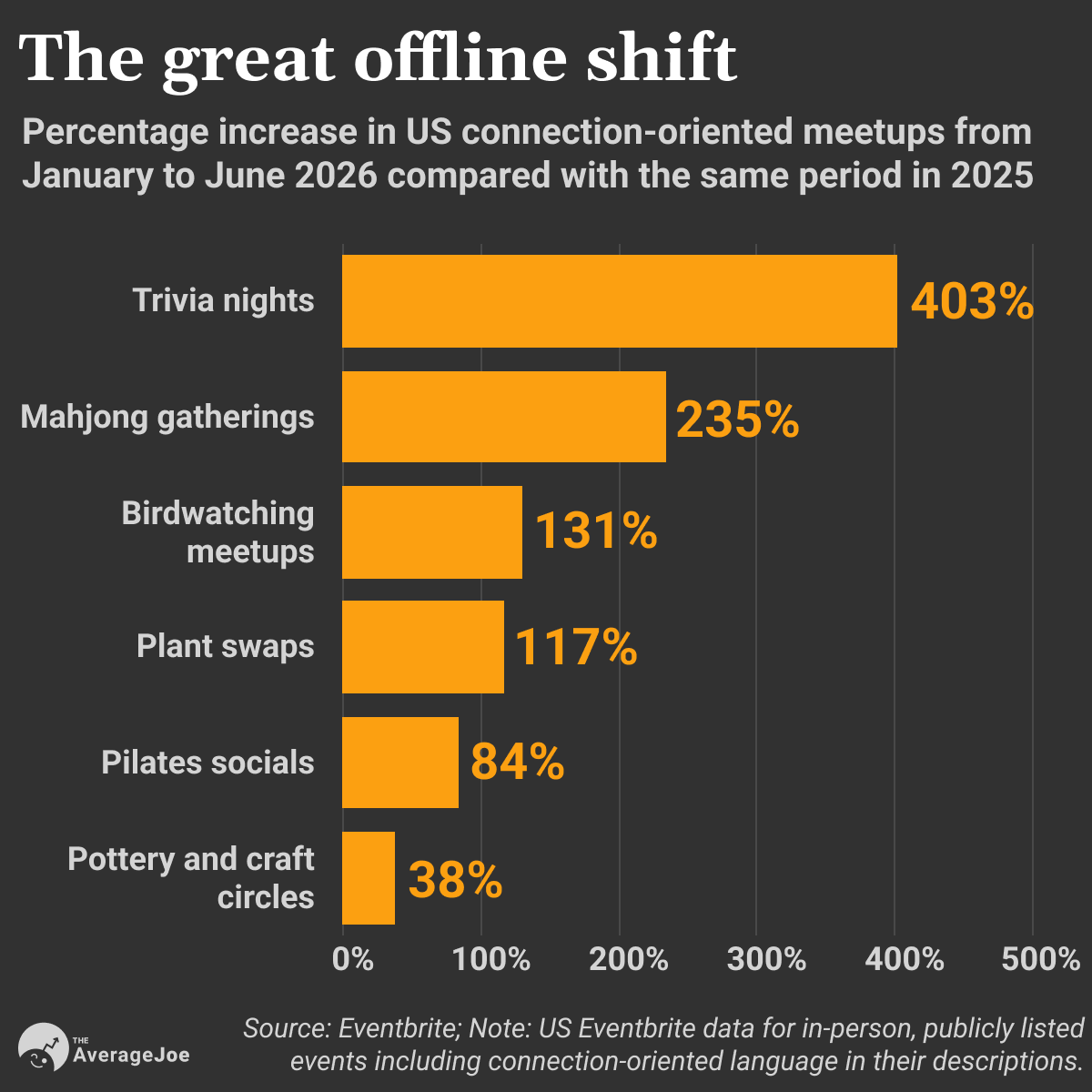
Good morning. Swiping right is out — showing up is in. Millennials and Gen Zers are flooding real-life meetups (opens in a new tab) built around birding, mahjong, and trivia nights, driven by a hunger for connection that screens simply can’t satisfy. Trivia night events alone surged 403% in the first half of 2026 versus the same period last year. People want more connection and less doomscrolling, and they're willing to leave the couch to get it. Touching grass is so back.
Sector Spotlight

America's Homebuilder Trade Is Heating Up. Here’s Where the Bargains Are Hiding
The housing market’s hottest trade is hiding in its bargain bin. Small-cap homebuilders trading near or below book value are dramatically outpacing their larger peers in 2026, even as sentiment across the sector remains deeply depressed. M&A is adding fuel to the rally, and one very famous conglomerate has quietly been loading up on the sector.
Cheap beats pricey: The top-performing builder stocks (opens in a new tab) this year have one thing in common: they’re small and inexpensive. Beazer Homes leads the pack, up ~64% after Dream Finders Homes offered to acquire it for $33.50 per share in cash. Hovnanian Enterprises, LGI Homes, and Century Communities have all posted double-digit gains, with each trading near or below book value.
- Larger builders have lagged, with PulteGroup, Toll Brothers, and D.R. Horton trading at much pricier 1.7x–1.9x book value multiples.
- The iShares US Home Construction ETF is up just 3.4% YTD, showing how broader housing headwinds are keeping the sector in check.
Housing's Deal Rush
Merger fever is a big part of the story. Japanese builder Sumitomo Forestry agreed to buy Tri Pointe Homes in February at a 29% premium, and Berkshire Hathaway completed a $6.8B acquisition (opens in a new tab) of Taylor Morrison in July. Berkshire also boosted its Lennar stake by nearly 30% in Q2 and opened a fresh position in D.R. Horton, signaling strong conviction in the sector from CEO Greg Abel.
- Homebuilder sentiment remains weak, with the Housing Market Index at just 35 in August and 63% (opens in a new tab) of builders still relying on sales incentives to attract buyers.
- Existing-home sales rose only 0.7% year over year in July, but the high end held up much better, with $1M-plus transactions jumping nearly 15%.
The value setup: UBS analyst John Lovallo sees plenty of upside in the back half if inventory, costs, and mortgage rates stabilize, with builders buying down rates today potentially best positioned when conditions improve. As he puts it, “This is an industry that people love to hate, and when rates are doing what they’re doing, it makes it easy to hate.” For now, the strongest opportunities appear to be among cheaper builders, a view increasingly backed by the wave of dealmaking across the sector.
Large-Cap Recap
Industrial Giants Capitalize on the AI Power Surge
US manufacturing is getting an unexpected boost from the AI data-center boom. Caterpillar, Cummins, and Eaton are ramping up production of the generators and power equipment needed to keep those facilities running, with Caterpillar’s generator business now its biggest profit driver. Demand is still climbing, but so is the risk of overbuilding as manufacturers expand capacity and states take a harder look at tax breaks and regulation. [Read (opens in a new tab)]
The Next Phase Of The AI Trade
AI infrastructure giants drove half of S&P 500 earnings growth last quarter, but investors are now looking for the next potential winners. Goldman Sachs analysts suggest the focus could shift to companies with high labor costs that are poised to capture AI-driven productivity gains. Names like CoStar Group, Dollar Tree, and Airbnb screen well for this transition. While infrastructure spending continues to scale, tangible earnings boosts from software adoption remain largely ahead of us. [Read (opens in a new tab)]
American Brands Challenge Europe’s Luxury Dominance
US luxury brands are gaining momentum as middle-class consumers shift away from traditional European houses. LVMH recently lost its long-held valuation premium to Ralph Lauren, as American names capitalize on more disciplined pricing strategies. While European giants hiked prices aggressively post-pandemic, US brands like Coach, under Tapestry, and Ralph Lauren have successfully captured price-sensitive shoppers. This divergence reflects a broader market shift where accessible luxury is currently outpacing high-end megabrands struggling with middle-class affordability. [Read (opens in a new tab)]
Market Pulse
Vista Energy, S.A.B. de C.V.
The Argentine shale producer’s shares rose after Peter Thiel’s hedge fund disclosed a $76M stake in the company.
Micron Technology, Inc.
The memory chipmaker’s shares climbed as booming AI infrastructure spending fueled demand for its high-bandwidth memory chips.
Markets & Economy
TV’s shift to streaming accelerates: Media executives expect cable subscriptions to keep declining as streaming bundles and personalization expand. Live sports, free ad-supported platforms and YouTube are expected to gain more influence. [Read (opens in a new tab)]
Goldman sees consumer spending losing steam: Goldman Sachs expects spending growth to slow as the boost from oversized tax refunds fades. Softer retail sales and stagnant real cash flow could pressure consumer-facing companies through the second half. [Read (opens in a new tab)]
Prescription drug prices post historic decline: US prescription prices fell 3.1% from a year ago, their steepest drop in more than six decades. Medicare negotiations, generic competition and cheaper GLP-1 drugs are helping drive the decline. [Read (opens in a new tab)]
Business & Wealth
Berkshire turns net buyer after long selling streak: Berkshire Hathaway deployed $19.8B into stocks last quarter, led by a larger Alphabet stake. It also added to Delta Air Lines and doubled its Macy’s position. [Read (opens in a new tab)]
Uber launches drone delivery push with Zipline: Uber is partnering with Zipline to scale autonomous drone deliveries, aiming for 1M daily shipments by 2029. The integration significantly reduces delivery times to just 5-10 minutes. [Read (opens in a new tab)]
Paramount seeks $1.88B bond over merger delay: Paramount wants state attorneys general to cover costs if their antitrust suit stalls its Warner Bros. Discovery deal. Fees and integration losses are mounting. [Read (opens in a new tab)]
Chart of the Day
Digit of the Day
The AI Spending Boom Has Another $3T Hiding Off the Books
Big Tech’s AI spending already looks massive, but the real tab is much higher. Nine major tech companies have nearly $3T (opens in a new tab) in off-balance-sheet commitments tied to data centers and chip purchases, roughly triple their combined leases and long-term debt. Those commitments are also growing faster than traditional capex, which totaled about $600B over the past year.
- Uncommenced lease obligations have surged to $1.2T across the nine firms, with Meta alone carrying $347B in future commitments.
- Purchase commitments total another $1.9T, with Alphabet accounting for $811B, up from just $332B three months earlier.
The pressure isn't letting up: Amazon, Google, Meta, and Microsoft are on track to pour $1.5T (opens in a new tab) into data centers through next year, while Amazon recently swung to $7.6B in negative free cash flow. Morgan Stanley says (opens in a new tab) off-balance-sheet commitments are making true leverage harder to gauge, and LGF+ZEST estimates AI monetization must grow fivefold to thirteenfold to support current spending. Sooner or later, AI has to start picking up the tab.
Extra Joe