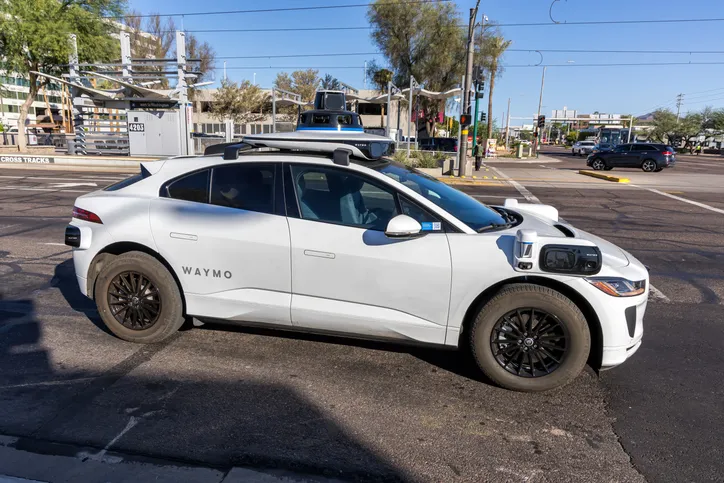
Waymo opened its fully autonomous ride-hailing service to the general public in San Antonio, San Diego, and Tampa, including trips to San Antonio International Airport.
Anyone in those three cities can now download the app and hail a driverless car without a waitlist.
The Alphabet unit says it has carried hundreds of thousands of riders across the three metros since opening limited service earlier in 2026.
First public riders were welcomed in Denver, San Diego, and Tampa from Sept. 1, after Dallas on Aug. 4 and Houston on Aug. 20.
The scoreboard is paid rides per week
Waymo was running roughly 500K paid rides a week by Aug. 20 on a fleet of about 3.7K Jaguar I-Pace vehicles.
The company has targeted 1M fully autonomous rides a week by the end of 2026, a goal it has repeated since December 2025.
Its February funding round of $16B valued the company at $126B post-money, when weekly rides topped 400K across six US metro areas.
Getting to 1M weekly rides would take roughly 7.4K to 9.5K vehicles at current productivity, and the import pipeline, not demand, is the limiting factor. Tens of thousands of people in new cities signed up before launch.
Debt replaces dilution
Waymo closed a $5B term loan in October, its first debt financing, with PIMCO, Blackstone, and Sixth Street as lead syndicated lenders.
Goldman Sachs arranged the deal, which was upsized from an initial $3B target and priced at a 5.25-point spread over the benchmark.
Lenders now underwrite the robotaxi business like a transportation network, a shift from the equity-funded startup model. It gives Waymo five years of committed capital without further dilution.
The money is earmarked for more US cities and international markets such as Tokyo and Dubai. Waymo launched its 15th US city last month and named new international cities.
Scaling still costs real money, with Alphabet's Other Bets segment, which includes Waymo, posting a $1.8B operating loss in the second quarter of 2026.
US experience shows growth depends as much on depots, charging, and fleet operations as on the driving software itself.
For investors, the three new public cities matter less as a revenue event than as evidence Waymo can open a market, fill it with riders, and then borrow against the result.

