
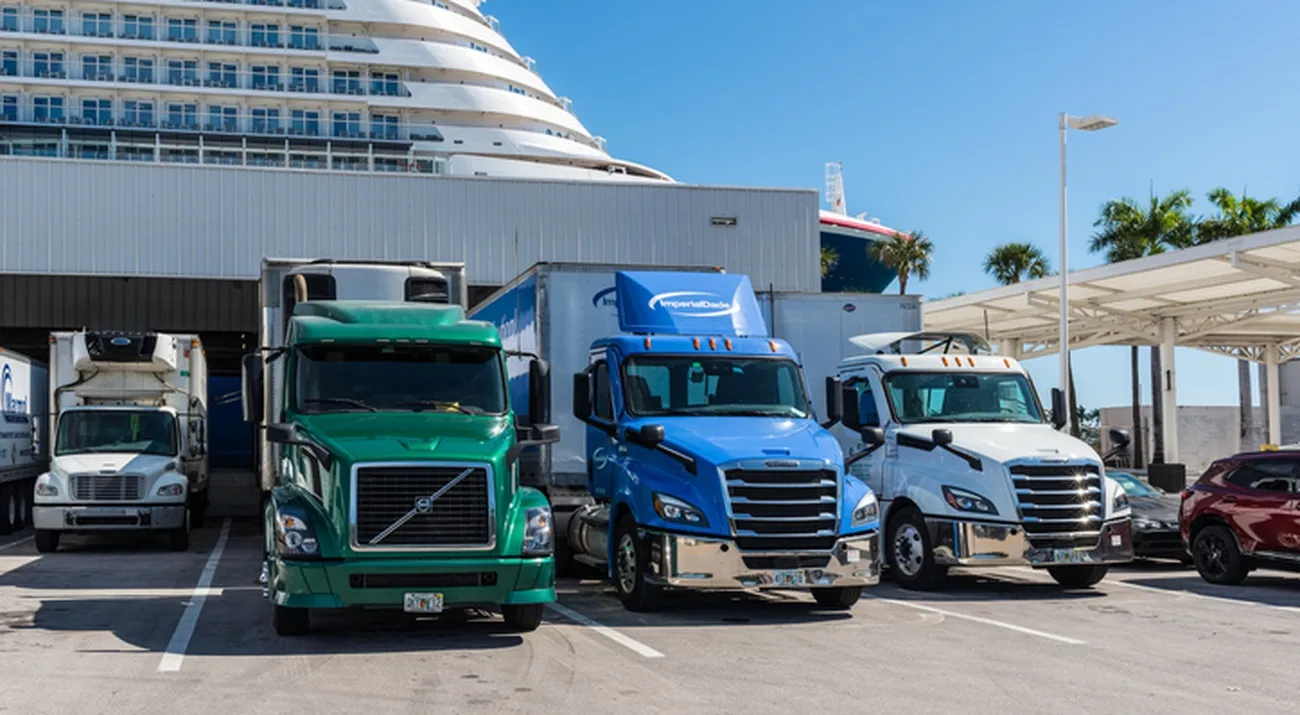
The average US spot rate to move dry van truckload freight rose to $3.05 a mile in October, the highest monthly average since February 2022, DAT Freight & Analytics reported. DAT is owned by Roper Technologies.
The rate climbed 4 cents from September and 98 cents from a year earlier.
Reefer spot, for refrigerated trailers, came in at $3.60 a mile and flatbed at $3.61. All three were about 45% higher than a year earlier.
Contract rates, the prices locked in with shippers for months at a time, set records too. Dry van contract rates rose 4 cents to $3.28 a mile, matching the May 2022 record, while reefer at $3.62 and flatbed at $4.05 notched their second and third straight monthly records.
Flatbed Contract Rates Top Four Dollars a Mile
US truckload rates, October 2026, $ per mile
- Spot rate
- Contract rate
Bar chart. Dry van: Spot rate 3.05, Contract rate 3.28. Reefer: Spot rate 3.60, Contract rate 3.62. Flatbed: Spot rate 3.61, Contract rate 4.05.
- Spot rates are all-in with no fuel surcharge; contract rates include fuel surcharges.
Source: DAT Freight & Analytics
Fewer trucks, not more freight
DAT's Truckload Volume Index for dry van read 254 in October, down 1% from September and 2% year over year, with reefer down 9% and flatbed down 7%. Freight demand isn't driving any of this. AI data center construction has kept flatbed rates at a premium even with those volumes, Forwarder News reported.
The trucks are what's missing. Equipment posts on DAT's load board are running 22% to 26% below last year, depending on equipment type.
Carriers are also turning work down. The tender rejection rate, which tracks how often carriers refuse loads under existing contracts, hit 12.9%, more than double the 6.2% a year earlier.
Truckload volumes rose about 4.7% over the prior two weeks as holiday freight started moving.
Diesel eats the upside
The national average on-highway diesel price ran about $6.25 a gallon in October, roughly $2.60 higher than a year earlier, per Energy Information Administration surveys. DAT's estimated fuel surcharge of 83 cents a mile for van is about double the year-earlier level.
A tractor and van trailer covering 500 miles a day at 6 miles per gallon burned about $521 of fuel a day in October, against $310 in February. Strip out fuel, and the dry van spot linehaul rate was $2.22 a mile, up 55 cents from a year earlier.
Those costs land on shippers, then on shelves. The Cass Freight Index shows the bill: its expenditures component accelerated to 20% year-over-year growth in September, with a 12% gain expected for 2026.
Ocean freight is tightening on the same logic. Hapag-Lloyd raised its full-year outlook for the third time this year, to earnings before interest and taxes of $2B to $2.4B from $1.25B to $1.75B. Earnings before interest, taxes, depreciation, and amortization are now seen at $4.6B to $5B.
Red Sea rerouting, Asian port congestion, and Panama Canal limits have cut effective capacity.
Forwarders are being told to plan for record inland trucking costs through the winter and into the 2027 contract season.

