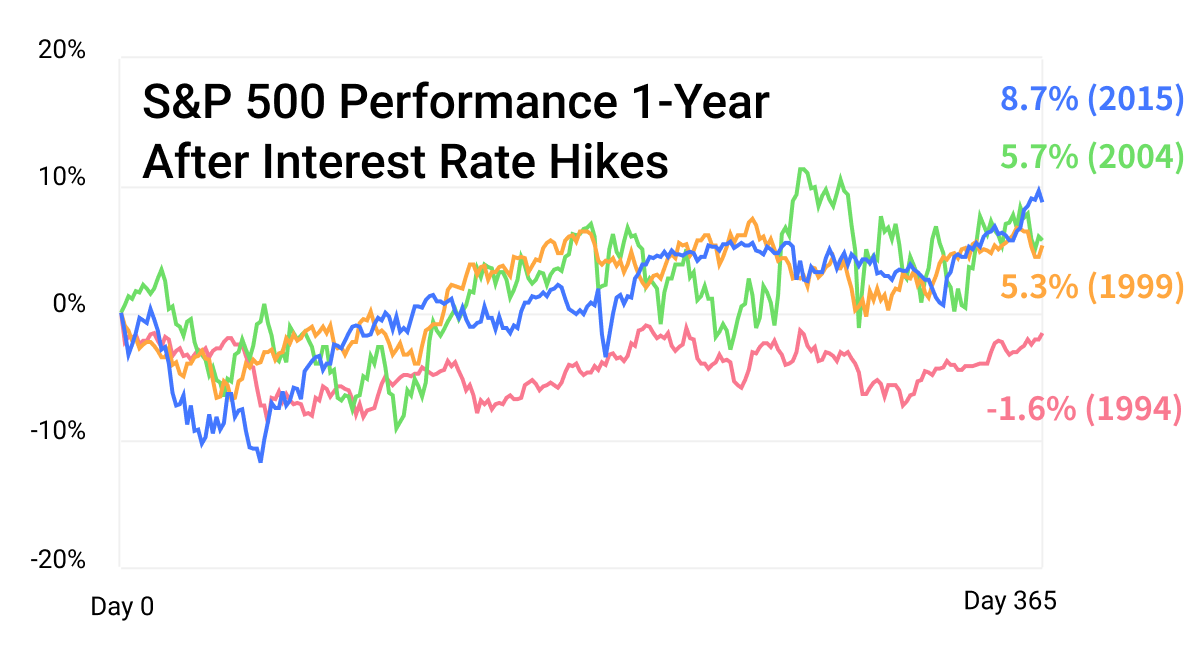
With interest rates likely coming in March, what should investors expect? Here’s how the market performed in the past four rate hike cycles…
- Dec. 2015: The S&P 500 fell nearly 10% over the following two months — making new highs eight months after the rate increase.
- Jun. 2004: The S&P 500 fell nearly 7% over the next 45 days — making new highs four months later.
- Jun. 1999: The S&P 500 traded sideways — making new highs 5 months later, until eventually collapsing from the dot-com bubble.
- Feb. 1994: The S&P 500 fell over 8% in the following two months and traded sideways — eventually making new highs a year later.
Here are the takeaways…
- Markets often fell right after the initial hike — finding a bottom within the following months.
- The markets went on another bull run for 3-4 more years — with the exception of 1999.
- The Fed started rate increases by 0.25% each time.
So interest rates aren’t necessarily bad for the stock markets and in many cases — the Fed is increasing interest rates on the back of a strong economy (low unemployment and high growth). But this time, market conditions are very different…
- Inflation is much higher than ever before.
- The market is pricing in a potential 0.50% initial increase.
The cyclically adjusted price-to-earnings (CAPE) ratio — an indicator that shows how expensive the stock market is — hasn’t been this high since 2000. When interest rates rose in 1999, the market went into a bear market within a year.
Looking forward: The market could likely go even lower from now — so expect higher volatility in the coming months. Are we going up after? No one can tell but until inflation starts to ease, a multi-year bull market will be a tough sell.

