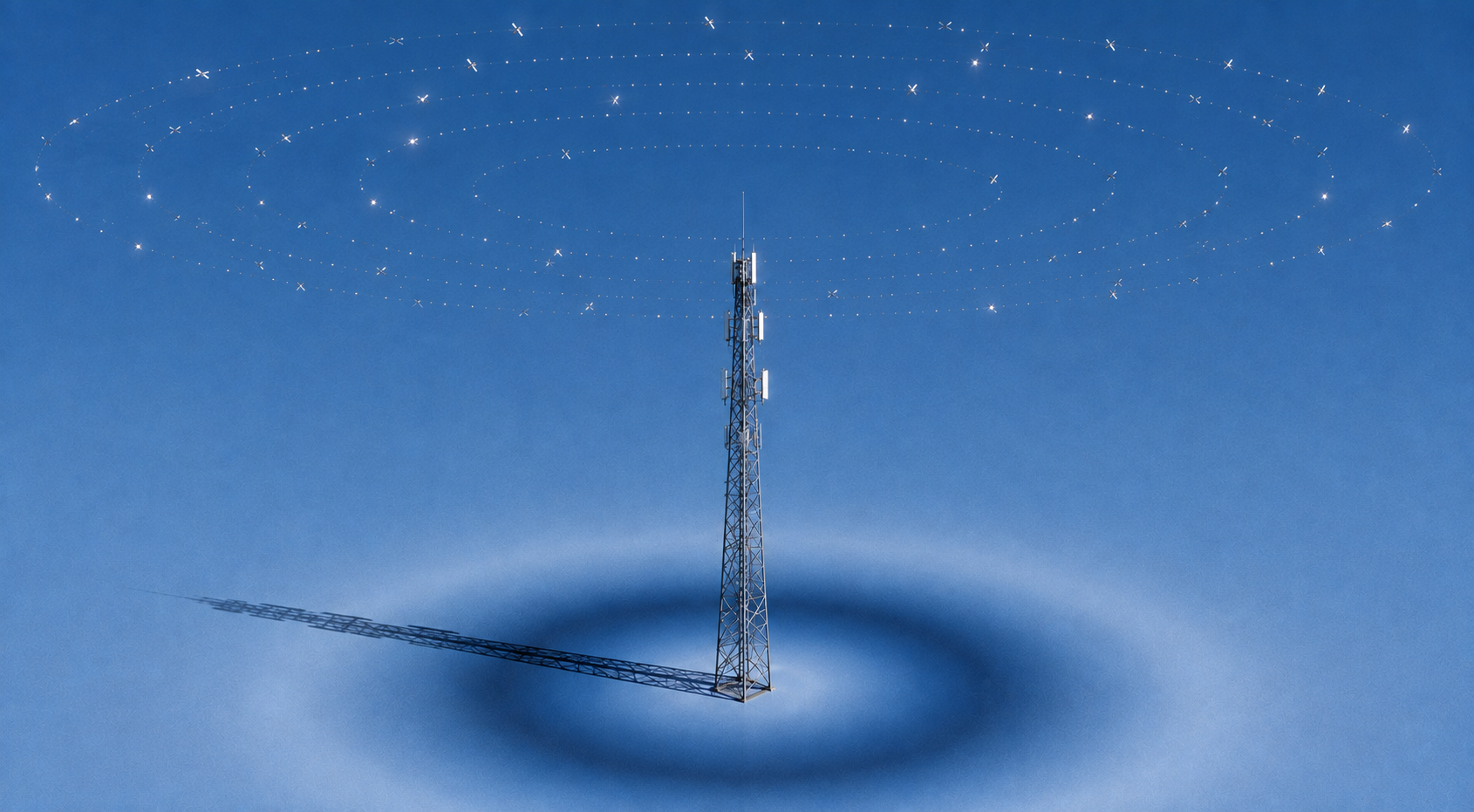
The telecom sector just had its Blockbuster moment — but the story isn't over yet. SpaceX's debut earnings call rattled wireless investors, sending shares of the Big Three carriers sharply lower. Investors now have to decide how much disruption is already priced in.
Starlink fires its opening shot: During SpaceX's first-ever earnings call, President Gwynne Shotwell outlined plans to build terrestrial infrastructure alongside its satellite network. The buildout includes cell towers, small-cell nodes, and other ground-based hardware needed for a mobile service. She said SpaceX expects to win "quite a few" customers from AT&T, Verizon, and T-Mobile.
- Starlink already serves 12M subscribers, generates profit margins above 60%, and remains one of SpaceX's fastest-growing businesses.
- The company spent $19.6B to acquire EchoStar's 65 MHz of wireless spectrum, giving it the terrestrial airwaves needed to launch a nationwide mobile network.
The Selloff Overstates the Near-Term Danger
Analysts are pumping the brakes on doomsday scenarios. Daiwa analyst Jonathan Kees estimates it would cost more than $100B to fully build out SpaceX's Starlink V3 constellation, excluding its AI investments. He argues satellites are poorly suited to dense urban markets, where cell towers provide far greater capacity. Morgan Stanley analyst Sean Diffley echoed that view, saying the perceived risk to the US wireless industry is greater than the actual risk over the next one to two years.
- AT&T, Verizon, and T-Mobile own more than $400B of spectrum assets, equal to roughly 80% of their combined market value and nearly enough to cover their ~$420B in net debt.
- AT&T trades at 9.4x forward earnings and T-Mobile at 13.9x, with a return to their early-2026 valuation multiples implying roughly 20% to 30% upside.
The partnership question: RBC analyst Ken Herbert believes SpaceX is "going to have to partner with one of the mobile network operators" rather than build its own nationwide wireless network. T-Mobile's urban footprint makes it a natural fit, while Verizon could also benefit. If satellite and terrestrial networks prove complementary, incumbent carriers' spectrum and infrastructure become more valuable. At current valuations, AT&T and T-Mobile look more like bargains than companies under threat.

