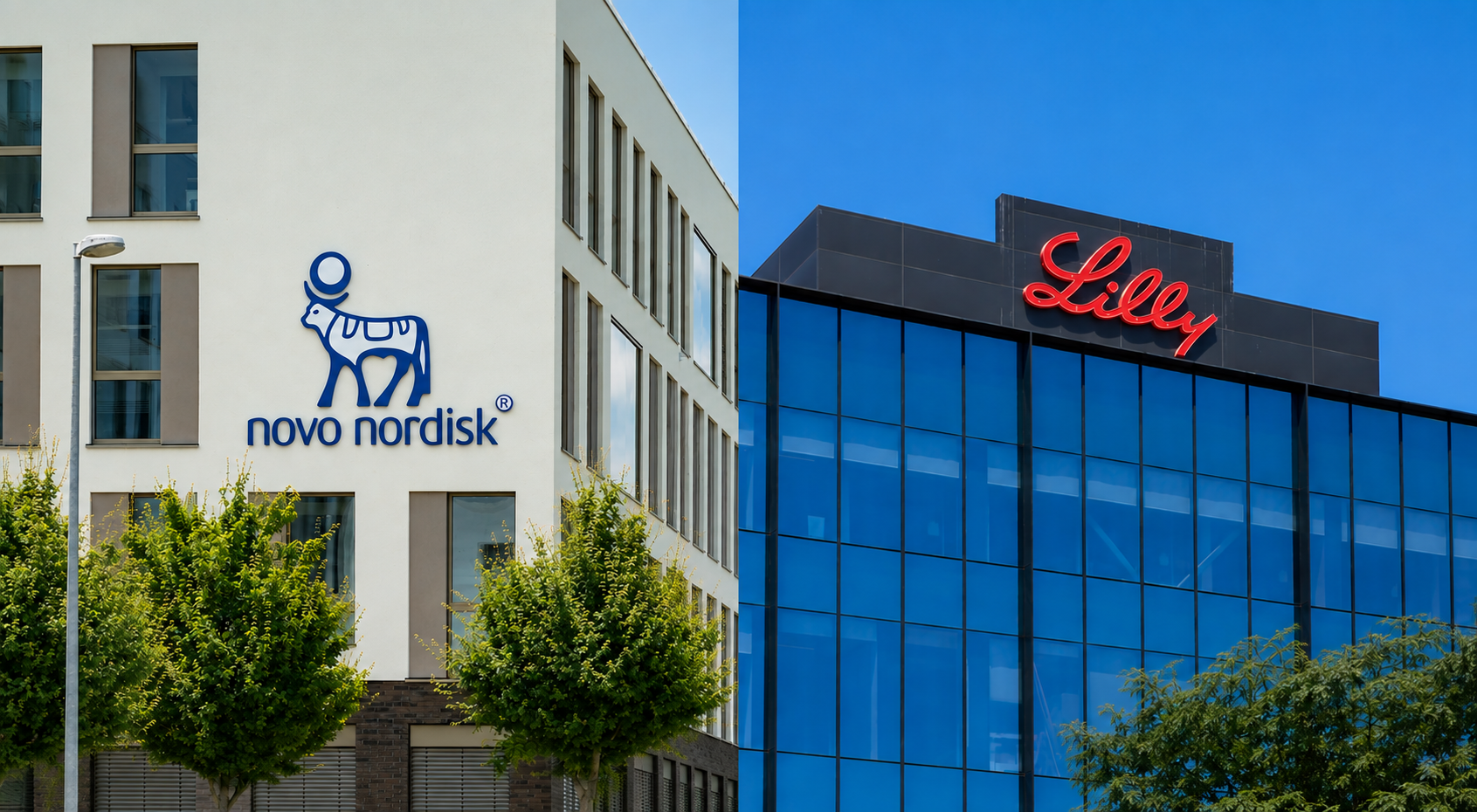
The same week that Eli Lilly posted one of the strongest quarters in pharma history, Novo Nordisk handed investors two disappointments in a single report. The contrast was stark enough to move both stocks in opposite directions and renew questions about whether Novo can keep pace in the obesity drug market.
Contrasting fortunes
Lilly's second-quarter revenue jumped 48%, well above what Wall Street had expected. Mounjaro, its injectable diabetes treatment, brought in $9.9B, nearly double what it earned a year earlier.
Zepbound, the same drug approved for weight management, added $4.93B. Lilly raised its full-year revenue outlook to a range of $85B to $87B.
Novo's report landed differently. Its Wegovy pill recorded $494M in quarterly sales, short of analysts expectations. That miss stung because the pill had been considered a bright spot and a source of competitive advantage over Lilly.
The second blow came from CagriSema, Novo's next-generation weekly injectable currently under FDA review. In a head-to-head trial against Lilly's tirzepatide in patients with Type 2 diabetes, CagriSema failed to control blood sugar as well as its rival.
It was the latest in a string of mixed results for the drug, which Novo still plans to launch in 2027.
The oral GLP-1 pill gap
The oral obesity drug market is shaping up as a second front in the Novo-Lilly competition. Novo's Wegovy pill launched earlier and has captured roughly 90% of the oral obesity market, according to Novo's CEO.
Lilly's oral pill, Foundayo, is newer. It launched in April and brought in $98M in its first full quarter, just below the $103M to $104M consensus estimate.
Investors didn't punish Lilly for the Foundayo miss, partly because expectations were already modest for a product that early in its launch.
CVS Health separately announced a partnership with Lilly to make Zepbound and Foundayo available through its app with transparent pricing and potential same-day pickup at CVS pharmacies. That deal adds another retail distribution layer behind Lilly's GLP-1 portfolio.
Novo's CEO is now under pressure to move faster
Novo's CEO Mike Doustdar acknowledged the setbacks directly and pledged faster research timelines and bolt-on acquisitions to rebuild the pipeline.
"Because of the setback, we need to have more shots at goal. We need to be faster and we need to learn from the failures and reinvent ourselves again."
Mike Doustdar, Novo Nordisk CEO
The urgency behind that pledge is real. Semaglutide, the active ingredient in Wegovy and Ozempic, is set to lose patent protection by early next decade.
Analysts expect the overall GLP-1 market to exceed $100B annually by 2030. Novo needs a successor drug in place well before that patent gap arrives.
Doustdar said Novo would also explore expanding beyond obesity and diabetes, pointing to early science suggesting GLP-1 biology could apply to addiction and skin diseases. He said more early-stage pipeline details would come at a September investor day.
Lilly's share price has climbed roughly 285% since Mounjaro's first approval in 2022. It now consistently trades above $1K per share, which has prompted speculation about a potential stock split.
Lilly hasn't indicated it plans to split, and the company recently closed four acquisitions in a single quarter, including its largest completed deal to date.
Both companies raised their full-year outlooks, but Novo's guidance still calls for US sales to decline this year, while Lilly continues to widen the distance between them.

