
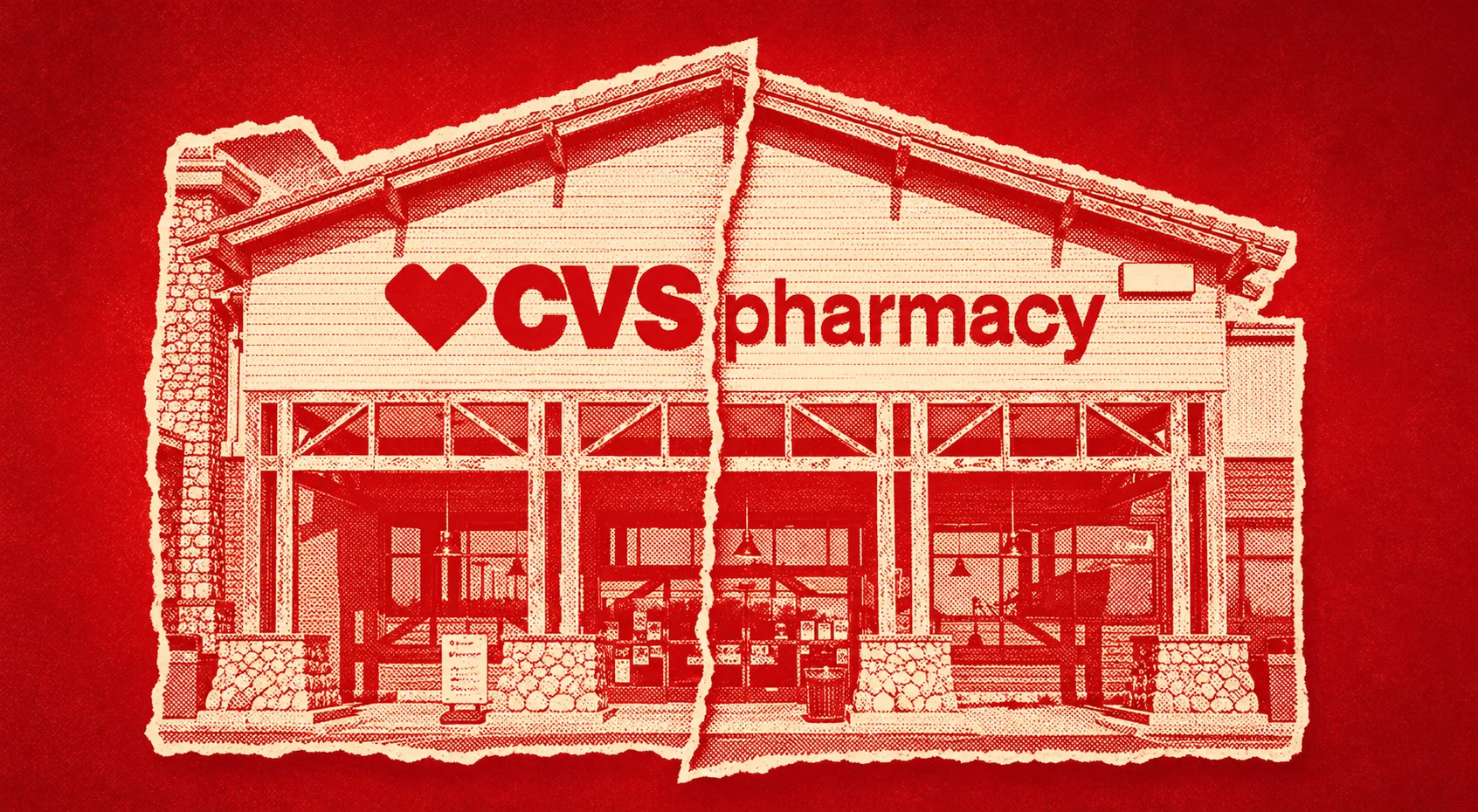
For years, the big idea in American healthcare was to put everything under one roof. Insurance, drug pricing, clinics, and the corner pharmacy would all talk to each other and squeeze out savings. CVS Health ($CVS) just decided that roof is too big. The $117B company is making the call while the turnaround is working.
Two companies, one old merger
CVS plans to separate into two independent, publicly traded companies in the first half of 2028. The decision follows a comprehensive strategic review by the board.
One keeps the CVS Health name and holds Aetna, Caremark, CVS Specialty, Oak Street Health, and Signify Health. Chairman and CEO David Joyner runs it.
The other, CVS Pharmacy, takes roughly 9K retail pharmacies, the mail pharmacy, MinuteClinic, and the Health100 technology business. Group President Prem Shah becomes its CEO.
Shareholders will own pieces of both. The split is meant to be tax-free for US federal income tax purposes, and both are expected to carry investment grade ratings.
Why the timing looks strange
The move reverses the 2018 acquisition of Aetna, the deal that built its vertically integrated model. A pharmacy benefit manager, or PBM, is the middleman that negotiates drug prices for insurers. Caremark is one of the three largest in the country.
CVS considered a breakup in 2024, when it engaged advisers for a strategic review and weighed separating the retail pharmacy from the insurance arm.
The breakup lands while the numbers are improving. Third-quarter revenue rose 5.4% to $108.4B, and adjusted EPS climbed to $2.09 from $1.60 a year earlier. Management raised full-year 2026 guidance to adjusted EPS of at least $8.20, up from a range of $7.90 to $8.10.
CVS Revenue Kept Climbing Into the Breakup Announcement
Total quarterly revenue, Q3 2025 vs Q3 2026, $B
Line chart. Q3 2025: Total Revenue ($B) $103. Q3 2026: Total Revenue ($B) $108.
Source: CNBC, Yahoo Finance
The regulatory shadow nobody names
Joyner says regulation is not the reason. He calls the breakup the logical next step in the company's evolution, with each side free to tailor its own investments.
Not everyone buys the clean version. Leerink's Michael Cherny wrote that the split feels like a complete shock, and pointed to the alternative explanation.
CVS is challenging state laws in Arkansas and Tennessee that would ban one parent from owning both a pharmacy and a PBM. A bipartisan group of lawmakers has introduced similar legislation federally.
What each half sells
The pharmacy side booked $37.66B in 2025 sales, the insurance unit $36.29B, and health care services $51.24B.
The retail chain enters independence in better shape than in years. It is winning share from rivals and stabilizing gross margins under CostVantage, a reimbursement model tied more directly to what CVS pays for drugs.
The insurance half looks like UnitedHealth ($UNH) or Cigna, operating a health plan, a PBM, and a specialty pharmacy together. Aetna's segment delivered $912M in third-quarter adjusted operating income, up 190% from $314M a year earlier, with the share of premiums spent on medical care improving to 91.3% from 92.8%.
Health Care Services Was CVS' Biggest Revenue Segment in 2025
Segment revenue, 2025, $B
Bar chart. $B. Pharmacy business: Revenue ($B) $37.7. Insurance unit: Revenue ($B) $36.3. Health care services: Revenue ($B) $51.2.
Source: CNBC
Getting there took $2B in cost cuts, store closures, and an executive overhaul. The payoff is two separate stocks in 2028, each with its own dividend, and no more pretending a drugstore and an insurer need the same boss.
The case for smaller
Not everyone reads the split as a retreat. Arielle Trzcinski, principal analyst at Forrester, said the move unwinds a central piece of the premise behind CVS's acquisitions: that a pharmacy, PBM, insurer, and care-delivery organization could coordinate care and create economies of scale. CVS, she said, is effectively acknowledging that "bigger isn't always better."
J.P. Morgan's Lisa Gill wrote that she sees "some logic to the split." Leerink's Cherny added that a standalone retail pharmacy with meaningful scale may have a stronger outlook now than before.