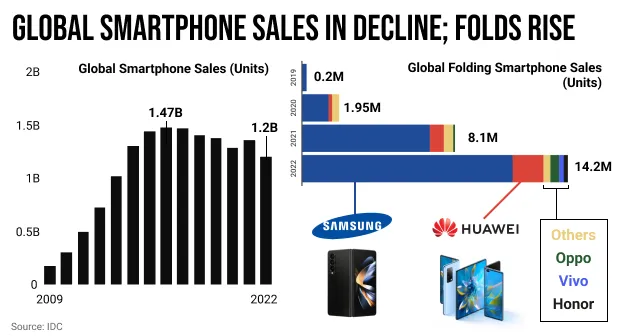
Consumers are upgrading their phones less frequently — sending global sales down 18% from their 2016 peak. And that’s pressuring phone makers to find ways to get consumers spending again.
Their answer: “Folding phones.”
This week, Google (NASDAQ:GOOG) joined the foldable smartphone war with the reveal of the Pixel Fold — set to release in June for $1,799.
Why so costly? Screens are typically the most expensive part of the phone. And folding phones can have 3x the amount of screen space.
The leader of the fold
Samsung dominates the foldable phone space — having launched its first back in 2019. Today, it controls 79% of the market.
- Folding phones are expected to be the fastest-growing segment of the smartphone industry — but only represent a small portion…
- 14M foldable smartphones were sold in 2022 — still just a tiny 1.16% of the 1.21B smartphones sold.
It was Samsung’s solution to declining phone sales and to challenge Apple’s dominance in the premium category — which held 77% market share for phones >$751 last year.
Folding phones are still limited to Android phones, with no announcement from Apple yet. But analysts think it’s unlikely that Apple will release one anytime soon.
Folding phones are popular in Asia
Many Chinese phone makers have already released their own folding phones as premium options — with 90% of China’s top 5K apps already having been adapted for foldable phones.
- The bull: An exec from China’s largest smartphone maker Oppo says, “Foldables are the future and are of utmost importance to Oppo’s overall product strategy.”
- The bear: Daishin Securities analyst says, “Sales of foldable phones keep increasing, but the growth rate seems slower than expected” (FT).
Popular Eastern trends often fail to pick up traction in the West (e.g. live shopping). Are folding phones just another gimmick?

