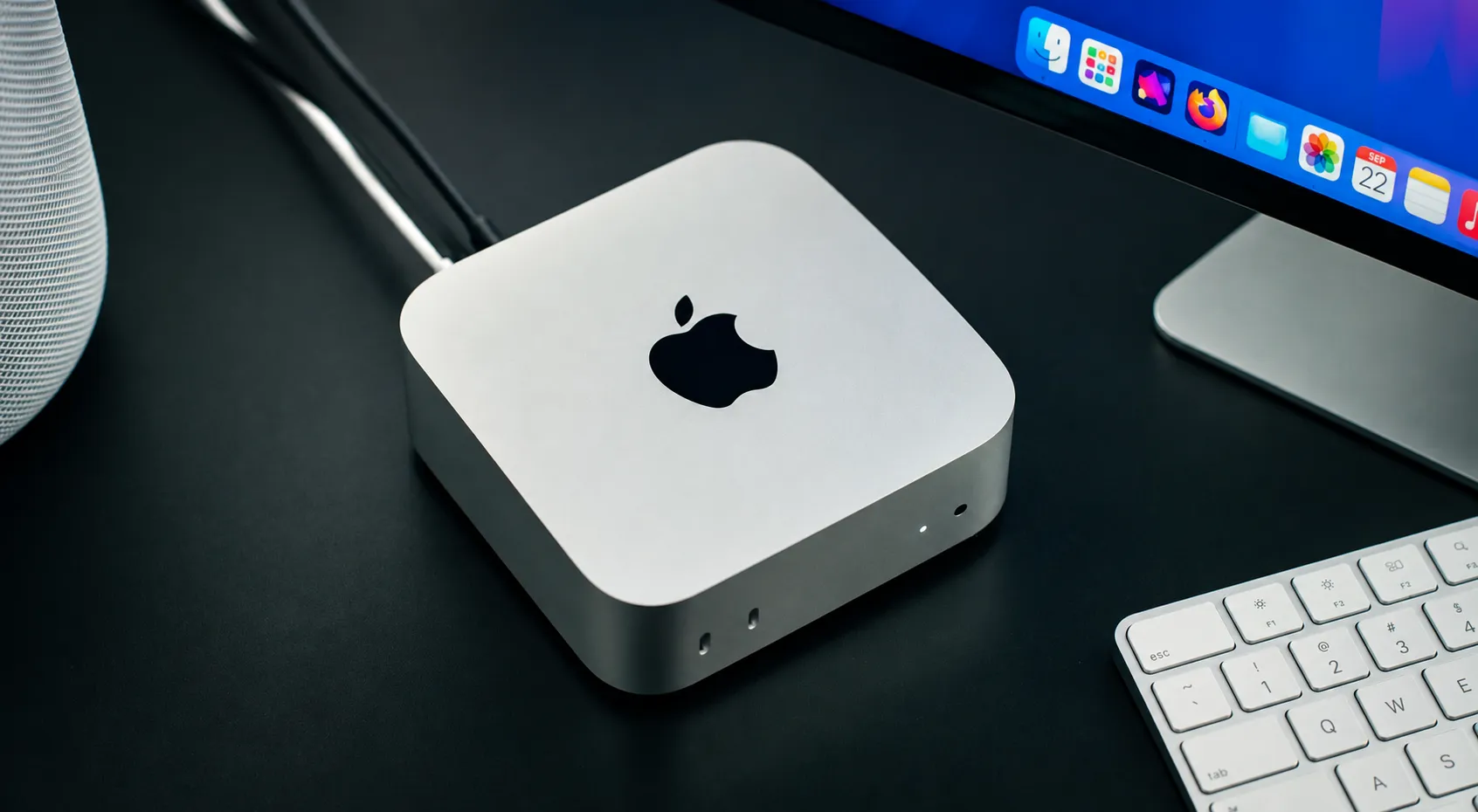
Apple started shipping its new Mac mini and Mac Studio on Sept. 22, with high-end configurations approaching $20K and a pitch aimed at corporate AI budgets.
The new M6 Mac mini starts at $899, rising to $1.7K for the M5 Pro version. Mac Studio starts at $2.5K with M5 Max and $5.5K with M5 Ultra.
Apple says the M6 mini delivers up to 4x faster AI performance than the M4 generation, while Mac Studio reaches up to 4.3x. The top-end Studio supports up to 512GB of unified memory, though that configuration won’t arrive until late October.
The pitch is buying compute once instead of renting it
Executives are telling business buyers the machines are cheaper than renting data centers, a direct shot at the token-based billing used by cloud providers.
The target workloads are coding and complex business tasks that would otherwise run on OpenAI or Anthropic models billed by the prompt.
At its launch event this month, Apple linked four Mac Studios to run a trillion-parameter model that found and fixed a graphics coding bug, powered by a single wall outlet.
The clustering runs on RDMA over Thunderbolt, Apple's chip-to-chip networking, which the company says brings up to 3x faster distributed AI inference versus one machine.
The underlying advantage traces back to 2020, when Apple fused computing and memory chips into a unified memory architecture for battery life. Nvidia and others have only recently moved the same direction.
Distribution is the hard part
Apple holds about 4.6% of the enterprise desktop and laptop market against 91.3% for Windows, according to IDC. Microsoft is chasing the same on-device opportunity, with CEO Satya Nadella calling it "unmetered intelligence" and planning a Windows AI super app.
A Windows event in San Francisco next month is expected to focus on rival AI desktops from Nvidia and PC makers. Nvidia's Jensen Huang downplayed direct competition with Apple, saying the company is focused on expanding what Windows PCs can do.
Apple’s Mac mini is finding an unexpected new audience as OpenClaw, an open-source AI agent, gains traction in markets including China. Demand has left some models sold out, helping lift Apple shares on Tuesday.
The stock’s premium now rests on whether Apple can turn that AI-driven demand into a lasting foothold in enterprise computing. A sold-out Mac mini is a promising start, but it’s not a corporate buying spree.

