Inside Apple’s Biggest Product Launch: Foldable iPhones, Upgraded Wearables and Next-Gen AI
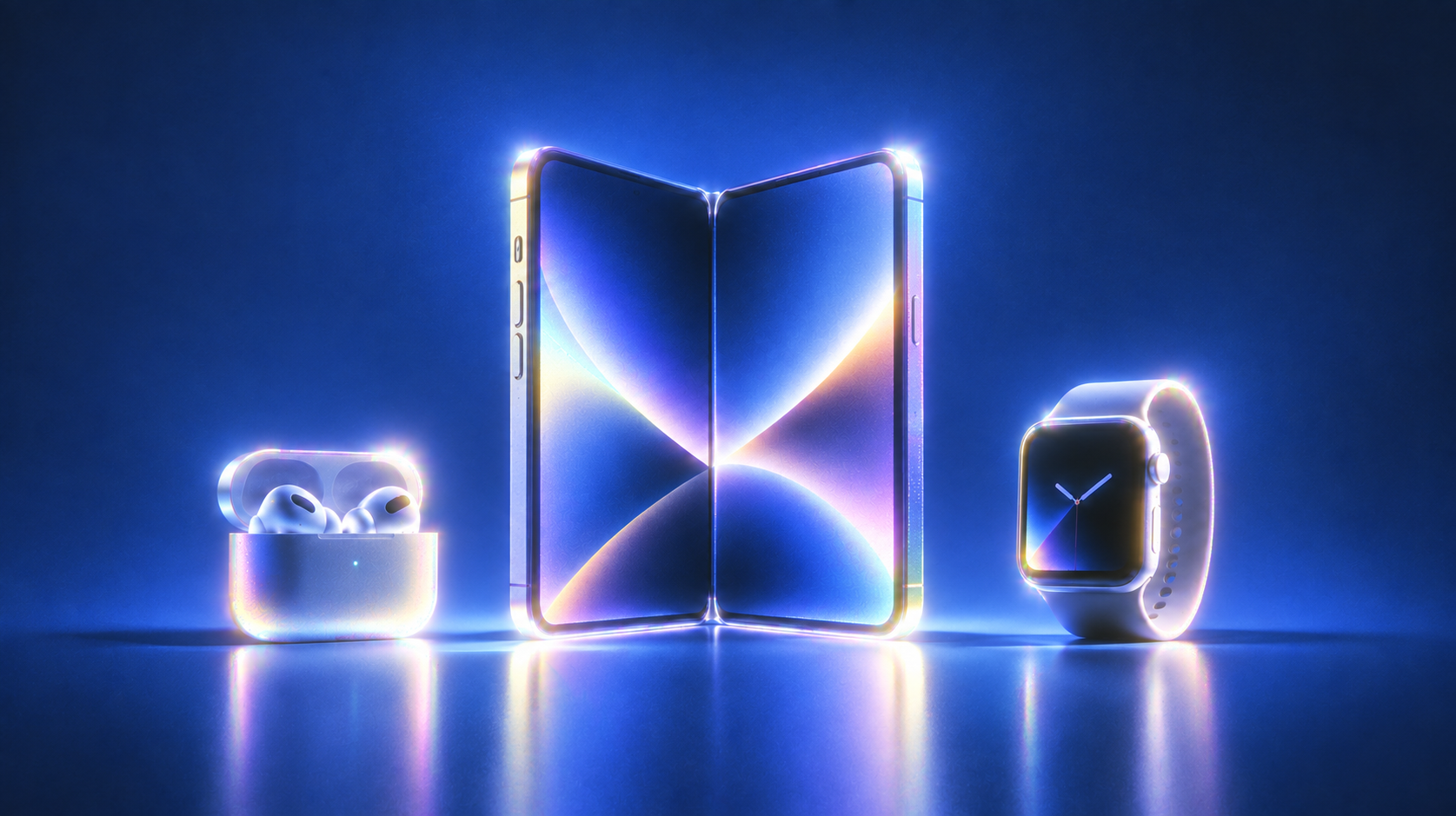
Apple used John Ternus’ first major keynote as CEO to introduce the iPhone Duo, its first foldable phone. The Sept. 9 launch brought the iPhone 18 Pro, Apple Watch Series 12, Apple Watch Ultra 4, AirPods 5, and a much bigger Siri AI push alongside it.
Siri is spreading across that hardware as AI assistants become a new way to navigate apps and services. Apple already controls many of the devices its customers use throughout the day, giving it a ready-made home for the technology.
The foldable takes center stage
The iPhone Duo marks Apple’s biggest departure from the familiar iPhone design in years, pairing a larger display with a form factor designed to remain manageable as an everyday phone.
“For a device that plays such a central role in your life, a larger display would open up entirely new possibilities.”
John Ternus, Apple
Samsung, Huawei, and Google have already spent years building the foldable market, leaving Apple to compete on how the category feels rather than who got there first. Ternus made that pitch explicit when he described rival designs as “two phones awkwardly stuck together.”
IDC expects Apple to ship more than 17M foldable iPhones by 2027 and capture roughly 40% of the global foldable market. Sales could reach more than $45.7B.
Pro prices move higher
The iPhone 18 Pro starts at $1,199 and the Pro Max at $1,299, with 256GB of storage standard on both models. Pre-orders open Sept. 12, followed by store availability on Sept. 18.
The increases arrive during a global component shortage that has put particular pressure on memory costs. Apple had already raised prices on Macs and iPads earlier in 2026.
More expensive Pro models come with the new 2-nanometer A20 Pro chip, which delivers up to 40% faster GPU performance and 50% more memory bandwidth than the A19 Pro. A vapor chamber with three times more surface area handles cooling.
Photography received a mechanical upgrade through the 48MP Fusion Main camera, which uses six blades to adjust aperture and depth of field. Apple Reference Image can verify that a photo originated from an iPhone camera as AI-generated images make authenticity harder to establish.
Siri moves deeper into the iPhone
Siri AI can search across messages, email, photos, and apps before carrying out actions inside supported third-party software. More than 300K apps already work with the system, giving the assistant a broad range of services to reach from the iPhone.
Camera-based actions and customizable voices are coming with the update. Apple Intelligence will support 16 languages, while Siri AI launches in English in September before adding French, Japanese, Korean, Portuguese, and Spanish in October.
Brooke Hopkins, founder of Coval and a former Google Voice AI Assistant engineer, called Apple “extremely well positioned” in personal assistants because its hardware already follows customers throughout the day.
Much of the opportunity now rests on whether Siri works consistently across search, personal information, and app actions. Apple has spent years building the installed base, while the new software has to give those customers a reason to change how they use it.
Apple puts its ecosystem to work
AirPods 5 bring Live Translation into conversations through Siri, AirPods controls, or the iPhone Action button. Active noise cancellation comes with the $129 model, while the $149 version adds wireless charging, longer battery life, and on-stem volume controls.
Noise cancellation removes up to 50% more external sound than AirPods 4 with ANC, while the wireless-charging model offers up to five hours of playback with ANC enabled.
Apple Watch Series 12 and Ultra 4 extend those software features further with improved heart tracking and a readiness score based on activity, vitals, and sleep. Audio Intelligence can rewind nearby conversation by 15 seconds, while Siri Recap turns conversations into notes.
Those additions push more of the launch beyond the iPhone itself, spreading new features across devices customers already wear and use throughout the day.
The iPhone Duo opens another premium category and higher Pro prices push the lineup further upmarket, while AirPods, Apple Watch, apps, and cameras give Ternus far more places to build out Apple’s AI ambitions. Getting those features into everyday use will determine how much Apple can make of that reach.