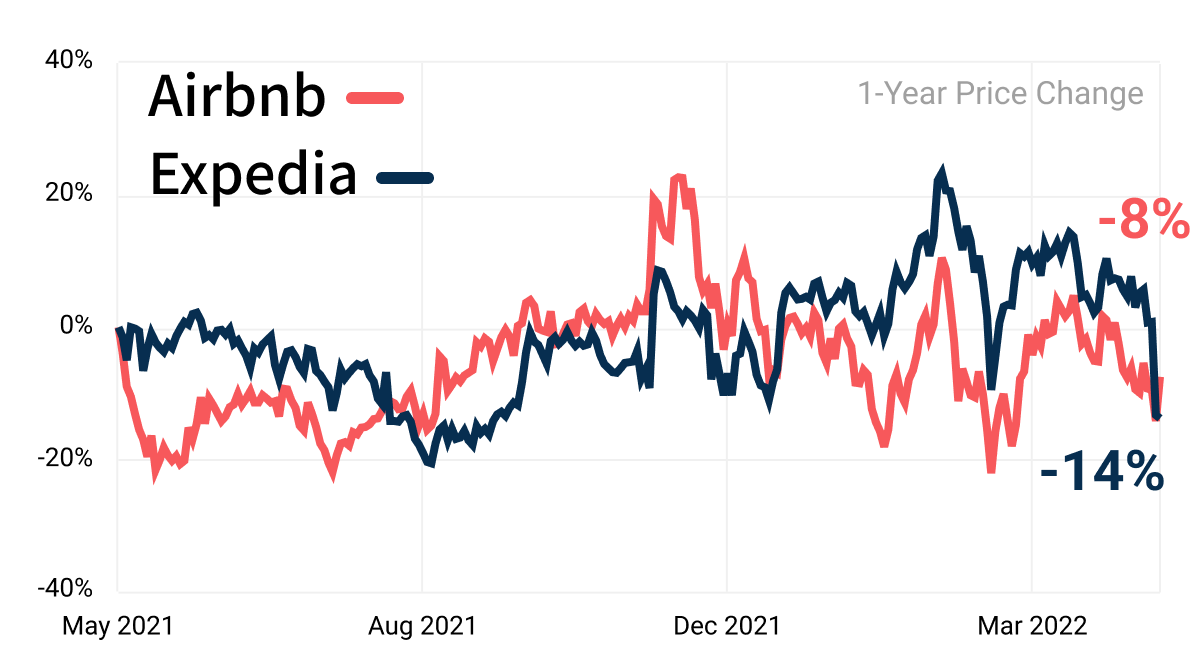
Travel demand has taken off — with travel companies Airbnb and Marriott reporting their strongest recovery since the start of COVID — jumping over 4.7% and 7.7%, respectively, yesterday.
But direct competitor Expedia (NASDAQ:EXPE) hasn’t shared in their fortunes — falling 0.5% after reporting worse-than-expected earnings.
- Rising: Airbnb reported record nights booked in the previous quarter — surpassing 2019 stays.
- Falling: Expedia’s stayed nights were down 30% from the same period in 2019.
Pricing power: Strong travel demand has given hotel operators and rental owners the ability to increase prices:
- In March, daily U.S. hotel rates were up 11%, according to STR data (WSJ).
- In the first quarter, Airbnb’s booking value per night rose 37% compared to the same period in 2019.
Airbnb previously attributed this growth to increasing interest in larger homes — and “modest evidence” of hosts raising prices (Insider).
But late last year, Airbnb forecasted its average daily rates on short-term rentals to fall 4% in 2022. If travel demand falls, prices would be a risk of falling further.
The Airbnb bear case: In 2019, Airbnb held 19% of the vacation rental market — gaining ground on hotel operators like Hilton and Marriott. But investors might find a lack of upside potential in its valuation.
At a forward price-to-sales (P/S) multiple of 10.8x, Airbnb isn’t cheap compared to other travel companies.
- Valuation: Airbnb trades at a price-to-sales multiple 5x greater than Expedia’s.
- Growth concerns: It’s uncertain how long travel demand will keep up in the face of a potential recession.
Higher growth has helped Airbnb trade at higher valuations than competitors, but that could also work against it if travel slows down.

