The Year Is Halfway Over, But the S&P 500 Has Already Delivered More Than Investors Expected
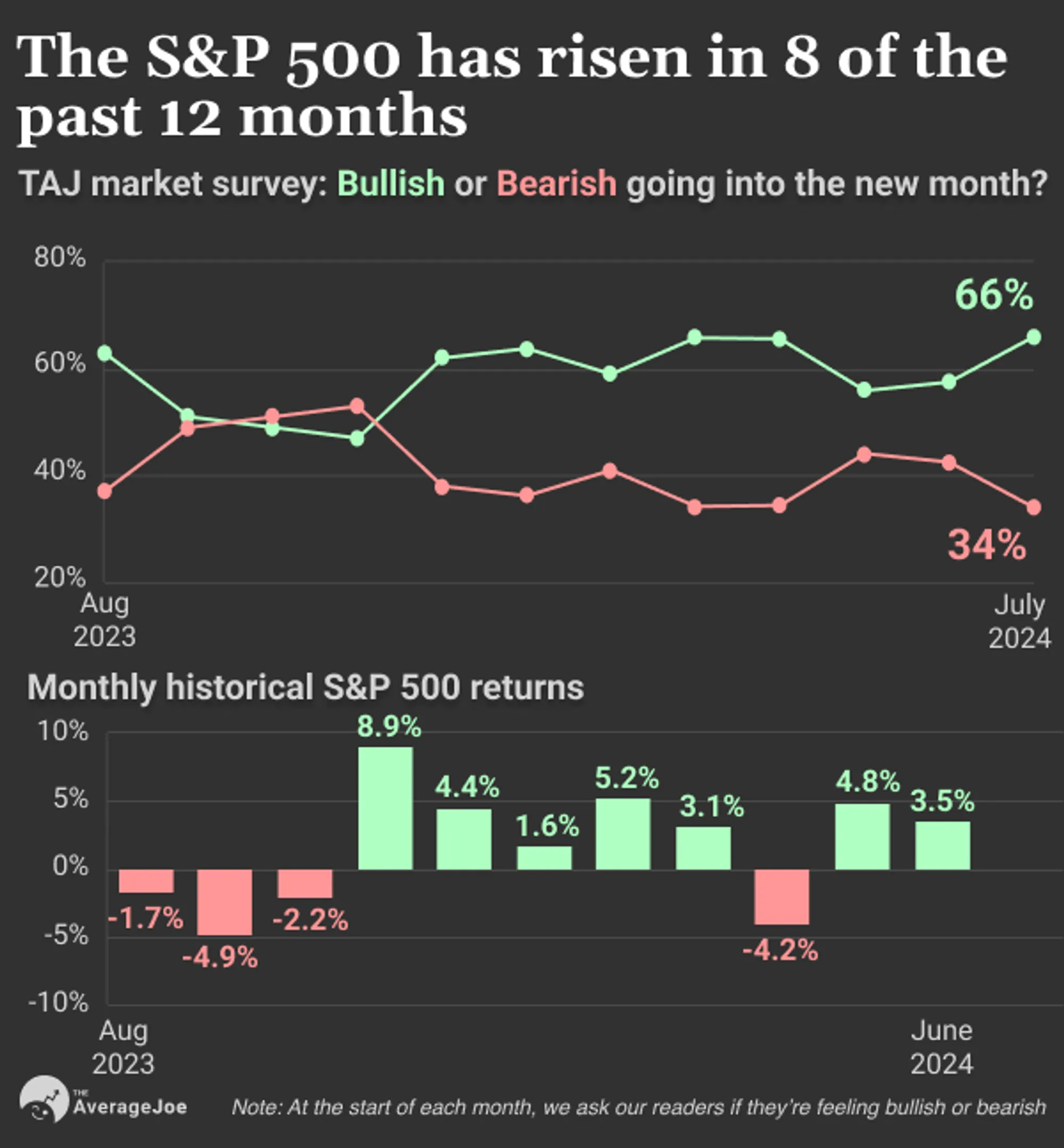
Time flies when you’re having fun… and it really flies when the S&P 500 keeps climbing month after month. Believe it or not, we’re halfway through 2024 — and it has exceeded investor expectations in many ways. The S&P 500 is up 15% year-to-date, already enough to put past years’ returns to shame.
Bull or bust? The S&P 500 has surpassed Wall Street analysts’ price targets, setting 32 all-time highs this year. Nvidia led the charge, contributing nearly a third of the S&P 500’s returns. With 302 of the index’s 503 components up so far this year, investors are on cloud nine heading into the year’s second half (or rather, floating on the S&P’s 5.4K).
- In our latest Bear and Bull survey, 66% of readers were bullish heading into July, the highest since Feb. 2024.
- Recently, institutional investors raised their original targets, reflecting strong first-quarter earnings and economic data.
A Brief Intermission
With conflicting economic data, an upcoming US election, and a Fed that can’t seem to decide the direction of interest rates, predicting the S&P 500’s movement in the second half of the year is tough. AI stocks have stumbled in recent weeks, causing concern that their record run might be ending.
- In a June Bloomberg Pulse survey, nearly half of respondents expected the S&P 500 to drop at least 10% this year, while 35% forecast the decline in 2025.
- Valuations are also a concern, with 52% of Bloomberg survey respondents calling the S&P 500 the “most overpriced” asset over US credit and gold.
There’s always something to worry about… But even then, the S&P 500 knows it’s a Hot Stock Summer — and investors can’t seem to take their eyes off the market or their hands off the buy button. If you’re worried about a dot-com-style market crash, data shows today’s markets are healthier and less expensive than in 1999. For those skeptical about consecutive triple-digit market increases, history proves otherwise. But to keep the party going, companies will need to deliver strong earnings, kicking off late next week.

