

Struggling consumers are falling behind on car payments, and many are having their vehicles repossessed.
Here’s the story of 21-year-old Kobe Hatch (BBG).
- With higher interest rates, his monthly car bill cost nearly $1,000 and he fell behind on payments.
- His car was repossessed, and without it, he got fired from his job as an Amazon driver.
- It’ll cost him $1,100 to pay the repossession fee to get his car back — which he doesn’t expect to be able to afford.
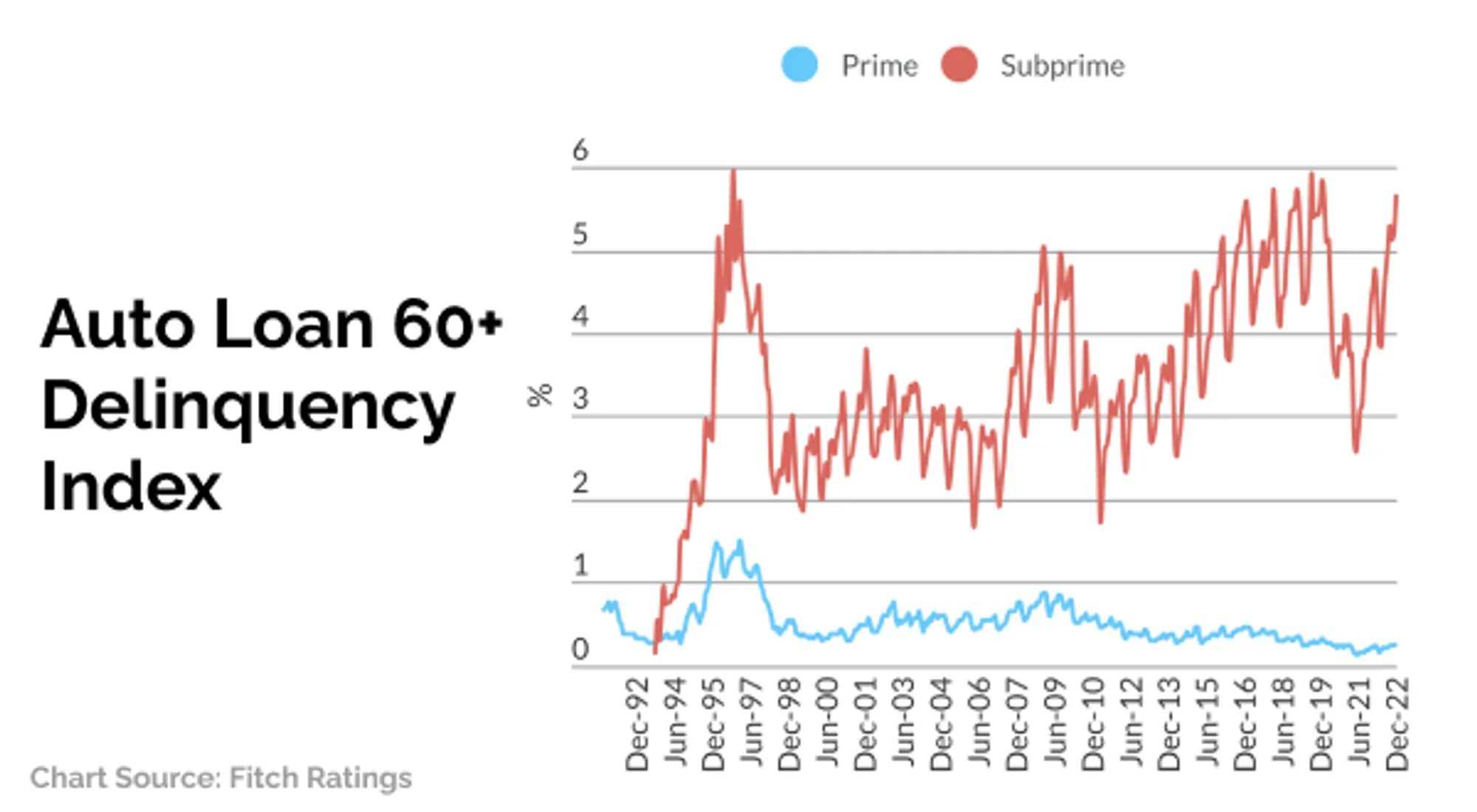
Many Americans share a similar story, and the data reflects the changes:
In December, 5.67% of subprime borrowers — those with lower credit quality — were 60 days late on their payment.


The data also shows just how unevenly the downturn is hitting different parts of the economy.
Here’s some positive news:
- The number of repossessed cars is still 26% below 2019 levels, and prime auto loans haven’t significantly increased.
- Subprime loans are a lesser portion of total loans — at under 20%, per Cox Automotive — compared to over 30% in 2008.
Is it time to panic? Trick question; it’s never time to panic. Staying out of the market in anticipation of a bubble popping can be costly.
- Imagine thinking the S&P 500 was in bubble territory after nearly doubling over five years (2011-2016).
- Just to cash out — and watch it rise another 100% over the following five years (2016-2021).
No one can accurately call a bubble. The only thing we know is that the S&P 500 has risen nearly 15,000% in the past 50 years — surviving countless recessions.
Stay diversified, stay invested and don’t be bubble boy.



