The Sky’s The Limit For Weight Loss Drugs and Potentially Their Creators
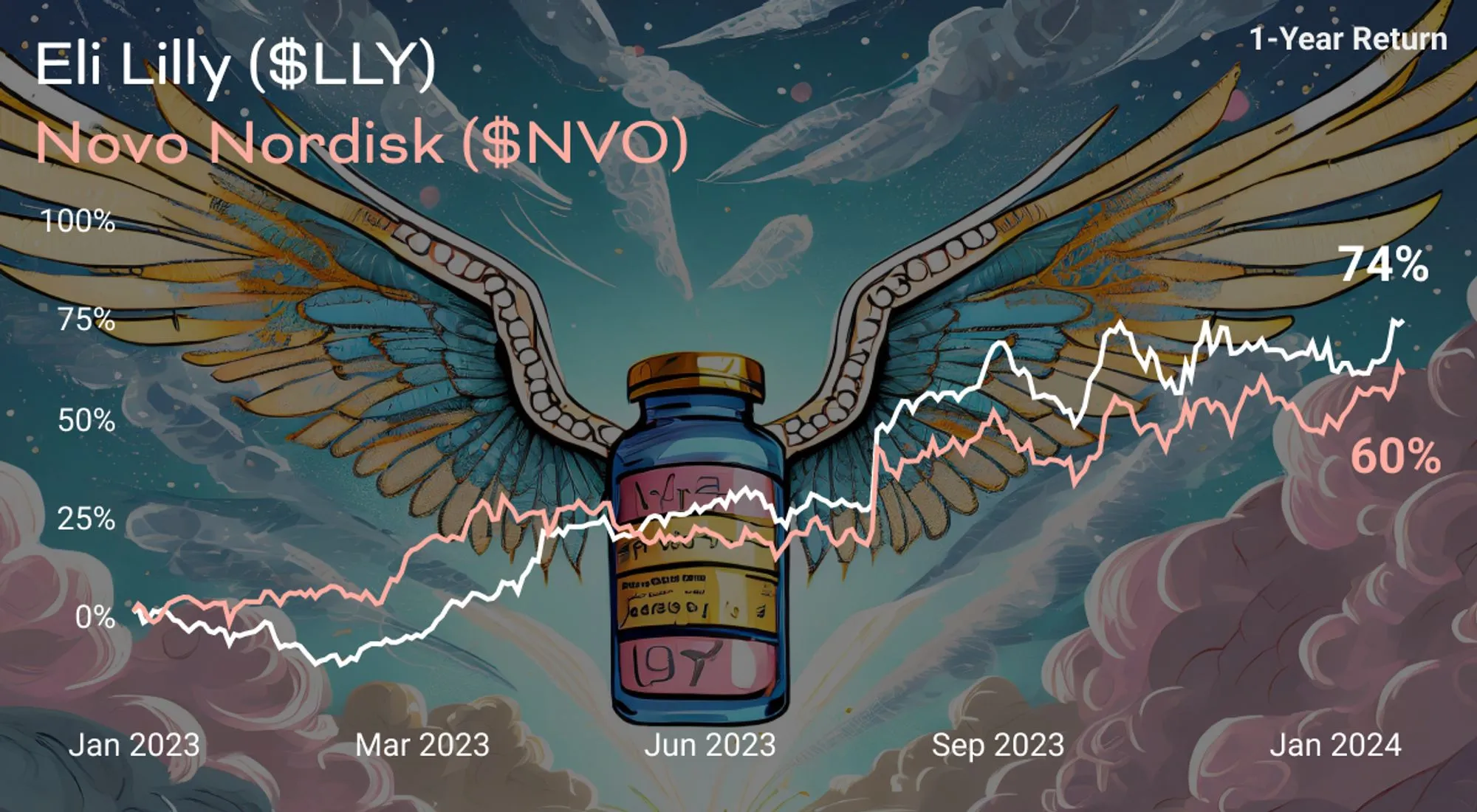
Red or blue pill? Americans will take whichever one helps them shed the most pounds. Weight loss drug producers Novo Nordisk (NYSE:NVO) and Eli Lilly (NYSE:LLY) made a fortune displacing diets and exercise with a once-a-week injection — sending their shares up over 50% last year. And now they’re aiming even higher.
What can’t they do? Analysts aren’t just excited about the prospects for the weight loss market, anticipated to be worth $100B by 2030. They’re now betting on their future in other applications, including treating cardiovascular disease and addiction, as demonstrated by successful research outcomes last year.
- Lilly and Novo are already testing their drugs’ potential in treating heart failure, sleep apnea, Alzheimer’s and non-alcoholic fatty liver disease.
- Positive results could make it easier for drugmakers to convince insurance providers to cough up the money for these drugs.
One limitation, however, is the inability to keep that weight off after patients stop taking the drug. Last month, a JAMA study showed that patients on Eli Lilly’s Tirzepatide lost an average of 21% of their weight over 36 weeks.. Those switched to placebos regained 14% of their weight over the next year. Which, from the drugmaker’s POV, might not be such a bad thing.
Weight loss drugs, straight to your door
Pharma giants are still working through supply shortages and insurance headaches — which has led Eli Lilly to make a bold move to push itself ahead of Novo. Last week, announced it would launch a telehealth platform to sell directly to consumers — cutting out the go-betweens, including insurers, doctors and pharmacies.
- The product was introduced to help speed up prescriptions, help consumers “access Lilly’s affordability solutions,” and ensure more reliable deliveries.
- The move set off a chain reaction, sending Hims and Hers Health (NYSE:HIMS) and WeightWatchers (NASDAQ:WW), which offer similar services, down on the news.
Forward-looking: By the end of last year, nearly 1.7% of Americans were prescribed weight loss drugs. And by 2028, Goldman estimates that 68M Americans (20% of the US population) could be using them. In such a case, they expect the market to grow to $400B, quadruple some of the most bullish expectations today — and for Eli Lilly’s stock to double to $1.2T, potentially making it the first trillion-dollar healthcare company.

