Lyft moves up on stronger earnings — but future depends on self-driving vehicles
Lyft’s future depends on self-driving cars but the future seems to be arriving a little late.
On Feb. 9, Lyft reported stronger than expected quarterly earnings — sending shares up 8%.
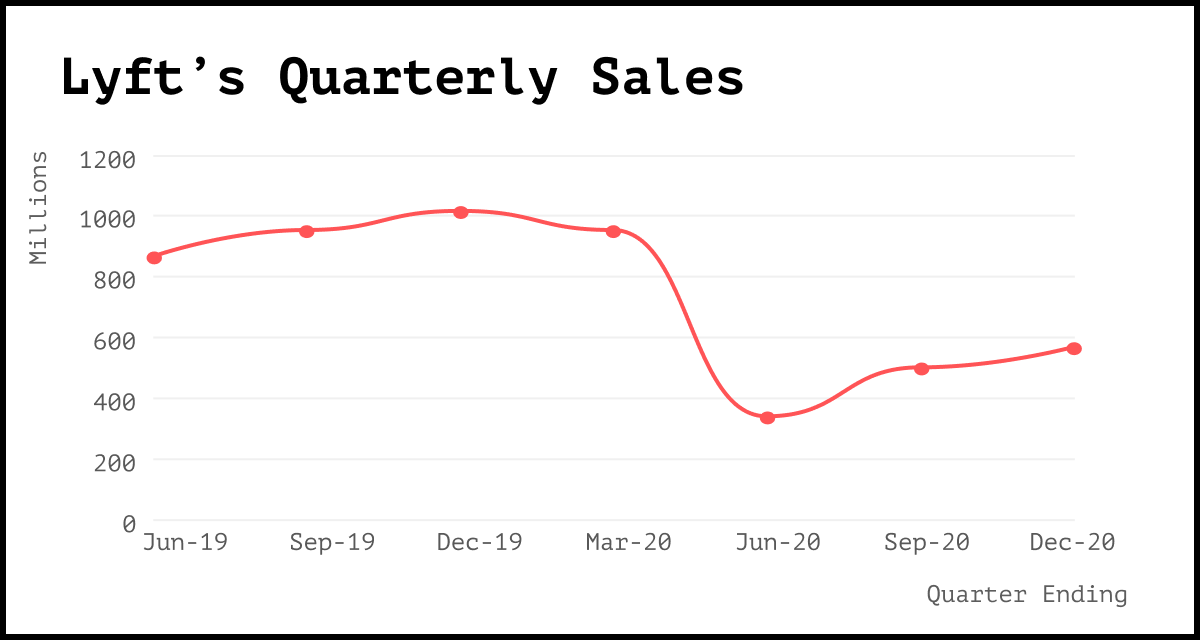
- Sales of $570m vs $563m expected
- Active riders of 12.5m vs 13.2m expected
- Net loss of $458.2m up from $356m in the last quarter of 2019
The ride-hailing duopoly
The US ride-hailing business is dominated by two giants — Lyft and Uber. In recent years, the two began to move in different directions…
- Lyft is sticking with its ride-hailing business — by focusing on building out its self-driving vehicle technology.
- Uber is focusing on expanding its delivery service — by acquiring Postmates (food delivery) and Drizly (alcohol delivery) in 2020.
Uber even sold its autonomous vehicle division in Dec. 2020 to focus on becoming profitable. These bets are creating very different outcomes for the two companies. While Lyft’s revenue fell 60% at the start of COVID, Uber’s revenue fell only 29% — protected by its food delivery business.
Take us to the autonomous and (hopefully) profitable future
According to Insider, Lyft pays out 62% of a ride’s fare to drivers. In a world where Lyft’s cars are self-driving, Lyft would significantly lower its expenses.
But the path to self-driving vehicles hasn’t been easy. Lyft expects self-driving vehicles to be available to its users by 2023 but the industry has a history of missing targets and underestimating the cost to develop autonomous vehicles.
The profitability of self-driving cars for Lyft is still uncertain…
- To convince customers to adopt a self-driving taxi, Lyft may have to charge a lower price than a human-driven ride.
- Self-driving vehicles — which are more expensive than regular cars — will have to be owned or financed by Lyft.
In a self-driving world, Lyft will likely be up against a new competitor — Waymo, who’s backed by Google and leading the race towards developing a self-driving car.
For investors… Ride-hailing nightmare
Lyft’s stock has recovered its losses from the crash but the stock is still below its IPO price in 2019. One of the biggest concerns for ride-hailing companies is the amount of cash they’re burning…
- Lyft lost $2.6b in 2019 and $1.8b in 2020.
- Uber lost $8.4b in 2019 and $5.6b in the first 3 quarters of 2020.
Lyft expects to be “Adjusted EBITDA” profitable by the end of 2021 — a metric that excludes expenses like interest, depreciation and stock-based compensation to employees. As a metric that is commonly used to reflect how much cash is going in/out of a company, a step closer to becoming EBITDA profitable would be big for Lyft.
But a full recovery still relies on a post-COVID world where riders aren’t afraid to commute with strangers.
Learn more: How does Uber compare to Lyft?

