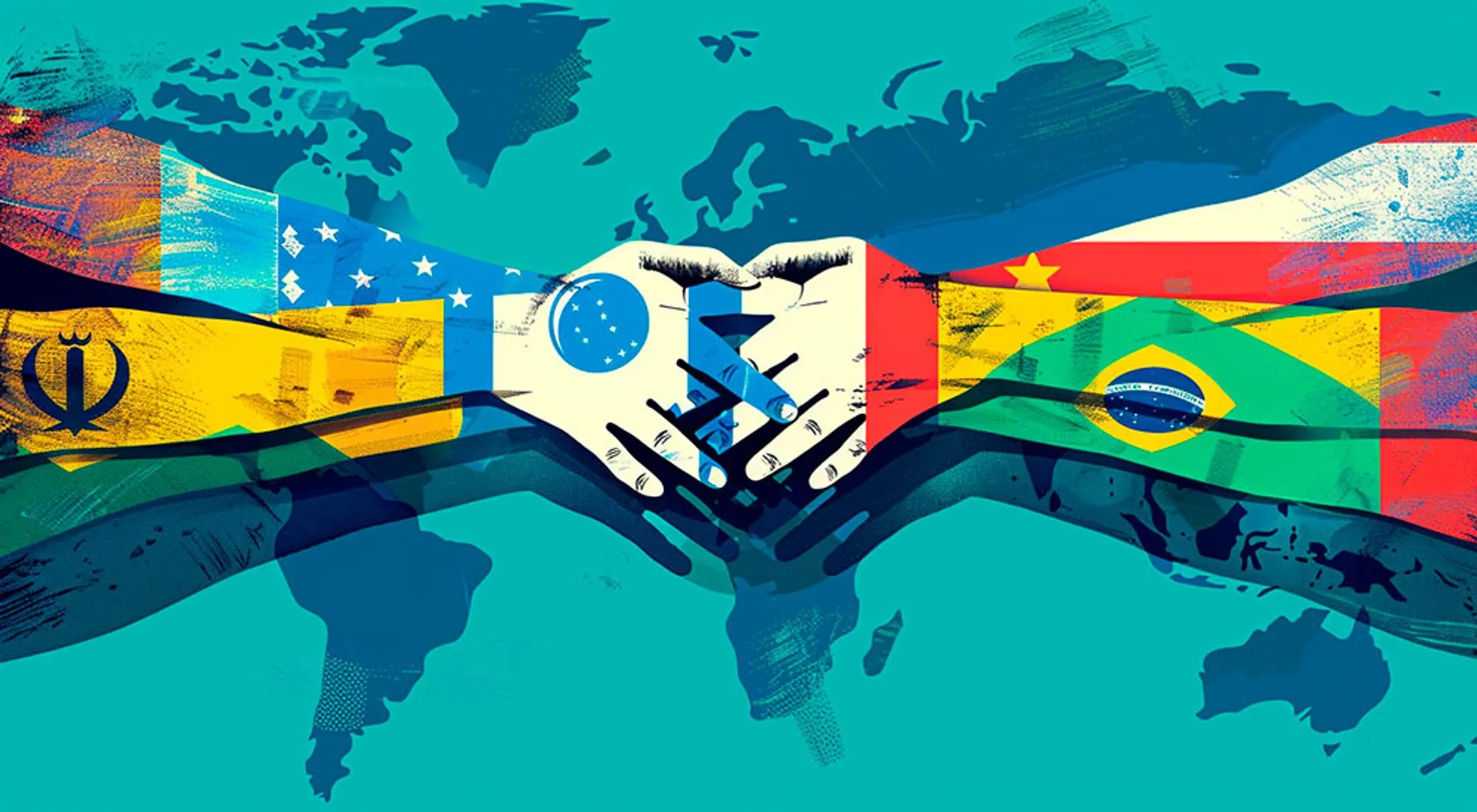
In 2001, economist Jim O’Neill from Goldman Sachs made a bold prediction: by 2050, four countries will dominate the global economy. The shortlist included Brazil, Russia, India, and China — later joined by South Africa in 2010. Together, they formed BRICS — an economic alliance aimed at boosting the representation and power of emerging economies. Today, BRICS is showing results, but the coalition hopes to expand its influence further by adding new members. In January, BRICS welcomed five new countries: Egypt, Ethiopia, Iran, Saudi Arabia, and the United Arab Emirates — doubling the bloc’s membership and extending its reach into North Africa and the Middle East. Together, these ten countries form BRICS+ (luckily, they didn’t call it RISECUBIES).
- BRICS+ represents more than 45% of the world’s population and 28% of its GDP — with some of the fastest forecasted global growth.
- Thanks to the addition of oil-dominant Middle Eastern countries, BRICS+ also accounts for 44% of the world’s crude oil production — rivaling the OPEC+ oil cartel.
But is BRICS+ a real threat?
In recent years, BRICS+ has become the stuff of nightmares among some US political conservatives — who warn that the economic bloc could take up arms against Western countries by creating its own reserve currency, establishing a united military, or raising trade costs through collective bargaining. However, the reality is more nuanced. While BRICS+ is bigger than ever, it lacks the structure for such actions.
- BRICS+ countries cooperate to a certain extent, but they often have divergent interests — for instance, India and China are considered political enemies.
- Unlike the European Union, BRICS+ doesn’t have a common currency or trade agreements like NAFTA.
What’s the big deal then? Analysts express concerns that the alliance could empower potential Western adversaries — like China (its largest member) and Iran (its newest member). However, experts like Geopolitical Monitor’s George Monastiriakos argue that BRICS+ isn’t a strategic threat to the US due to structural challenges, ideological differences, and economic weakness among some of its newest members, such as Egypt. This is why Javier Milei withdrew from joining the global partnership after becoming the President of Argentina. Nonetheless, BRICS+ is likely to continue growing in both membership and influence.

