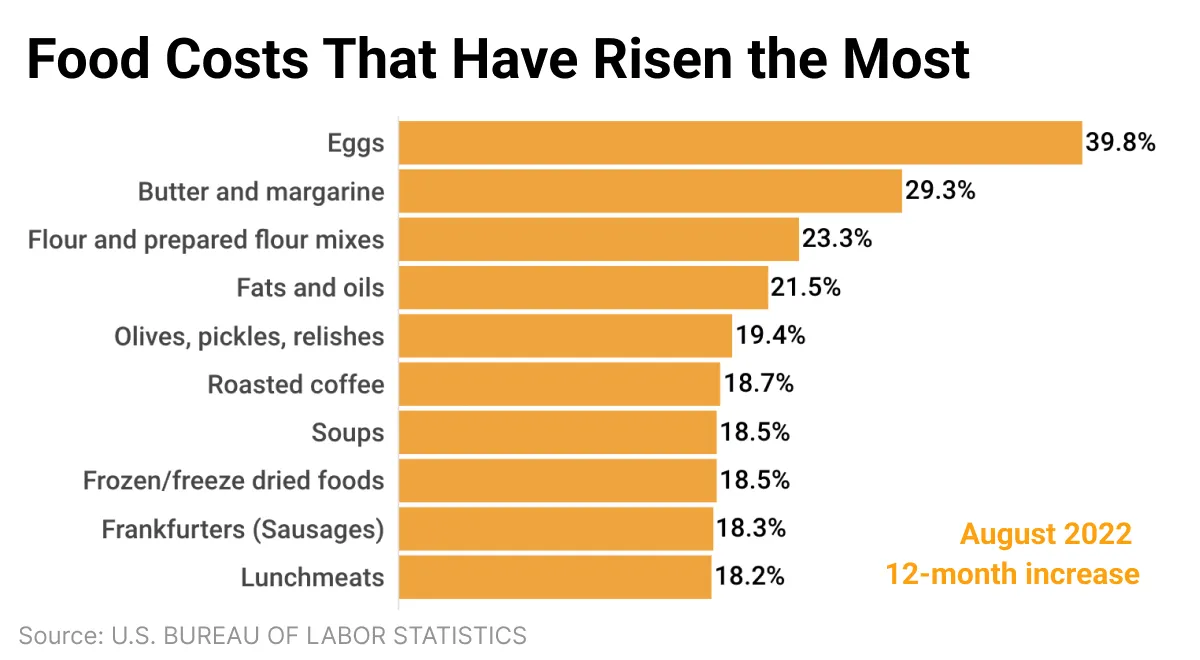
Rising food costs have become one of consumers’ biggest headaches. For many, it’s turned into a full-blown crisis.
In August, home food preparation costs and dining out prices were up 13.5% and 8% from last year, respectively.
Some of the highest increases in food costs: eggs (39.8%), chicken (16.6%) and flour (23.3%).
Why are food costs so ridiculously high?
- Avian bird flu outbreak impacted the supply of chicken.
- Ukraine war sent wheat, soybean and other food commodity prices up.
- Crop damage from severe droughts across the globe.
Europe’s drought is the worst in 500 years. In India — which accounts for 40% of the global rice trade — rice planting has fallen 8% this season from a lack of rain.
When will food prices go down?
That’s the question on everyone’s mind, but luckily, we’re already seeing signs of falling food prices.
The U.N.’s Food Prices Index — which tracks the prices of five breadbasket staples — cereals, vegetable oil, dairy, meat and sugar — has fallen for five consecutive months.
Here’s what could continue lowering food prices:
- Ukraine has reopened its shipping ports under a July deal with Russia to unblock grain exports.
- Transport (i.e., shipping and gasoline) costs are falling. These costs make up one of the largest portions of food costs.
But we’re not out of the oven yet.
- Bad weather conditions could send prices soaring before the harvesting season ends.
- Global warming could continue to impact food costs.
Read: Global food crisis is leading to strong demand for Deere’s (NYSE:DE) tractors.

