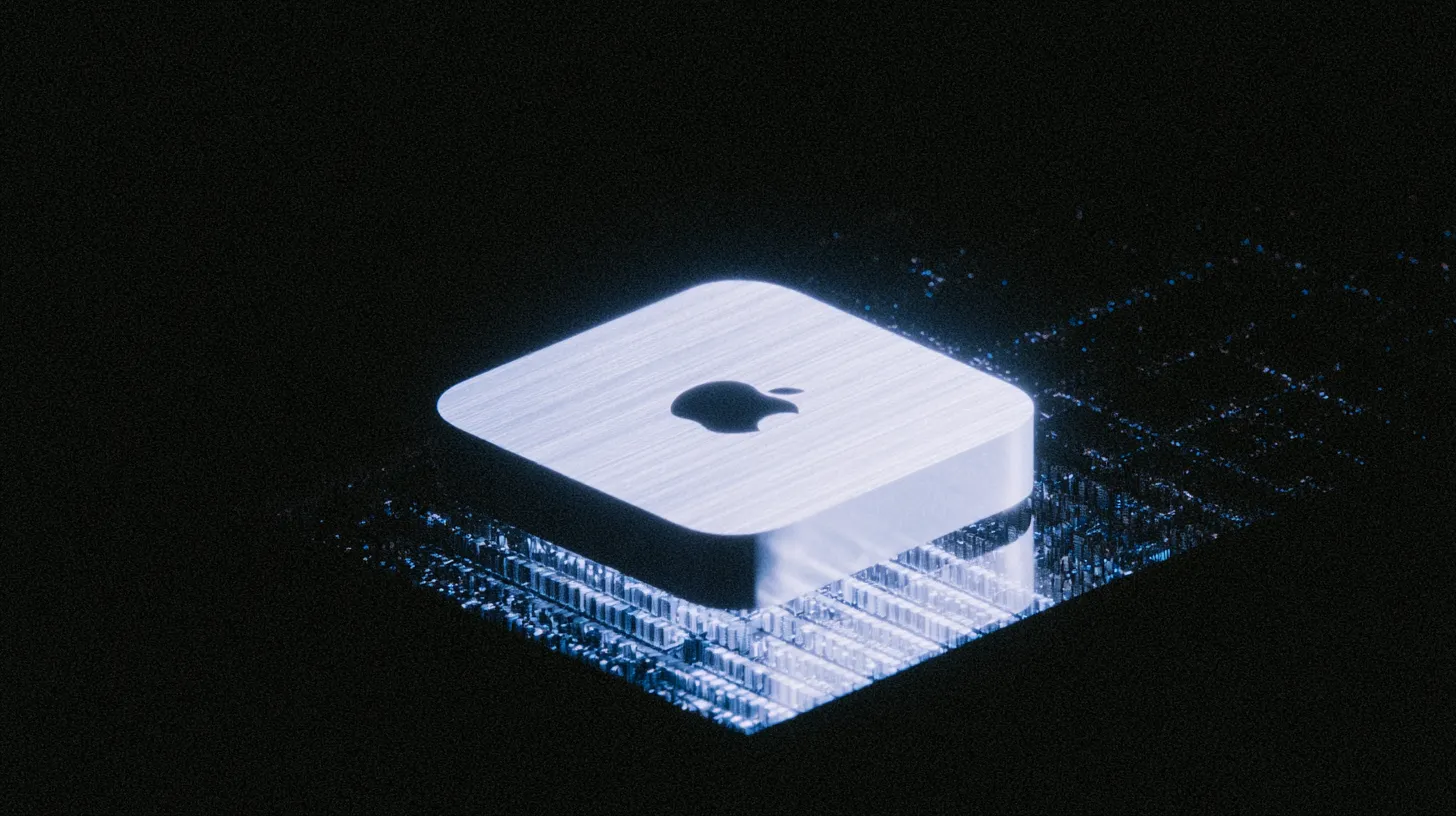
Apple just turned one of its quietest product lines into a bigger piece of its AI strategy. The company unveiled new Mac Mini and Mac Studio models powered by upgraded chips built to handle AI workloads locally, without relying on the cloud.
It’s a push into the AI development market through a product category that has largely stayed out of the spotlight.
The numbers behind the launch
The new Mac Mini starts at $899, up $100 from the prior model. It can be configured with two chips: the all-new M6 or the M5 Pro. The M5 Pro version processes large language model prompts 8.5x faster than older Pro versions of the Mac Mini.
The Mac Studio starts at ~$2.5K for the M5 Max configuration and ~$5.5K for the M5 Ultra. A fully maxed-out Mac Studio can cost as much as ~$18.3k.
Prices on both machines are higher than before. Apple has blamed a global memory chip shortage for the increases. CEO Tim Cook told The Wall Street Journal that price increases are unavoidable due to surging costs for memory and storage chips.
Why the Mac Mini became an AI darling
The Mac Mini historically accounted for just ~3% of Apple’s US Mac sales, according to Consumer Intelligence Research Partners.
Then the AI agent boom gave it a new purpose. Developers began using dedicated Mac Minis for always-on, local AI processing, with apps like OpenClaw driving demand.
Its unified memory architecture, which lets the CPU and GPU share the same memory pool, also makes it particularly well suited for running large language models.
Demand quickly overwhelmed supply. Apple pulled the $599 entry-level model, brought it back at $799, and still struggled to keep some configurations in stock for months.
In an April earnings call, Cook warned it could take several months for Mac Mini supply to reach balance with demand.
What the new chips actually do
The M6 is Apple's first 2-nanometer chip, manufactured by Taiwan Semiconductor Manufacturing Co. It features a 12-core CPU, a 12-core GPU with Neural Accelerators built into each core, and a Dual 16-core Neural Engine. Apple says the Neural Engine delivers up to 2x the peak compute of previous generations.
The M6 also provides up to 170GB/s of unified memory bandwidth, a 10% increase over M5. Apple says the chip delivers nearly 30% more peak GPU compute for AI compared to M5.
The M5 Ultra, which powers the top Mac Studio configurations, uses a quad-die architecture, a first for Apple silicon. It offers up to 512GB of unified memory and 1.2TB/s of memory bandwidth, 50% higher than the M3 Ultra it replaces.
Multiple Mac Studios with the Ultra chip can also be linked together to pool memory and run trillion-parameter AI models.
Supply is the real question
Apple isn't saying whether it has enough manufacturing capacity to meet demand. The company recently opened a Mac Mini assembly line in Houston that will start producing machines later this year.
Both machines go on presale now and ship Sept. 22. The 512GB Mac Studio configuration ships in late October. Given that previous models sold out for months and the new versions are more capable, scarcity is expected to continue.
Apple's pitch to businesses is that the higher upfront cost pays off by reducing dependence on cloud AI service providers. Whether buyers can actually get their hands on one is a different story.

