The AI Infrastructure Boom Is Far From Over. Where Investors Are Looking Next
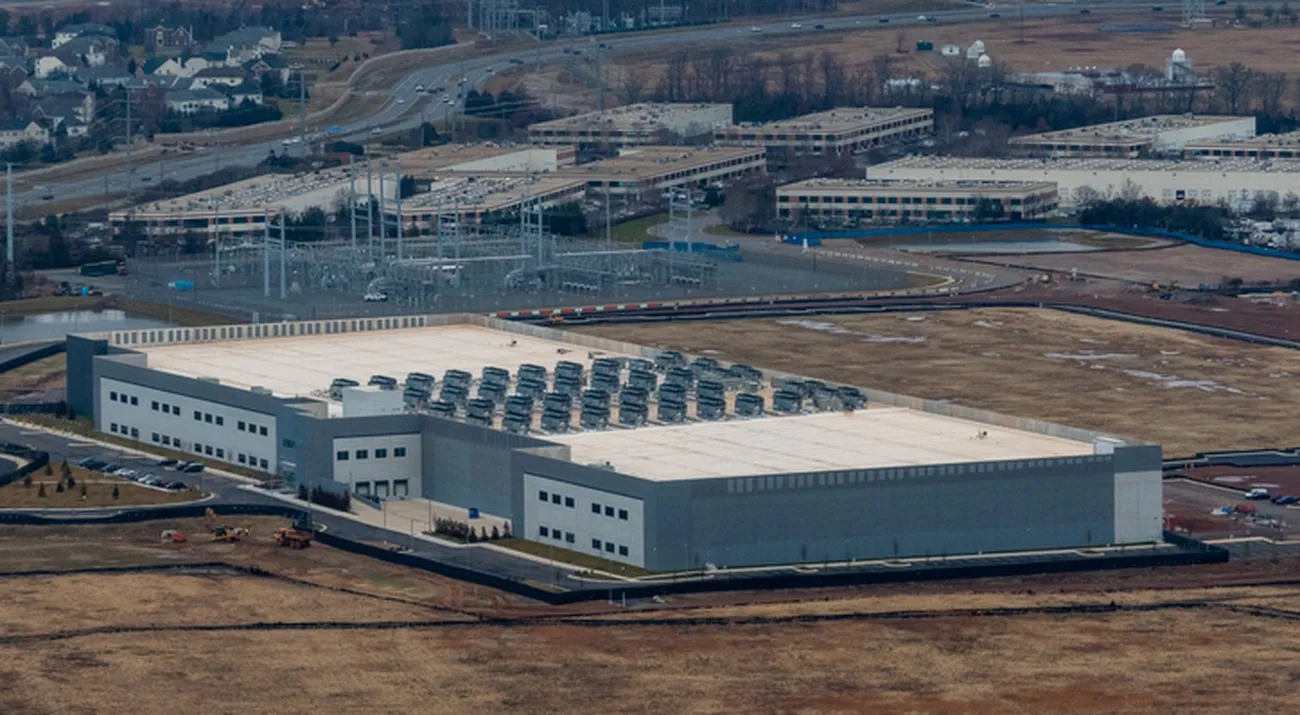
The machinery behind artificial intelligence runs on electricity, land, and steel long before it runs on software. That physical layer has become its own investable sector, pulling utilities, pipelines, and chipmakers into the same spending cycle. Fresh capital forecasts and a shift in how AI labs buy capacity are now redrawing where the money lands.
Spending keeps compounding
Global spending on AI infrastructure could reach $31.6T through 2050, according to PricewaterhouseCoopers. Annual data center capital expenditure sits at roughly $800B today.
PwC expects that annual figure to climb to $1.8T in 2050. Unlike past infrastructure booms, this one accelerates rather than tapers, because servers and GPUs need replacing every few years.
That recurring refresh cycle, not construction, drives most of the projected long-term capital investment tied to Nvidia. The catch is adoption. If enterprises stop seeing returns, the later years of the buildout could get harder to fund.
Why power became the bottleneck
Brock Campbell, who runs the BNY Mellon Global Infrastructure Income ETF, says the theme is far from finished. His fund has returned 21% on a three-year annualized basis against 16% for the S&P Global Infrastructure Index.
Assets reached $1.9B as of Sept. 21, up from $640M in February. The strategy leans on the idea that electricity and data are needs, not discretionary spending.
The fund bought Dominion Energy in late 2022, before NextEra Energy announced a $67B merger with the power group earlier this year. Campbell now focuses on natural gas plants feeding data centers, and the pipelines required to supply them.
Hess Midstream is the fund's top holding. The logic is that new pipelines are hard to permit, so owners of existing lines can build short connectors into new gas plants.
He has also rotated out of US utilities into European names. Finnish utility Fortum recently signed a long-term electricity deal with Alphabet's Google to expand its European AI reach.
Smaller deals, faster capacity
Anthropic and OpenAI are both hunting for 20-30 MW deployments, sources told CNBC. That is a sharp step down from the gigawatt-scale projects both have announced.
Anthropic has sounded out agreements in that range across the UK and the Nordics. OpenAI has explored similar deployments in the Nordics.
The driver is timing. Securing a few megawatts at an existing powered site beats waiting for a larger block, said Jabez Tan, head of research at Structure Research.
The underlying shift is from training to inference. Training means building a model, while inference means running it for users across smaller clusters.
Inference made up 9% of global data center workloads in 2025 against 14% for training, per a JLL report. By 2030, inference could take 37% of capacity versus 13% for training.
That matters for who wins. Neocloud operators renting out compute benefit, and Crusoe recently raised a $3.9B round at a $30.9B post-money valuation while investing in smaller sites.
Where the hardware exposure sits
Memory is the other pinch point. Taiwan's Nanya Technology expects a 30% year-to-year increase in bit shipments, driven by 16-gigabit DDR5 for AI applications.
Chinese DRAM maker CXMT posted first-half 2026 revenue of CN¥150.31B and net income of CN¥77.61B. Delton Technology, a Guangzhou printed circuit board maker, generates about CN¥6.9B from boards used in AI switches and high-speed networking.
Rates complicate the picture. Long-term Treasury yields near 5% have made bonds competitive again after the Federal Reserve raised rates and signaled another hike.
Goldman Sachs still prefers the buildout. Anshul Sehgal, the bank's global co-head of fixed income, currencies and commodities, called being long compute the asymmetric expression.
He drew a line between AI infrastructure and everything else, warning that tighter policy could still weigh on equities outside the trade. Exposure now splits three ways across power, physical capacity, and hardware supply, and each carries a different bottleneck.

