Small-Cap Stocks Are Cheap, Underloved and Potentially The Sleeper Play of the Decade
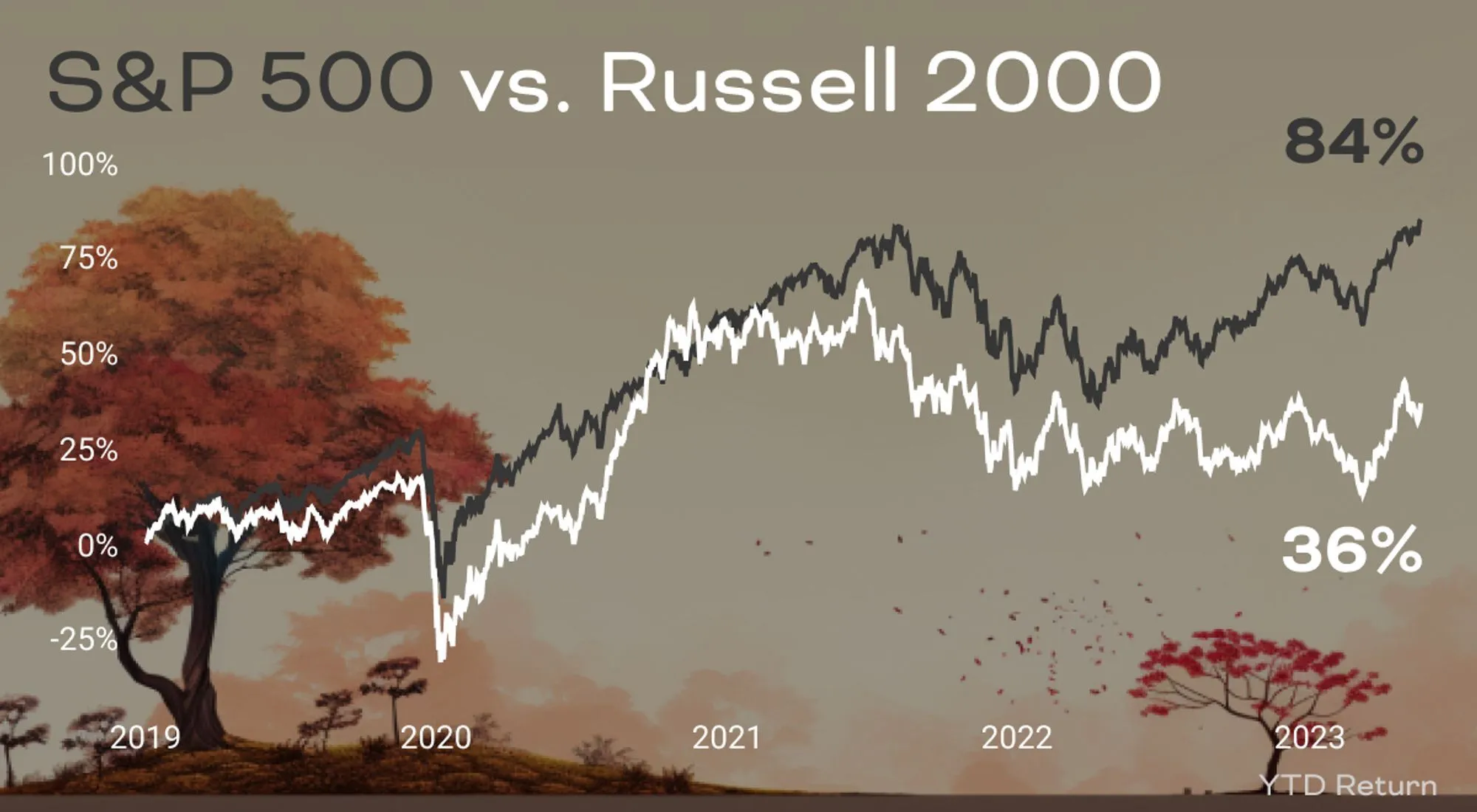
Major stock indices like the S&P 500, DOW, and NASDAQ, have finally reached new highs — all except one, the Russell 2000. The index includes some of the smallest publicly traded US companies — still down 20% collectively from its peak.
The Russell may be the only major index down this year, but when it starts with a decline of at least 4%, the index rose in six out of the seven years with a median gain of 26.1%, per Bespoke Investment Group (WSJ).
Five-year hangover: Historically, the S&P 500 and Russell 2000 have moved closely together, but that’s changed in the past decade. Notably, in the past five years, the Russell 2000 is up a modest 36% — far below the DOW (+53%), S&P 500 (+84%), and Nasdaq-100 (+155%).
- While companies in the S&P 500 have returned to earnings growth after decelerating in 2022, those in the Russell have recorded four consecutive quarters of negative growth.
- That’s changing in 2024 as analysts predict earnings growth among Russell 2000 companies to rise to 28.2% in 2024, per FTSE Russell.
In recent years, small-cap stocks, which are more sensitive to changing interest rates, have been pummeled by rising rates. But with cuts on the horizon, that could finally change.
Big Tech 👋 Russell 2000 👈
Vontobel Swiss Financial Advisors’ Pascal Koepell expects that tech companies could fail to replicate their last decades’ successes and believes that “investors are really overexposed to tech” — while analysts are bullish on small-caps:
- London CIV’s Chief Investment Officer Aoifinn Devitt suggests that large-caps are at risk of falling over valuation concerns — potentially underperforming small-caps (WSJ).
- Fundstrat’s Tom Lee notes the Russell 2000’s valuation hasn’t been this cheap compared to the S&P 500 since 1999, and could rise “50% or 60%.”
ETF watch: investors CAN gain exposure to the Russell 2000 via the iShares Russell 2000 ETF (NYSEARCA:IWM). But if small-cap seems too risky, try one that invests in a small subset of small-cap stocks based on their cash-generating potential. Bloomberg analysts have called out the Pacer US Small Cap Cash Cows 100 ETF (BATS:CALF) for outperforming the S&P 500 in the past five years.

