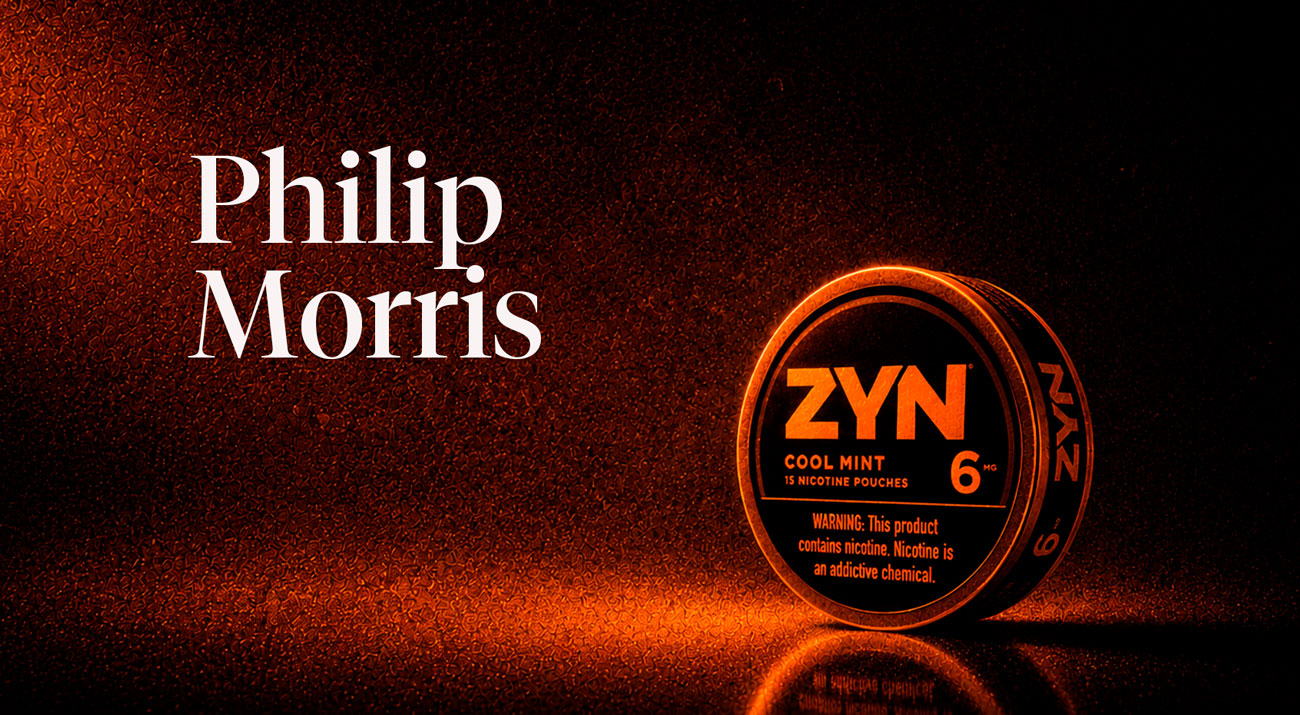
Philip Morris International is betting its future on smoke-free nicotine, and regulators just gave that strategy a major boost.
The FDA recently approved 20 Zyn nicotine pouch products to carry a modified-risk designation, marking the first time a nicotine pouch has received such status.
Regulatory wins built into the machine
The FDA authorization allows Philip Morris to market Zyn as a lower-risk alternative to cigarettes for diseases including lung cancer, heart disease, stroke, emphysema, and chronic bronchitis.
That gives the company a powerful new marketing advantage. The authorization lasts five years, and Philip Morris has already shown it can navigate the renewal process after IQOS regained reduced-exposure authorization in April.
The authorization covers Zyn in flavors such as cool mint, coffee, and cinnamon across two nicotine strengths.
IQOS, its heated tobacco device, received renewed FDA authorization to market reduced-exposure claims in April. The company knows how to play this regulatory game.
The smoke-free portfolio is now a growth engine, not a side project. Analysts forecast smoke-free products will generate $19.1B of total 2026 sales of $43.4B, nearly half the company's revenue.
Philip Morris holds roughly 77% of global heat-not-burn volume, a category Grand View Research expects to expand to over $165B by 2030.
Margins moving in one direction
Smoke-free products carry higher gross margins than combustibles, and that mix shift is already showing up in the financials.
Gross margin is forecast to rise from 68% to ~69% by 2027, while competitor Altria Group posted ~65% gross margin in its most recent quarter.
Philip Morris dominates the tobacco industry
Breakdown of global tobacco market share by company as of Q1 2026
Bar chart. Market Share (%). Philip Morris International: Market Share (%) 48.08%. British American Tobacco: Market Share (%) 29.64%. Altria Group: Market Share (%) 19.79%. Vector Group: . Others: Market Share (%) 0.73%.
Philip Morris grew adjusted EPS 12% annually for the two years ended 2025. That trajectory supports close to double-digit EPS growth long-term, according to Barron's analysis.
Analysts expect smoke-free sales to grow 12% in 2027 to $21.4B, pushing total revenue to $46.2B.
Even the legacy combustibles business is holding up, with pricing power offsetting volume declines and international combustibles revenue growing organically in Q1.
The risks aren't small
Philip Morris' total US smoke-free shipment volume fell 21.2% in Q1 as retailers worked through excess channel inventory.
Retailers over-stocked in late 2025 and worked through that supply in Q1. Underlying Zyn offtake grew 10%, and consensus forecasts expect US volumes to normalize and return to growth.
The sharper risk is competitive. Velo Plus, made by a British American Tobacco unit, has expanded its smokeless market share ~6% over the past year while Zyn grew ~1%.
Philip Morris launched Zyn Ultra to recapture the high-potency segment, but that product isn't yet covered by the new FDA modified-risk authorization. Regulatory unpredictability is a major hurdle.
The move forward
Philip Morris trades at around 21 times forward earnings, below its early-2025 multiple of 23 times
BofA holds a $209 price target, Morgan Stanley raised its target to $200, and Stifel is at $195 (all Buy-equivalent ratings).
The stock yields just over 3% in dividends, and total annual return including price appreciation could exceed 20%, per Barron's analysis. A beta of 0.30 makes it a genuine haven in a volatile tape.
The market keeps treating every regulatory headline as a coin flip. Philip Morris keeps converting those flips into compounding wins.

