This year was supposed to mark a breakthrough for humanoid robots — a turning point where billions of machines would transform factories. Turns out building a general-purpose robot is proving far tougher than training a chatbot. Reality’s showing that agility and balance don’t scale as easily as code.
Charging into hype: Many companies began rolling out humanoid robots this year, fueling fresh hype about the dawn of mass production. Tesla CEO Elon Musk promised to build 5K Optimus bots by year’s end, while Google launched its own AI robot. Shanghai startup Agibot matched that forecast, while robotics firm 1X opened pre-orders for its NEO home robot at $20K and said it would test robots in thousands of homes before 2026. Analysts further fueled the hype with bullish projections.
- Morgan Stanley forecasts there will be nearly 1B humanoid robots in service by 2050, as Humanoid Robotics’ Xiong Youjun declared the industry’s “ChatGPT moment” had arrived.
- Merrill Lynch projected global shipments to surge from 2.5K last year to 18K in 2025, with the worldwide robot population reaching 3B by 2060.
Where’s My Robot Butler?
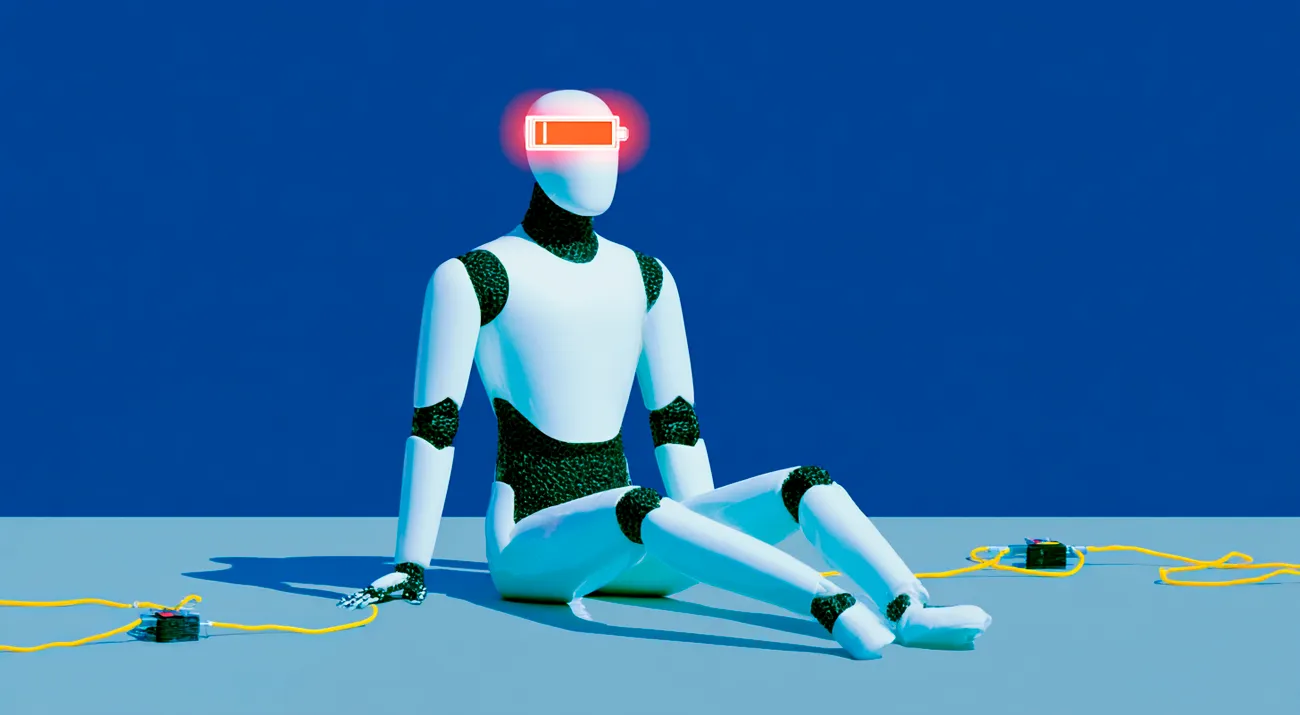
Few of the promised robots actually exist, and those that do face problems AI won’t fix anytime soon. Agility Robotics’s Melonee Wise believes many hope to “AI their way out of this,” but current technology isn’t strong enough to meet market needs. Battery life is another major hurdle, with Agility’s Digit robot lasting 90 minutes — but only 30 usable, since an hour must be kept in reserve. Wise said factories don’t want robots needing battery swaps every half hour, calling it a logistics nightmare no one wants to handle.
- During a demo, Salesforce CEO Mark Benioff asked Tesla’s Optimus for a Coke, but the bot lagged, froze mid-sentence, and then moved “agonizingly slowly, loudly clunking along like an oversized RC toy.”
- Anyone buying 1X’s NEO robot must agree to let human teleoperators control it remotely and see inside their homes through its cameras because the AI still needs training data from real-world use.
Error 404: Former Amazon robotics head Brad Porter reported the company found only around 40 use cases where humanoids outperform existing machines. Wise told IEEE that “the bigger problem is demand,” saying no one has found a use case that needs thousands of humanoids in one facility. Analyst Reyk Knuhtsen added that humanoids won’t arrive in a single breakthrough but will slowly take over “low-stakes, failure-tolerant tasks” as they improve. For now, the humanoid dream is all talk, no torque.

